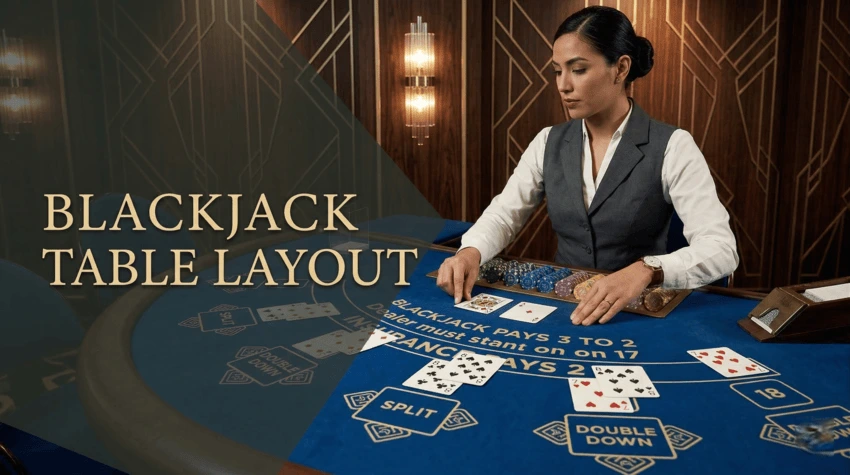

Walk into pretty much any casino or crypto blackjack site, and you're playing six deck. That's just what they run. Those extra cards shift the math against you a bit. Not by much, but enough that it matters when you're playing hundreds of hands.
We're going through the odds, breaking down basic strategy (hard hands, soft hands, splits, doubles), and calling out the mistakes that'll bleed your stack dry without you noticing.
Casinos stack six decks together for one reason: they don't want you counting cards. More decks means it's way harder to track which cards are left, and that cuts into your edge. You've got 312 cards in play instead of 52. Pull one ace out, and it barely changes anything. That's the whole point.
Six deck blackjack? Same rules as regular blackjack. The dealer just pulls cards from a shoe loaded with six decks instead of one. Rules don't change. Beat the dealer's hand without busting past 21. That's it. What changes is the math behind the scenes.
If you sit down at a blackjack table without checking the rules first, whether at a physical casino or playing crypto blackjack online, you're almost certainly looking at a six-deck game. Six deck is what casinos run. It's standard everywhere.
Two reasons: math and logistics. More cards means the house gets a tiny edge. Plus the game moves faster when dealers don't have to shuffle every ten minutes.
Six deck isn't a bad game. You just need to know basic strategy and stick to it. That's where your edge comes from.
Deck count changes your odds. Not as much as you'd think, but it matters. Table rules and payouts matter way more.
Here's what the house edge looks like with standard rules:
Single deck to six deck? You're looking at about 0.3% difference. Play a few thousand hands and that 0.3% starts to bite. One night at the tables? You won't even notice it. Regular card swings matter more.
Natural blackjack should pay 3:2. Bet ten bucks, win fifteen. Some tables only pay 6:5. The same ten-dollar bet now wins you twelve instead of fifteen.
That one rule change adds 1.4% to the house edge. Way worse than anything the deck count does. Six-deck with 3:2 payouts crushes single-deck with 6:5. Every single time. Check the payout before you sit down. Seriously.
Basic strategy tells you the right mathematical play for every hand. No guessing, just math. You'll still lose hands. But over time, this cuts the house edge down as far as it goes.
The same strategy applies whether you're playing bitcoin blackjack, live online blackjack, or sitting at a physical table. Math works the same everywhere.
Hard hand? No ace, or your ace has to count as 1, because counting it as 11 would bust you.
Soft hand means you've got an ace counting as 11. Can't bust on the next card with a soft hand. That's why you can play more aggressively.
Split a pair and you're playing two hands now. Two separate bets. Some pairs you always split. Others depend on the dealer's upcard.
Double down and you double your bet. You get one more card and that's it. You do this when you've got the edge.
Everyone hates this hand. You're losing this hand most of the time. Hitting just loses less often than standing.
Stand on 16 against a 10 and you lose more. Dealer's probably finishing at 17 or better. Hit and at least you've got a shot at improving. Not a great shot, but a shot. Hit. That's the play.
The strategy chart shows you what to do for every hand against every dealer upcard. Use it until you've got the moves memorized.
Find your hand on the left, check the dealer's upcard across the top. Where they meet is your play. That box tells you what to do.
Tip: Most crypto casinos allow you to keep a strategy chart open in another tab while playing. Use it until you've internalized the decisions.
Most strategy charts assume standard rules. Dealer stands on soft 17, you can double after splits, blackjack pays 3:2. Different rules at your table? A few plays might change.
Yeah, but it's way harder than counting a single deck.
Counting cards means tracking how many high cards versus low cards are left. In a six-deck game, counters convert their running count into a "true count" by dividing by the estimated number of decks left. Extra math slows you down and makes it easier to screw up.
Most live online blackjack and crypto blackjack tables also use frequent shuffles or continuous shuffling machines, which further limit counting effectiveness. Counting's still worth learning, but it doesn't give you the same edge it used to. Modern tables killed most of that advantage.
Even if you know basic strategy, you can still make these mistakes. Here are four mistakes people keep making.
Insurance? You're betting the dealer's got blackjack. Pays 2:1, which sounds good. Then you run the actual math. You lose this bet more than you win it. Just adds to the house edge. Skip it.
Can't bust a soft hand when you hit. Stand on soft 17, and you're giving up value. Dealer's showing a weak card? Hit or double. You'll do better.
Twenty wins most of the time. Split that and now you've got two weaker hands. Don't do it. Keep the twenty.
Playing by feel seems right. It's not. You'll bleed money. Every time you ignore basic strategy, the house edge goes up. Use the chart. Keep using it until it's in your head.
How many cards are in a 6-deck blackjack shoe?
Six decks of 52 cards each. That's 312 cards total in the shoe.
Is 6-deck blackjack better than single deck blackjack?
Depends on the rules. Single deck has better base odds. But casinos know that, so they kill you with 6:5 blackjack payouts. Six deck with 3:2 payouts usually gives you better value overall.
Should I split 6s against a dealer 5 in blackjack?
Yes. Yeah, split sixes against a dealer 4, 5, or 6. Basic strategy says so.
Does basic strategy change for live dealer blackjack online?
Nope. Math doesn't change. Physical table, RNG game, live dealer stream same strategy. The right play stays the same no matter where you're playing

.webp)