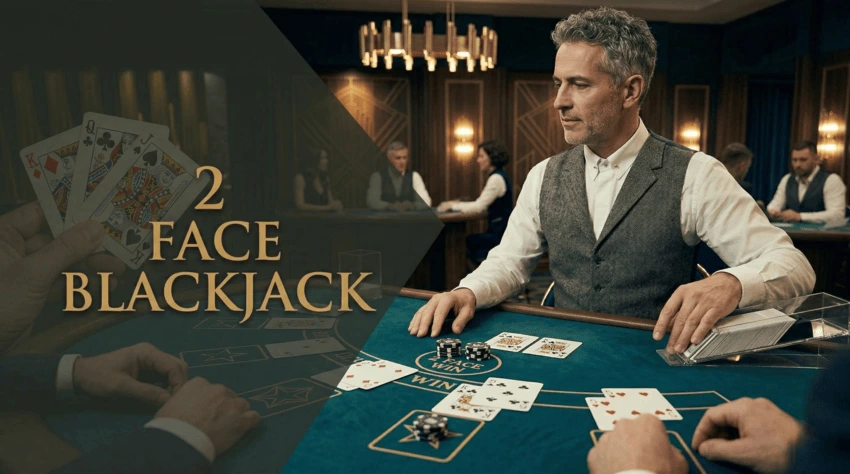
Every time the dealer shows a Jack, Queen, or King, you get to see their hole card right away. The trade-off? A modified deck, even-money blackjacks, and ties that favor the house.
We'll walk through the rules, how your strategy needs to change, and what catches most players off guard the first time they play.
So what's 2 Face Blackjack? Basically, anytime the dealer's up card is a face card (Jack, Queen, King), they flip over their hole card immediately. The name refers to this "two face" trigger: see a face card, see both cards. You'll know exactly what the dealer has on about one in three hands, which is huge.
But casinos aren't giving that away for free. They take out all four 10s (face cards are still there). Blackjacks only pay even money instead of 3:2. And ties? Dealer wins those. It looks like regular blackjack, but once you start playing, you'll notice the differences fast.
Three things make this version different from regular blackjack. Each change matters for your strategy and what the casino's edge looks like.
Dealer shows a Jack, Queen, or King? The hole card comes up right then. You'll know their exact total before you decide anything. Is the up card a 2 through 10 or an Ace? Hole card stays down, and you're playing regular blackjack.
You're basically playing two different games at the same table. Face card hands? You see everything. Everything else plays blind, just like you're used to.
You're playing with 48 cards, not 52. The 10s are gone. Jacks, Queens, and Kings are your only ten-value cards now. That shift messes with the math more than you'd think.
You'll see fewer blackjacks all around because there aren't as many ten-value cards in the deck. Any hand where you're hoping for a 10? Not as strong. The differences are small on each hand, but they pile up.
Here's how the casino gets its money back:
That even-money blackjack payout? It's a big deal. Regular blackjack pays 3:2 on naturals, and that's one of your best edges in the game.
Hands play out like normal blackjack, except for one moment right after the deal.
Bet first, cards second. Limits vary by table.
You get two cards face-up. Dealer gets one up, one down.
Here's where things change. Face card showing? That hole card comes right up. You'll know exactly what you're playing against before you make a move.
Anything else? Hole card stays down. Play continues normally.
Hit, stand, double down, split. Make your call based on what's showing. Face card hands are easier because you know the dealer's total. Hidden hands? Play regular blackjack strategy.
Dealer follows house rules, usually stands on all 17s. Whoever wins, wins. Tie? Dealer takes it.
Each casino sets its own doubling rules, but seeing the dealer's full hand changes everything. You're not guessing probabilities anymore. You're just doing math.
When you can see both dealer cards, doubling gets easier:
Hidden hands? Use a regular doubling strategy. Double your 10 or 11 when the dealer shows weakness. Double 9 against 3-6.
Soft hands have an Ace counting as 11, so you can't bust on the next card:
Tip: See both dealer cards? Forget the charts. Just look at their total. What you can see beats basic strategy every time.
Your strategy has two gears: face card hands where you see it all, and regular hands where you don't.
Dealer showing 17-20 on a face card hand? Hit hard. No guessing. You know what you need to beat. Dealer has 19, you have 16? You gotta hit. It's your only shot.
Hidden hands: hit your 12-16 when the dealer shows 7 or better.
Dealer sitting at a weak total? Stand sooner than you normally would. Dealer's at 15 and you have 13? Why risk busting? Make them draw and risk the bust.
Hidden hands: stand on 17+, stand on 12-16 when dealer shows 2-6.
Full information makes splitting calls easier:
The house edge runs higher than standard blackjack.
That 48-card deck messes with the probabilities too. You go from 16 ten-value cards down to 12, so you'll see fewer blackjacks. Some hands that look good in regular blackjack? Not as strong here. Others get better.
You're playing the dealer, not the other people at the table. Two players can sit at the same table without competing against each other. Your decisions are yours. You win or lose based on your hand against the dealer's.
The same goes for 2 Face Blackjack. Whether you're at a physical table or playing live online blackjack, multiple players share the experience without affecting each other's outcomes directly.
Multiple players at the table? Here's how it works:
Crypto blackjack tables usually have different numbers of players. More players make it more fun, but you're still just playing against the dealer.
Two face cards? That's 20. One of the best hands you can get. Stand pretty much every time. Dealer shows a face card too? You'll see their hole card and know if your 20 holds up.
They're similar but not the same. Double Exposure reveals both dealer cards on every single hand. 2 Face only shows the hole card when the dealer's up card is a face. Rules change between versions too, so check before you play.
Card counting doesn't work as well here. The 48-card deck throws off traditional counts. Plus, online versions shuffle constantly. Better to focus on what you can see than trying to count cards.
Dealer-wins-ties balances out the edge you get from seeing the hole card. Without these changes and the even-money blackjack payout, players would have too big an edge. Casinos couldn't make money on it.

.webp)