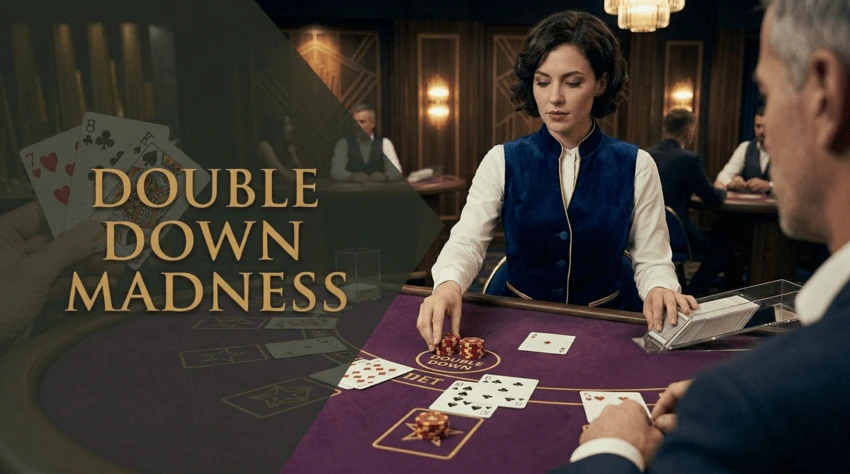
Double Down Madness is a blackjack variant where you start with one card instead of two and can double down as many times as you want throughout a single hand. Unlike standard blackjack, you can keep hitting after you double, which opens up entirely new ways to build and bet on your hand.
The catch? A rule called Push 22 means dealer busts on exactly 22 result in a tie rather than a win. We'll walk through the rules, show you what makes it different from regular blackjack, and break down the strategy tweaks you actually need.
Light and Wonder created Double Down Madness, and it flips the script right from card one. You get one card to start. Then? You can double as many times as you want in that same hand. Better yet, you can keep hitting after you double. Standard blackjack won't let you do that.
The game offsets all that freedom with Push 22. Dealer busts on 22? That's a tie, not a win for you. That one rule changes the math just enough to keep the house edge in check. You still get tons of control over your hand.
What makes it different:
In regular blackjack, you double your bet and get one more card. That's it. You're betting your hand's strong enough to risk more cash. One card, then you're done.
Standard blackjack has a catch. Double once, and you're locked in. Double Down Madness kills that restriction. You can build your hand however you want.
These differences actually matter. They flip how you think from card one.
One card means more uncertainty. But you get way more freedom to play your hand. You're building from zero instead of reacting to what you got dealt. Every call matters because you're making the hand, not just playing it.
Doubles can stack up fast in one hand. Things looking good? Hit it again. The catch? Your bet can get huge fast. Watch your bankroll closer than you would in regular blackjack.
This rule flips the whole doubling game. Regular blackjack locks you in after one double. Here? Keep going. Say you double on soft 15 and pull a 2. You can hit again or double a second time if it makes sense.
Push 22 offsets all those player-friendly rules. Without it, players would have too much edge. Dealer hits 22? Every hand left pushes instead of winning. It happens more than you'd think, and it'll hit your win rate.
Learn these rules so nothing catches you off guard.
Dealers usually hit soft 17. Push 22 only applies to dealer hands. Bust first? You lose no matter what happens next.
Natural blackjack still pays 3:2. Regular wins pay even money. Stack a few doubles? Your payout covers the whole bet, so wins can get way bigger than regular blackjack.
Here's how a hand plays out.
Place your bet before cards hit the table. That's your base bet. You'll multiply it each time you double.
One card lands face up. Dealer gets one too, face up. You're already working with less info than regular blackjack gives you.
Double your bet or hit. Your call. Live tables? Drop more chips to signal. Online, just click. You're not stuck like you'd be in regular blackjack.
Hit or double until you're good, or until you bust. Each double bumps your total bet. Start at $10 and you could end up betting $40 or more on one hand.
Dealer plays out their hand by house rules. Dealer hits 22? Push. Any other bust, you win.
Push 22 keeps the game profitable for casinos. Dealer busts on 22? Every hand still standing pushes instead of winning.
Regular blackjack? Any dealer bust means you win. Push 22 takes away one of the dealer's most common bust numbers. It happens enough to change your results over time.
Standard blackjack charts won't work straight-up here. Starting with one card and unlimited doubles changes how you should play.
Start with a basic strategy, then tweak it. You can hit after doubling, so you can push harder in spots where regular strategy says play it safe. Soft hands get interesting because you can bounce back if a double goes wrong.
Some spots call for aggressive doubling:
The key difference is that a "bad" double isn't as punishing when you can hit afterward. That changes the math on risk.
Knowing when to double separates winners from break-even players.
Soft 13 through 17 with an ace? Great spots to double when the dealer shows weak cards. Soft hands give you cushion. Go aggressive, knowing you can recover if the next card sucks.
Hard 9, 10, and 11 are still solid doubles. The math that works for these in regular blackjack still applies. Plus, you can hit if your double doesn't pan out.
Dealer showing 4, 5, or 6? They're likely to bust. These are good spots to double hard, though Push 22 cuts into the edge a bit compared to regular blackjack.
The house edge here runs higher than standard blackjack with good strategy. Push 22's the main reason. The generous doubling rules help balance it out if you play smart.
More action and more chances to press winners. But Push 22 takes some edge back. Know when to double hard and when to hold back, and you'll keep the house edge down.
You'll find Double Down Madness at some Vegas casinos and a few regional spots. Hard Rock Tampa and Canterbury Park have it. Call ahead because availability changes.
More online casinos are adding it as it catches on. Live dealer versions may appear at select platforms, though the variant is still newer than established blackjack games.
Can't find Double Down Medness everywhere yet, but JB runs fast crypto blackjack with instant deposits and withdrawals. They use provably fair systems. You can check each hand's randomness yourself using crypto proof.

.webp)