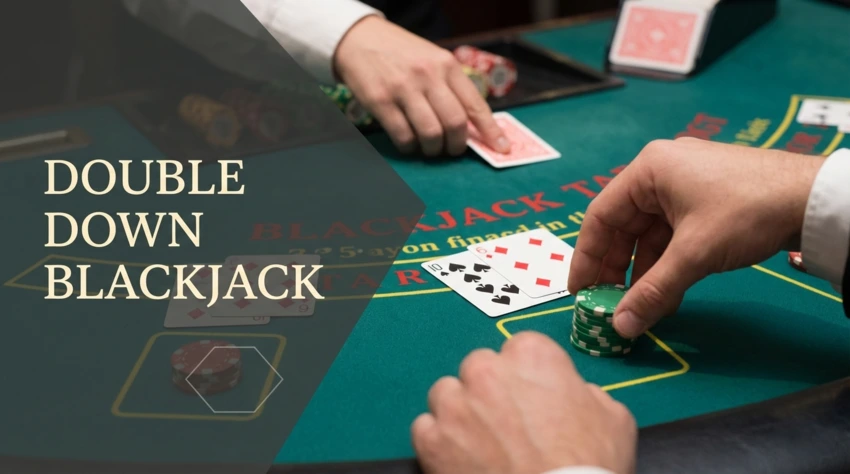
Doubling down means you're betting twice as much after you see your first two cards.
Here's the deal. You get one more card, then you're done. No more hits, no takebacks. It's one of the few moves in blackjack that lets you increase your wager mid-hand when the odds tilt in your favor. The catch? You're locked in after that single card, no matter what you draw.
Here's what happens. You double your bet, get dealt one card, and that's it. You can't hit again even if you draw a 2. It's a smart play when the numbers are on your side, but you're locked in. Whatever card you draw becomes your final hand, good or bad.
Here's how it works in practice:
So why would anyone lock themselves into just one card? The answer comes down to probability. Sometimes your cards plus what the dealer's showing just line up perfectly. That's when you want to put more money down. You're basically loading up your bet right when you've got the best shot at winning.
The flip side is real, though. If you double on 11 and draw a 3, you're stuck with 14 and can't improve your hand. That's the gamble. You might get stuck with a weak hand, but the upside makes it worth the risk.
Different casinos have different rules about doubling down. Some tables give you more options, which changes how you should play.
That last option might sound appealing, but it rarely makes sense from a math perspective. If the math says double, bet the full amount. Anything less and you're just giving up easy money.
Online crypto blackjack and live dealer games typically follow standard blackjack rules, though variations exist across different platforms. Check the posted rules before you sit down. Takes five seconds and saves you from surprises.
Two things matter when you're deciding whether to double: what you're holding and what the dealer's showing. Basic strategy tells you exactly when to double based on pure math. The numbers don't lie.
A "hard" hand contains no Ace, or an Ace counted as 1. A "soft" hand contains an Ace counted as 11, which gives you flexibility since the Ace can adjust if you draw a high card.
11 is the best hand you can have for doubling down. Any 10, Jack, Queen, or King gets you to 21, and there's a ton of those cards in the deck. Even if you draw low, you'll still end up with a decent hand.
The smart play? Double on 11 no matter what the dealer's showing. The numbers back this up every time.
A hard 10 is nearly as strong, but the dealer's upcard matters more here. If the dealer's showing a 10 or Ace, they're in good shape to make a strong hand. In those cases, the advantage of doubling shrinks.
Against a 2 through 9, doubling on 10 makes you money in the long run.
With a hard 9, you're in decent shape but not dominant. You only want to double here when the dealer shows a weak card: 3, 4, 5, or 6. Those cards put the dealer in bust territory more than any others, so you don't need to draw perfectly to win.
If the dealer's showing something stronger, just hit instead.
Soft hands are great for doubling because you can't bust on a single card. Say you've got Ace-6 (soft 17) and pull a 9. Your hand becomes 16, not 26, because the Ace drops down to 1.
If you're holding soft 13 through soft 18 and the dealer's got a 5 or 6 showing, double it. Those are the dealer's weakest cards, and they bust a lot. You're banking on the dealer screwing up, not on making a killer hand yourself.
Knowing when NOT to double matters just as much as knowing when to do it. Doubling when the odds are against you just makes you lose more money.
If you're holding 12 or higher, one card could push you over 21 with no way to recover. The chance you'll bust makes it a terrible bet, even if you're putting up more money. Hit or stand depending on what's happening, but skip the double.
An Ace puts the dealer in a great position to hit 21 or land on something high. Even with 11, the dealer's in such a strong spot that doubling feels more like a 50/50 bet than a real advantage.
When the dealer shows a 9, 10, or face card, they're sitting pretty. They won't bust as often and usually end up with 17 or better. Doubling when the dealer's strong just means you're putting up more money when you're already behind.
How you actually do it changes a bit between live tables and online games, but the idea's the same.
At a live table game, you have a few options. You can place a second stack of chips equal to your original bet beside (not on top of) your first bet. Alternatively, you can hold up one finger to signal your intention, or simply say "double down" to the dealer.
In online blackjack, including crypto blackjack and live dealer games, the process is simpler. After receiving your first two cards, a "double" button appears if the option is available. Click or tap it, and your extra bet goes down automatically.
If you're new to live tables, watching a few hands before playing can help you get comfortable with the rhythm and signals.
Doubling down isn't about gambling more aggressively. It's about spotting good opportunities and jumping on them.
Players who double at the right times end up winning more than the ones who play it safe when the odds are good. Play perfectly, and you can push the house edge under 0.5%. Doubling at the right times is a big piece of that.
Even players who understand the concept make errors in execution. Here are the most frequent:
That last mistake is subtle but costly. Doubling for less might feel safer, but you're just giving up money when you've already got the edge.
JB Casino offers live online blackjack with instant crypto deposits and fast withdrawals. The tables run around the clock, and the interface makes doubling down as simple as a single tap.
The smart play? Double on 11 no matter what the dealer's showing. It's your best shot because the deck's loaded with 10-value cards that'll get you to 21.
Nope. When you double, you get one card, and that's it. Doesn't matter what your new total is.
It depends on the table rules. Some casinos and online platforms allow "double after split" (DAS), which adds strategic options. Check the rules first. Always.
The rules are identical. The mechanics are the same. Online, you just click instead of using hand signals or stacking chips.