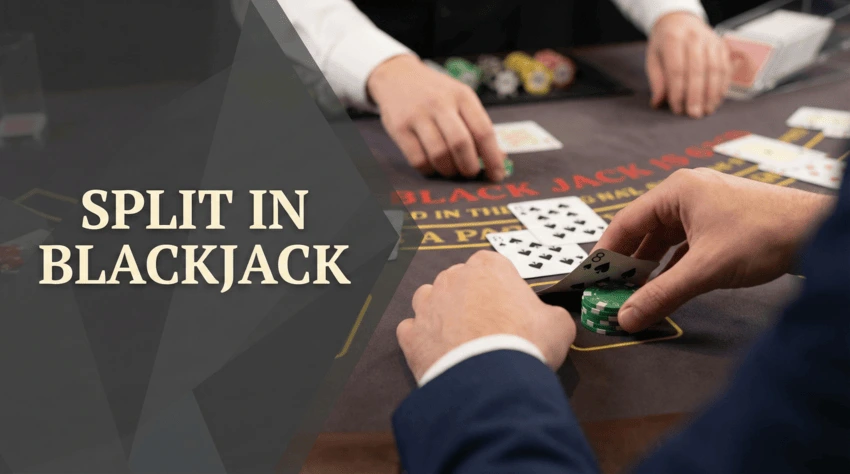
Splitting in blackjack takes a matching pair and breaks it into two separate hands. You're basically doubling your bet to play both cards independently. It's your chance to salvage a trash hand. That weak 16? Split it into two playable hands instead.
We'll break down when to split, when to keep your pair together, and which table rules actually matter.
When you get a matching pair, you can split them into two hands. Each one gets its own bet and plays separately. Get dealt two 8s or two Kings? You can match your original bet and start two new hands from those cards. The dealer separates your cards, gives you one new card for each, and you play the first hand before moving to the second.
So why would you want to do this? You're turning one bad hand into two chances to win. Look at a pair of 8s. Together, they make 16, the worst possible hand. Too high to hit without sweating, too low to stand and feel good about it. Split those 8s, though, and you've got two hands starting from 8, a much more workable position.
Here's what you're risking. You're putting up double the money since splitting means matching your original bet. Can't afford to lose double your bet? Don't split.
Splitting is simple once you've done it a few times. Here's how the process works, whether you're at a physical table or playing crypto blackjack online.
You can only split matching cards. Two 7s, two Queens, two Aces, all qualify. Quick heads-up: most tables won't let you split a King with a Jack, even though they're both worth 10. The cards need to match exactly, not just add up to the same number.
You need to put up a second bet that matches your first. At a live table, you'd place chips next to your original stack. In online and crypto blackjack, clicking the "Split" button handles this automatically, and the platform deducts the second bet from your balance.
After you split, the dealer pulls your cards apart and gives you one new card for each hand. You finish the first hand (hit, stand, whatever you need) before touching the second one. Each hand wins or loses separately.
Not every table game handles splits the same way. The rules can vary between casinos and even between tables at the same venue, so checking before you sit down saves confusion later.
You need matching cards to split. Can you split a 10 and a Queen? Depends on the house rules, but most places want exact matches.
There's no discount on the second hand. Splitting doubles your exposure, period.
Some casinos let you re-split if you catch another matching card. Split 8s and get another 8? You can split that one, too. Most places cap you at 3 or 4 hands total. Re-splitting burns through your bankroll fast, but it's worth it when the numbers work.
Aces get weird treatment at most tables. Split Aces, and you usually get one card per hand. That's it. No hitting after. Here's the catch: pull a 10 on your split Ac,e and you've got 21, but it only pays even money. Not the 3:2 you'd get from a natural blackjack. The hand isn't technically a "blackjack" since it wasn't dealt naturally.
Tables that allow "Double After Split" (DAS) give you the option to double down on your new hands after splitting. This rule helps when you split into something strong, like splitting 8s and catching a 3 for an 11. Not every table has DAS. Check before you start.
Splitting decisions depend on two things: what you're holding and what the dealer's showing. Basic strategy tells you exactly what to do in most spots.
This is the best split you can make. Starting two hands from 11 crushes sitting on 12. Even with just one card per hand, you've got solid odds of hitting 21 or getting close.
A hand of 16 is brutal to play. Splitting 8s gives you two chances to build something better. Starting from 8 is way easier to work with.
Dealer showing 2 through 7? Split those low pairs. Dealer's showing 8, 9, 10, or Ace? Just hit. Splitting won't help you there.
A pair of 6s gives you 12. Hit, and you might bust. Stand, and you'll probably lose. Splitting against a weak dealer card gives you better odds.
Same idea here. Hitting on 14 is risky. Split against a weak dealer, and your odds improve.
This one trips up a lot of players. Two 9s make 18. Feels like a winner, right? But against a dealer's 2-6, 8, or 9, splitting actually gives you better odds. Stand against a 7 (you're probably winning already) and stand against 10 or Ace (splitting's too dangerous).
Some pairs look like they should split. They don't. Here are the hands to keep together.
You're holding 20. That's one of the best blackjack hands. Breaking it up for two maybe-hands loses money long-term. Don't care if it worked once. The math doesn't support it.
Two 5s make 10. Perfect for doubling down. Split them, and you've got two trash hands starting from 5. Dealer showing 2-9? Double down on that 10 instead.
Having 8 isn't bad. You can hit without worrying about busting. Split those 4s, and you're stuck with two hands that'll bust the second you pull a face card.
Here's what basic strategy says about the most common splits. Keep this handy when you're deciding what to split.
Tables with Double After Split give you a few more profitable spots to split 2s, 3s, and 4s. Always check the table rules first.
Even players who know basic strategy mess up their splits. Here's where people screw up.
Greed is the culprit here. Two 10s look tempting to split, but you're tossing away a near-guaranteed win for two coin flips.
What you split depends completely on the dealer's upcard. Split 7s against a 6? Good move. Split them against a 10? Bad move. The dealer's card changes everything.
Splitting doubles your risk. Can't afford the second bet plus maybe doubling down after? You're playing too high.
No. Dealers follow house rules. They can't split or double down as you can. Only players get to split.
Most tables let you split matching face cards like K-K or Q-Q. But breaking up 20 is almost always stupid.
Most casinos stop you at 3 or 4 hands total. Online and crypto platforms show this limit on the table before you start.
Yes. Split right and you cut the house edge a bit. Incorrect splits increase it. Stick with basic strategy, and the math works in your favor long-term.