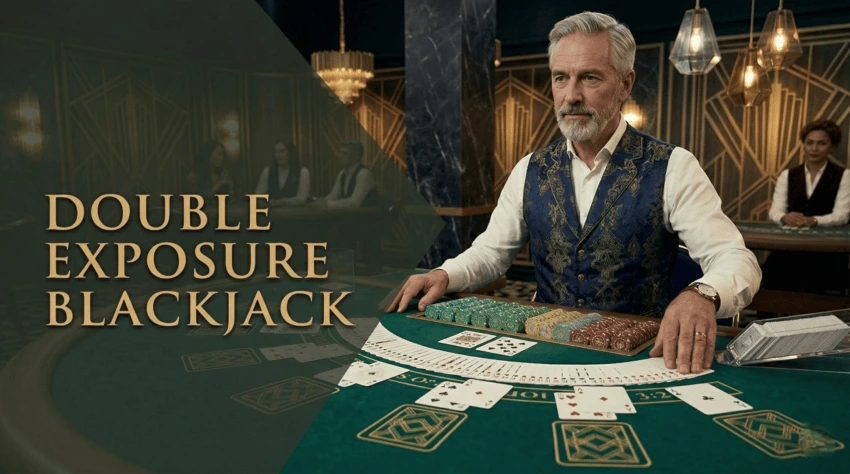
Double exposure blackjack flips the standard game on its head by dealing both of the dealer's cards face-up. No hidden hole card, no guessing what's underneath. You see everything before you act.
The catch? Casinos don't give away that kind of information for free. The rules change in ways that swing the edge back toward the house, and standard blackjack strategy won't cut it here. Let's break down how it plays, where it diverges from standard blackjack, and the strategy adjustments that matter.
So what's double exposure? It's blackjack where the dealer shows both cards right away. No mystery, no hidden card. Instead of guessing what the dealer might be hiding, you see the full picture before making any decision. The game goes by other names, too, including "Face Up 21" and "Dealer Disclosure."
Now, you might think seeing both dealer cards gives players a massive advantage. And it does, in a way. But casinos aren't in the business of giving away free edges. To balance out the transparency, the house changes a few other rules that swing things back in their favor.
The two biggest adjustments: blackjacks pay even money instead of the usual 3:2, and the dealer wins all ties. That second rule is the one that catches most players off guard. A push that would normally return your bet? In double exposure, it's a loss.
The core of the game still feels like blackjack. You're trying to beat the dealer's hand without going over 21. But enough details change that you'll want to know each rule cold.
Both of the dealer's cards come out face-up right from the start. Your cards? Same as usual. Face-up in most online games. Everyone at the table sees exactly what the dealer is working with before anyone acts.
This changes the entire dynamic. You're not playing against probabilities anymore. You're playing against a known hand.
The dealer can't make judgment calls. The rules are automatic:
The dealer has no discretion here. Every move is predetermined.
Here's where payouts change:
That reduced blackjack payout matters more than it might seem. Play a few hundred hands and you'll feel that difference in your bankroll.
Here's where the house claws back its edge. In double exposure, the dealer wins all ties. If you finish with 19 and the dealer finishes with 19, you lose your bet.
One exception: if you both hit natural blackjack (Ace plus a 10-value card), the hand pushes. You get your bet back. Every other tie goes to the house.
You can still hit or stand, double down, and split. But some casinos limit when:
Before sitting down at any table, check the specific house rules. House rules on doubling and splitting? They change how much you can expect to win or lose.
The transparency of seeing both dealer cards sounds like a gift. But the trade-offs are real. Know them before you decide if this game's for you.
Three rule changes give the casino its edge back. Blackjacks pay even money. The dealer wins all ties. And insurance doesn't exist since there's no hidden hole card.
Each rule costs you money over time. Put them together and the house gets its edge back.
Classic blackjack? You guess what's under the dealer's hole card and make your play. In double exposure, you're playing against a known quantity.
Some decisions become obvious. If the dealer shows 20, you know exactly what you're up against. But the tie rule complicates things. Hands that would push in classic blackjack now lose, so you often need to take more aggressive action to avoid matching the dealer's total.
With perfect play, the house edge in double exposure sits around 0.69%. That's slightly higher than well-played classic blackjack, which can drop below 0.5% under favorable rules.
You see both dealer cards, sure. But the house still has an edge. Two things create that edge:
The math is build to keep the casino profitable over time. Perfect play minimizes the edge but doesn't eliminate it.
Standard blackjack strategy charts don't work here. What works against one upcard? Doesn't always work when you see both.
The biggest shift involves standing on lower totals. When the dealer shows a hand likely to bust, like a hard 14 or 15, standing on your 12 or 13 often makes sense. You're letting the dealer take the risk of busting instead of taking that risk yourself.
No Ace in your hand (or it counts as 1)? Here's what to do:
When the dealer shows 12-16, they're in bust territory. Standing on your own weak hand lets them take the risk. Dealer shows 17-20? Hit. You need to beat that total.
Soft hands? That's any hand with an Ace counting as 11. That flexible Ace changes how you play:
The soft 18 decision is the trickiest. Against a dealer 19 or 20, standing on 18 means losing. Hitting gives you a chance to improve.
Split a pair, and you're playing two hands, each with its own bet. Double exposure pays even money, so splitting aggressively doesn't pay off as it does in classic blackjack.
Splitting 10s might seem tempting against a weak dealer hand, but two hands of 10 each are weaker than one hand of 20. Keep the strong hand.
New to double exposure? Watch out for these mistakes: Here are the most common:
Crypto players like transparency. Double exposure delivers everything's face-up from the start. All information is visible from the start. Nothing is hidden.
That same thinking shows up in provably fair gaming.
You can try double exposure blackjack at JB alongside other blackjack variants. Deposits and withdrawals process quickly, so you're playing within seconds rather than waiting around.

.webp)