
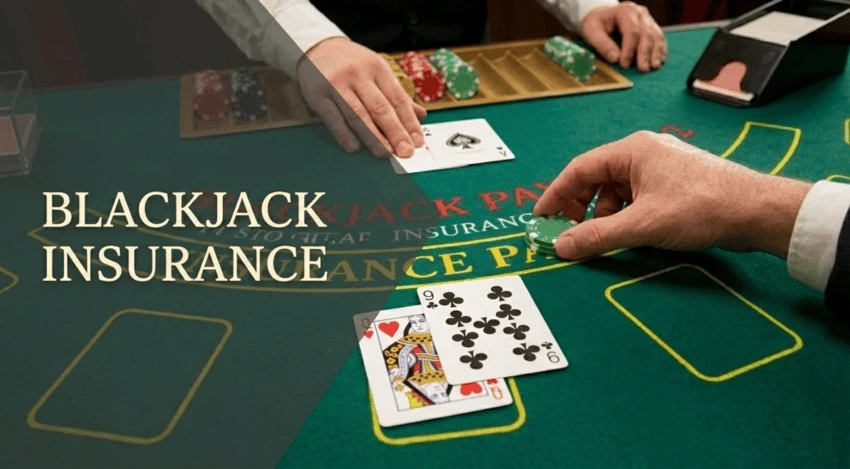
Insurance is a blackjack side bet you can place when the dealer's face-up card is an Ace. It pays 2:1 if the dealer turns out to have a natural blackjack, acting as a hedge against losing your main wager. The catch? The math rarely works in your favor.
Think of it as betting the dealer has blackjack hidden under that Ace. When the dealer shows an Ace, you can throw down this bet before they peek at their hidden card. If they're hiding a 10, Jack, Queen, or King underneath, you get paid 2:1.
The name "insurance" sounds like protection for your hand, but that's a bit misleading. In reality, you're simply betting on whether the dealer's hole card is a 10, Jack, Queen, or King. Your own cards don't factor into whether the insurance bet wins or loses.
Here's how it breaks down:
The insurance rules are fairly consistent, whether you're playing at a physical table or trying crypto blackjack online. Quick rundown:
One variation worth knowing about is "even money," which comes up when you have blackjack yourself. More on that below.
The math behind insurance explains why most experienced players pass on it. The dealer shows an Ace. Thirteen different cards could be hiding underneath. Only four of them give the dealer blackjack: 10, Jack, Queen, King.
A normal deck has about 30.8% ten-value cards. So insurance wins less than a third of the time. But the 2:1 payout needs you to win 33.3% of the time just to break even. That gap between what actually happens and what you need? That's where the house edge comes from.
The difference is substantial. Your main hand (if you play basic strategy) gives the house a tiny edge. Insurance multiplies that edge by more than ten times. Play enough hands, and that gap gets bigger and bigger.
Here's what it looks like in real play. Say you bet $20 and receive a Queen and a 7, giving you 17. The dealer shows an Ace.
You decide to take insurance for $10 (half your original bet). Dealer peeks at the hole card. Now it goes one of two ways:
See the problem? Insurance only helps one way. Every other time, you're just bleeding chips.
For most players, the answer is rarely or never. Look, there are two times when the math changes enough to maybe take it.
Card counters keep tabs on how many high cards versus low cards are left in the shoe. When the count shows way more tens left than usual, insurance actually turns into a good bet. One of the only times the math works out.
Without card counting, you're betting blind against unfavorable odds. If your count says the deck's loaded with tens, you've got real intel that flips the math.
Fewer decks means pulling out each card changes the odds more. Single-deck game? If you see a bunch of low cards out there and hardly any tens, insurance gets a tiny bit better.
Even then, the edge remains slim. Single-deck games with favorable rules are increasingly rare, both in physical casinos and at online tables.
Most of the time, insurance works against you. The exceptions are rare.
Playing casually without counting? You've got no edge. The odds favor the house. Keep taking insurance, and you'll burn through your money way faster.
This trips up many players. Doesn't matter if you're holding 20 or even blackjack. The dealer's odds don't change. Your strong hand feels like it needs protecting. But the insurance math doesn't care what you're holding.
Insurance makes your money swing more and costs you over time. If you're working with limited funds, every chip matters. Throwing money at this high-edge bet means fewer chances to play the main game, where you've got way better odds.
When you have blackjack and the dealer shows an Ace, some casinos offer "even money" instead of the standard insurance option. Works a little differently, but the math comes out the same.
Taking even money is the same math as taking insurance when you've got blackjack. You're swapping the chance at 3:2 for a guaranteed 1:1. The expected value ends up the same both ways.
A lot of players like even money because hey, guaranteed win. You're giving up value in the long run, though. Skip insurance normally? The same logic says skip even money.








.webp)