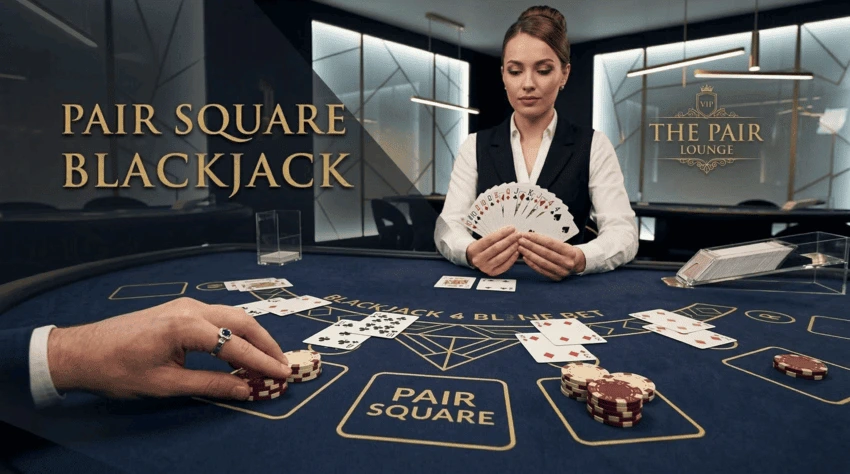
Pair Square is a blackjack side bet that pays out when your first two cards form a pair. That's it. You're not betting on the dealer, not betting on 21. Just: do your two cards match in rank?
Two eights? You win. Two kings? You win. If those two cards also share the same suit, you win more.
The bet sits alongside your main blackjack wager. It resolves before any hit, stand, or split decisions. Two cards dealt, result locked. Fast.
You'll find Pair Square at both live and online tables, including crypto blackjack games running on platforms like JB. It's one of the simpler side bets out there, which is part of why it keeps showing up in new shoe-dealt and live-streamed formats.
Quick distinction: Pair Square pays on two tiers (suited pair and unsuited pair). Some paytables add a third tier for colored pairs. We'll break all of that down below.
No complicated sequencing here. The whole thing plays out in about five seconds.
One thing to note: the number of decks in the shoe matters a lot for this bet. More decks mean more duplicate cards in play, which changes both the probability and the house edge. We'll get into that next.
Pair Square isn't a single bet with a single paytable. Casinos and game providers run different payout structures depending on deck count and house policy. The differences are real, and they move the house edge by several percentage points.
Here's what you'll actually encounter.
Six-deck shoes are the most common setup for Pair Square, both at brick-and-mortar tables and in live online blackjack streams.
Paytable A (15:1 suited, 10:1 unsuited)
This is the version you'll see most often. The house edge here sits around 4.14%.
Paytable B (12:1 suited, 10:1 unsuited)
Dropping the suited payout from 15:1 to 12:1 bumps the house edge up to roughly 6.58%. Looks like a small tweak. It's not.
Paytable C (20:1 suited, 10:1 unsuited)
More generous on the suited end. House edge drops to around 0.87%, which is unusually low for a side bet. If you spot this paytable, it's one of the better side wagers in the building. Problem is, it's rare.
Evolution Gaming runs a Pair Square variant on some of their eight-deck live blackjack tables. The structure shifts:
Eight decks increase the probability of being dealt a pair slightly (more duplicate cards per rank). But the lower unsuited payout offsets that. The house edge here lands around 5.09%.
You'll run into this paytable on live crypto casino table games powered by Evolution. JB runs several of these tables, so if you're playing bitcoin blackjack in a live format, check which paytable is posted before you bet.
Fewer decks, fewer matching cards, lower pair frequency. The math shifts noticeably.
Two-deck (15:1 suited, 10:1 unsuited)
House edge: roughly 6.78%. Same payouts as the common six-deck version, but the reduced probability of pairing makes it a worse bet.
Single-deck (varies, often not offered)
Pair Square on a single deck is uncommon. The math barely works. With only four cards of each rank and one of each suit-rank combo, the probability of a suited pair drops hard. When it does appear, suited payouts tend to jump to 30:1 or higher to compensate. Most operators just skip it.
The takeaway: deck count drives the edge. Same paytable, different shoe size, different house advantage. Always check both.
Here's the full picture, side by side.
That 0.87% edge on the 20:1/10:1 six-deck version stands out like a neon sign. Most blackjack side bets carry edges between 3% and 12%. Finding one under 1% is unusual.
The catch? You need to confirm the paytable before you sit down. Online tables display it. Live tables post it on the felt or in the rules tab. If you're playing crypto blackjack at JB, the info is usually one click away in the game lobby.
These three bets all pay when your first two cards match in rank. The differences are in tier structure, naming, and payout granularity.
Pair Square
Perfect Pairs
Any Pair
The names get swapped around by different providers. Some casinos label their pair bet "Pair Square" but use a three-tier paytable that's functionally identical to Perfect Pairs. Always check what actually pays before assuming.
If you're choosing between them and multiple options exist at the same casino, compare the posted house edges. The name matters less than the math.
Let's talk real numbers. The odds shift with deck count, and they shift more than you might expect.
Six-deck shoe (312 cards)
After your first card is dealt, the remaining 311 cards contain:
Eight-deck shoe (416 cards)
Two-deck shoe (104 cards)
See the pattern? Suited pairs get noticeably rarer as you drop decks. That's why single-deck Pair Square barely exists and why eight-deck versions can offer a juicy suited payout and still keep their edge.
Roughly 1 in 13 to 1 in 15 hands produces a pair, depending on shoe size. Suited pairs specifically? About 1 in 60.
Pair Square shows up across a few different environments.
Live dealer tables (online). Evolution Gaming and other major providers offer Pair Square on select blackjack tables. These tables stream in real time from studios, and you'll find them at crypto-friendly platforms. JB carries multiple live blackjack rooms with pair side bets, usually the eight-deck Evolution variant.
RNG (software-dealt) games. Some digital blackjack games include a Pair Square option. These run on random number generators rather than physical cards. If the platform is provably fair (meaning you can independently verify each deal using a cryptographic hash), the pair outcomes are verifiable too. That's a real advantage when you're playing at a crypto casino and want to confirm nothing's been tampered with.
Land-based casinos, Pair Square appears at physical blackjack tables, mostly in larger casino markets. Six-deck shoes dominate. The 15:1/10:1 paytable is the most common version on felt.
What to look for before betting:
At JB, the game rules and paytable are accessible from the table interface. Takes about two seconds.
Depends on the paytable. Depends on what "worth it" means to you.
If you find the 20:1/10:1 six-deck version: The house edge sits below 1%. That's better than most main-game blackjack bets made with imperfect basic strategy. If you're going to play a side bet at all, this is one of the least costly options in the entire casino.
If you're at a standard 15:1/10:1 six-deck table: The ~4.14% edge is higher than optimal blackjack play (~0.5%) but lower than most side bets (which regularly run 5–12%). It's a reasonable entertainment bet. Not a long-term profit strategy.
If you're at a 12:1/10:1 or two-deck table: The edge climbs above 6%. At that point, you're paying a real premium for the occasional pair hit. Fun in small doses, not something to grind.
The honest take: Side bets add variance and entertainment. They're not how you build a bankroll. If you enjoy the quick hit of a 15:1 or 25:1 payout on a suited pair, Pair Square gives you that without the complexity of other side wagers. Keep the bet size small relative to your main wager, treat it as a bonus layer rather than a core strategy, and always verify the paytable before committing chips.
Play smart. Bet what you understand. That's the whole game.






.webp)