
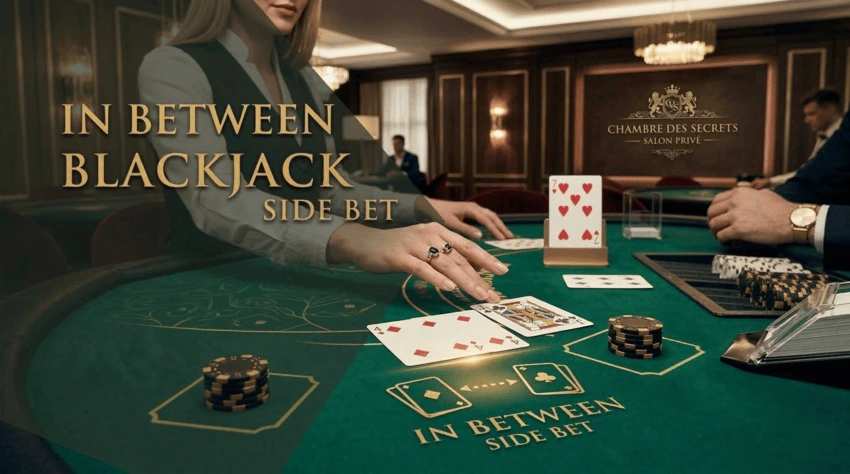
Here's the quick version: the In Between side bet is a simple wager that runs parallel to your main blackjack hand. You're betting on whether the dealer's next card falls between the value of your first two cards. Low complexity, high variance, and completely independent from your regular blackjack decisions.
Let's break down how it works, when it pays, and whether it belongs in your betting strategy.
The In Between bet is an optional side wager offered at some blackjack tables, both live and online. You place it before cards are dealt, and it resolves based on your first two cards plus the dealer's upcard.
The logic is straightforward: if the dealer's upcard lands between your two card values, you win. If it falls outside that range or matches one of your cards, you lose.
This bet plays out fast. No decisions required. No hand-splitting or doubling complications. Just three cards and a clean yes-or-no outcome.
Standard blackjack is a game of decisions. You hit, stand, double, or split based on what you're dealt and what the dealer shows. Strategy matters. Timing matters.
The In Between bet removes all of that. It's a pure probability wager. You can't influence the outcome once the cards hit the felt. That makes it fundamentally different from the main game, where skillful play can shift the house edge down to under 1%.
This side bet lives in a higher-variance space. You're chasing specific card sequences rather than playing the percentages over time.
The In Between bet isn't standard across all blackjack games. It shows up most often in these formats:
You won't find it at every table. Some casinos prefer to feature Perfect Pairs or 21+3 instead. If you're playing crypto blackjack online, check the table rules or game description before you sit down.
Let's walk through what happens from bet placement to payout.
That's it. The side bet is done before you even make your first blackjack decision.
Cards are ranked by their face value:
Your two starting cards create a "spread." The wider the spread, the better your chances.
Example: You get a 4 and a 9. The dealer needs to pull a 5, 6, 7, or 8 for you to win. That's four cards out of the remaining deck.
If you're dealt a 10 and a Queen, both count as 10. There's no spread. The bet loses automatically.
Win: The dealer's upcard is higher than your lower card and lower than your higher card.
Lose: The dealer's upcard is equal to or outside your card range.
Push: Some versions push if the dealer's card matches one of yours. Others count it as a loss. Check the specific table rules.
Most tables don't offer a push option. If the dealer pulls a matching card, you lose.
Pairs: If you're dealt a pair (two 7s, for example), there's no range. The bet loses immediately.
Aces: Typically valued at 1 for range purposes. If you get an Ace and a 5, your range is 1 to 5. The dealer needs a 2, 3, or 4.
Same card value (non-pair): If you get a Jack and a King, both count as 10. No range. Automatic loss.
These edge cases happen often enough to matter. Pairs show up roughly 6% of the time, which means 1 in every 17 hands will auto-lose before the dealer even flips a card.
Payouts vary by casino and table, but most follow a similar structure based on how narrow your card spread is.
The typical payout structure looks like this:
The tighter your range, the bigger the payout. That makes sense—you're less likely to hit, so the casino compensates with higher odds.
Some tables sweeten the deal for ultra-tight spreads. If you land a consecutive pair (like 7 and 8) and the dealer pulls the middle card (a 7), you might hit a 15:1 or even 20:1 bonus payout.
These bonuses are rare. They're designed to keep the bet interesting, not to shift the odds in your favor.
Not every casino uses the same payout table. Some adjust the spread-based multipliers to tweak the house edge. Always check the posted rules at your table.
Online casinos using Evolution Gaming or Ezugi typically stick to the standard structure. Land-based casinos might customize theirs to fit local preferences or regulatory caps.
Let's talk math. This bet carries a significantly higher house edge than the main blackjack game.
The house edge depends on two factors: payout odds and probability distribution across card spreads.
Here's the breakdown for a standard six-deck shoe:
When you run the full probability tree, the house edge lands somewhere between 3.5% and 5.5%, depending on the exact payout table and deck count.
Compare that to blackjack's ~0.5% house edge with basic strategy. The In Between bet is 7–10 times more expensive to play long-term.
Single-deck games would shift probabilities slightly, but most casinos offering the In Between bet use six or eight decks. More decks flatten the probabilities, which keeps the house edge stable.
Card removal effects exist, but they're minimal unless you're tracking spreads across multiple hands. Most recreational players won't see a meaningful edge from deck composition alone.
Can you beat this bet with a strategy? The short answer: not really. But you can play it smarter.
Mathematically, there's no scenario where the In Between bet becomes +EV (positive expected value) without an edge play like card counting. The house edge bakes into every hand.
If you're playing it, treat it as entertainment, not an investment. Budget it separately from your main blackjack bankroll.
That said, if you're chasing a short-session variance spike and you're okay with the risk, the bet can create big swings fast. Just know you're paying for that volatility.
Card counters can theoretically gain an edge on the In Between bet by tracking which card values remain in the shoe. If low cards are depleted and high cards are stacked, wider spreads become more likely.
But here's the catch: the edge gain is minimal, and the mental bandwidth required to count for both blackjack and the side bet simultaneously isn't worth it for most players. You're better off putting that focus into your main game.
Professional counters rarely bother with side bets unless the payout structure is unusually generous. The In Between bet doesn't meet that threshold.
If you're going to play the In Between bet regularly, set a strict cap. Treat it like a separate budget line.
A reasonable approach: allocate 10–15% of your session bankroll to side bets, and split that across multiple hands. Don't chase losses. Don't double up after a cold streak.
Side bets burn through bankrolls faster than main-game play. The variance is higher, the house edge is steeper, and the psychological pull to "get it back" is strong.
Let's compare the In Between bet to three other blackjack side bets you'll commonly see at crypto blackjack tables.
*Six-deck shoe
Lower is better. This shows how much house edge you're paying per unit of entertainment.
*House edge × (100 / win frequency) = relative cost
Choose In Between if:
Choose Perfect Pairs if:
Choose 21+3 if:
Avoid Lucky Ladies unless:
The In Between bet sits in an interesting middle ground. It's not the cheapest side bet, but it's far from the most expensive. Win frequency is decent, but payouts stay modest unless you hit tight spreads.
For crypto blackjack players who want something different from Perfect Pairs or 21+3, it's worth trying.
Here's how to approach this bet without bleeding chips.
Decide upfront how much you're willing to spend on side bets, separate from your main blackjack bankroll. A good rule: 10–20% of your total session budget, max.
If you're playing with $500 for the session, cap your In Between bets at $50–$100 total. Spread that across multiple hands rather than dumping it all on one shot.
Track your side bet spending separately. It's easy to lose count when you're focused on your main hands.
Don't chase losses. If you go cold on the In Between bet, don't start doubling your wager size to recover. That's how bankrolls evaporate.
Don't play it every hand. The house edge doesn't change, but your exposure does. Playing it selectively keeps variance from crushing your session.
Don't confuse side bet wins with main game profit. A big side bet payout feels great, but if you're losing your main hands, you're still behind overall.
If you're playing blackjack to grind out long-term profit, skip the In Between bet entirely. The house edge is too high to justify regular play.
If you're playing for entertainment and you enjoy the extra variance, budget it accordingly and treat it as a bonus feature, not a strategy.
There's no shame in ignoring side bets. Most serious players do.










.webp)