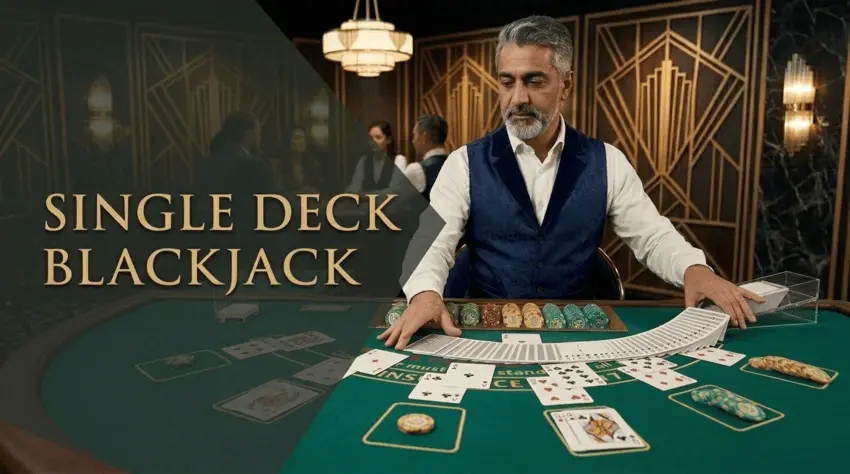
Single-deck blackjack uses just 52 cards instead of the six or eight decks stacked in most casino shoes. That smaller card pool shifts the odds in your favor, but only if you know how to adjust your play.
You'll learn the strategy chart that actually matters for single-deck games, plus when your doubling and splitting moves need to change. We'll also show you which tables are worth your time.
Single-deck blackjack is a variant of the classic card game that uses just one standard 52-card deck instead of the six or eight decks found in most casino games. That smaller card pool changes the math behind every hand. Smart players know this, which is why they hunt for single-deck tables when they can find them.
Three things separate single-deck blackjack from the rest:
Here's the catch: casinos know that informed players want single-deck games. So casinos fight back by attaching worse rules to single deck tables. They'll pay 6:5 on blackjack instead of the standard 3:2, which kills your edge fast. So while the deck count matters, the full rule set matters more.
Single-deck blackjack gives you two big advantages. Natural blackjacks happen more often because you're only dealing with 52 cards, not 312. When you double on strong hands like 10 or 11, you've got better odds of pulling a ten because the deck isn't diluted with hundreds of extra cards.
Here's where it gets tricky. A single-deck game with 6:5 payouts? That's worse than most multi-deck games paying 3:2. Bad payouts wipe out any advantage you get from fewer decks. Check what blackjack pays before you sit down. Period.
A single-deck strategy chart shows you the best play for every hand you'll get dealt. Why does the chart look different? When you pull one card from 52, it affects the odds way more than pulling one from 312.
The chart works the same way no matter how many decks you're playing. Find your hand on the left, then check the dealer's upcard across the top. Where they meet tells you what to do: hit, stand, double, or split.
The chart breaks hands into three groups:
Use the wrong chart, and you'll bleed money over time. The changes look small at first. Play a few hundred hands, though, and those mistakes add up fast.
Hard hands make sense once you see the logic behind them. Always stand on 17 or higher. The bust risk is too high to chase a better hand.
When you've got 12-16, the dealer's upcard is what matters most. When the dealer shows 2 through 6, they're more likely to bust. So you don't need to risk hitting and busting yourself.
Soft hands give you flexibility since the ace can count as 11 or 1, depending on what you draw. That safety net lets you play more aggressively.
Soft 17 (ace-6)? You hit that, you don't stand. A lot of players stand here to be safe. Bad move. The math says take another card. You can't bust, and you'll probably improve your hand anyway. Soft 19 and soft 20 are strong hands already, so you stand almost every time.
Single-deck games let you double more aggressively because you're more likely to catch the card you need. You can double in more situations than you would in multi-deck games.
That last one trips up players who learned on shoe games. In single deck, you double hard 8 against dealer 5 or 6. In multi-deck? Don't do it. See why you need the right chart for each game?
Soft doubles are where single-deck and multi-deck games differ the most. With one deck, you double soft hands more because your odds of catching a strong card go up.
You can double soft 13 through soft 17 when the dealer shows a weak card. Soft 18 (ace-7)? Double when the dealer shows 3 through 6 in a single deck. These plays feel weird at first. Trust them. The math works when you're playing with fewer cards.
Always split aces and eights. Doesn't matter what the dealer's showing. Split those aces and you've got two chances at blackjack. Two eighths? That's a terrible 16. Split them and you get two decent hands starting at 8.
Never split tens or fives. A pair of tens is already 20. That's about as strong as it gets. Breaking that up hoping for two blackjacks? Bad idea. A pair of fives gives you 10. Double that instead of splitting into two weak hands starting at 5.
Coming from multi-deck games? Here's what most players miss:
Taking out one card matters more when you're only playing with 52. Pull one card from the deck and the probabilities shift way more than in a shoe game. That's why these adjustments matter.
Look at the charts side by side and the differences seem tiny. Play a few hundred hands and those tiny mistakes add up to a much bigger house edge.
Single deck with 6:5 payouts, no doubling after splits, and dealer hits soft 17? That's worse than most eight-deck shoes with better rules. Deck count isn't everything. The other rules matter just as much.
That 6:5 payout? It adds about 1.4% to the house edge. One rule change and your advantage from fewer decks is gone. You're actually worse off.
A blackjack simulator lets you drill single-deck basic strategy until the correct plays become automatic. Mistakes at real tables cost real money. Practice for free first.
It depends on the rules. That's the honest answer. Single deck with 3:2 payouts and good rules? That's one of the best house edges you'll find. But a single deck with 6:5 payouts is worse than most shoe games paying 3:2.
Hunt for these conditions: 3:2 blackjack payout, dealer stands on soft 17, you can double on any two cards, and you can double after splits. When those rules align with a single deck, you're playing one of the best blackjack variants available. If the rules are bad, the deck count doesn't matter as much.
Provably fair technology uses cryptography to prove every shuffle was random and nobody messed with it. You can check the results yourself using seed data from before and after each hand.
This is bigger for online blackjack since you can't watch someone shuffle physical cards. Provably fair systems give you the same transparency you get watching a real dealer shuffle in person.
Bitcoin blackjack and other crypto table games eliminate the banking delays common at traditional online casinos. Deposits clear in minutes. Withdrawals don't take days.
Already hold bitcoin or other crypto? No conversion fees when you play. Fast and simple. You focus on the game instead of dealing with payment hassles.
JB offers provably fair blackjack with instant crypto payouts and a clean interface built for players who value speed and transparency. Ready to play? The tables are waiting.
Tracking is easier with fewer cards, but casinos fight back with frequent shuffles and continuous shuffling machines. The advantage is there on paper. Actually using it at most tables? That's the hard part.
Double deck uses 104 cards instead of 52. House edge goes up a bit, and you need to adjust your strategy slightly. Single-deck and double-deck games are closer to each other than either is to six-deck games.
Yes. Use a simulator or spreadsheet to learn the right plays before you risk actual money. Practice until you know the plays without thinking. Saves you money at real tables.
The 6:5 payout bumps up the house edge big time. That's how casinos stay profitable even with fewer decks. That one rule makes the game way worse than 3:2 tables.

.webp)