Labouchere Strategy for Roulette

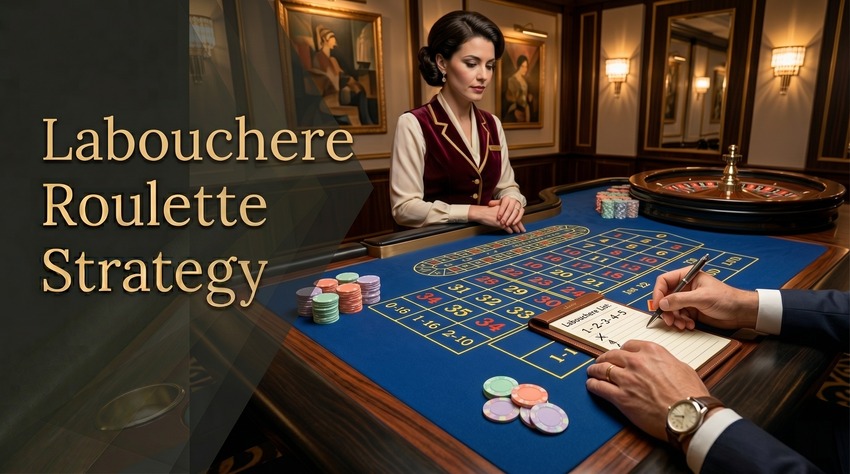
Here's how Labouchere works: you write down a string of numbers, bet whatever the first and last numbers add up to, then scratch both off when you win. Lose, and you add the lost amount to the end. It's way more flexible than Martingale, and you'll always know exactly how much you're trying to win.
I'll walk you through setting up your sequence, show you what happens over a bunch of spins, and tell you straight up where this thing shines and where it crashes.
What is the Labouchere strategy?
Labouchere falls into the negative progression category. You're building a number chain and betting based on what sits at each end. If you win, you cross off both numbers. Lose? Tack that losing bet right onto the end. Your goal is to work through every number. Once they're all crossed off, you've hit whatever profit you set out to make.
People call this system by other names, too:
- Cancellation system: Each win "cancels" two numbers from your sequence
- Split Martingale: It's kind of like Martingale, except your risk gets spread out over several bets instead of just doubling every time you lose.
A guy named Henry Labouchère came up with this back in the 1800s. He was an English politician who really loved playing roulette. Most systems force you to bet a certain way. Labouchere lets you build your sequence however you want, so you've got way more control.
How the Labouchere betting system works
Get the hang of it once, and you can practically run this thing in your sleep. Here's what you actually do:
1. Set your profit target
First, decide how much you want to win for the session. This number determines everything else. First time trying this? Keep your target small while you're figuring out how everything moves.
2. Build your number sequence
Next, break your target into smaller numbers that add up to that total. There's no single "correct" way to do this.
Say you want to win 10 units. You could write 1-2-3-2-2, or 2-2-2-2-2, or even 1-1-1-1-1-1-1-1-1-1. Go with a short sequence, and you won't place as many bets. The trade-off is that each one's gonna be bigger. Longer sequences drag out the action. You'll need way more spins to finish.
3. Place your first bet
Add the first and last numbers in your sequence together. That's your bet.
Say you start with 1-2-3-2-2. Your first bet is 1 + 2, so 3 units. Labouchere only works with even-money bets like red/black, odd/even, or high/low.
4. Update the sequence after each spin
Here's where the "cancellation" part comes in:
- Win: Cross off both the first and last numbers you just used
- Loss: Add the amount you lost to the end of your sequence
So if you bet 3 units and lose, your sequence grows from 1-2-3-2-2 to 1-2-3-2-2-3. If you win, it shrinks to 2-3-2.
5. Complete or restart the sequence
When every number gets crossed off, you've hit your target. Walk away, take a break, or build a new sequence and go again.
Is your sequence getting stupidly long? Next bet way more than you're cool with risking? Time to reset instead of chasing losses.
Labouchere strategy example in action
Let me show you what actually happens across a few spins. You'll see exactly how wins and losses mess with your sequence. Here's a sample run starting with 1-2-3-2-2 (target: 10 units):
Six spins later (four wins, two losses), you're done. Why does this work? Simple. Every win knocks off two numbers. Every loss only adds one.
Labouchere system pros and cons
Look, no betting system is perfect. Labouchere's got its ups and downs.
Advantages
- Flexible structure: You design the sequence to match your bankroll and comfort level
- Slower bet escalation: Wagers grow more gradually than with Martingale, where you double after every loss
- Clear endpoint: You know exactly when you've reached your goal
Disadvantages
- Losing streaks extend the sequence: A bad run keeps adding numbers, which pushes bet sizes higher
- Table limits become a problem: Extended losses can push required bets beyond the table maximum
- No change to the underlying odds: The Labouchère system organizes your betting but doesn't alter the house edge
Reverse Labouchere strategy explained
Reverse Labouchere works backwards from the regular version. You add numbers when you win instead of when you lose.
- After a win: Add the winning bet amount to the end of your sequence
- After a loss: Cross off the first and last numbers
The whole point? Ride winning streaks hard while keeping your losses small during cold runs. When you're winning, your bets grow. When you're losing, they shrink.
The trade-off? One bad spin after a hot streak can erase everything you just built up. This version's for players who don't mind bigger swings and want to push it when they're hot.
Best roulette bets for the Labouchere system
Some roulette bets work great with Labouchere. Others don't. The whole cancellation thing needs you to bet on stuff with nearly 50/50 odds.
Even-money outside bets
Red/black, odd/even, and high/low. That's where this system belongs. These bets give you the best shot at winning each spin, and that's what makes the system actually work.
Inside bets like straight-ups or splits hit far less frequently. Try running Labouchere on inside bets, and your sequence will balloon fast. You'll lose way more often than you win, so numbers just keep piling up.
European vs American roulette
European roulette has one zero. American roulette has two. That extra zero on American wheels increases the house edge.
Run a Labouchere sequence for dozens of spins? That difference starts adding up. European tables give the system more room to operate before the house edge catches up.
Does the Labouchere strategy actually work
Here's the real talk: Labouchere gives your betting some structure, but the math underneath stays exactly the same.
Roulette carries a house edge on every spin. Doesn't matter how smart your number sequence is. That reality doesn't budge. Spin the wheel enough times, and the casino's edge always shows up. Doesn't matter what system you're running.
What the system does offer is discipline. You get a clear target, you know when to stop, and it keeps you from betting randomly or emotionally. Lots of players find that structure makes the whole thing more enjoyable, even if they're not guaranteed to win.
Labouchere's really just bankroll management. It's not some magic winning formula.
Common Labouchere betting mistakes
First-timers usually make the same mistakes:
- Starting with an overly aggressive sequence that requires large bets early
- Refusing to reset after a brutal losing streak
- Ignoring table limits until a required bet exceeds the maximum
- Skipping a stop-loss, which turns a bad session into a much worse one
- Applying the system to inside bets where win frequency is too low for the math to work
This system works best when you actually respect its limits and decide your boundaries before you even start.