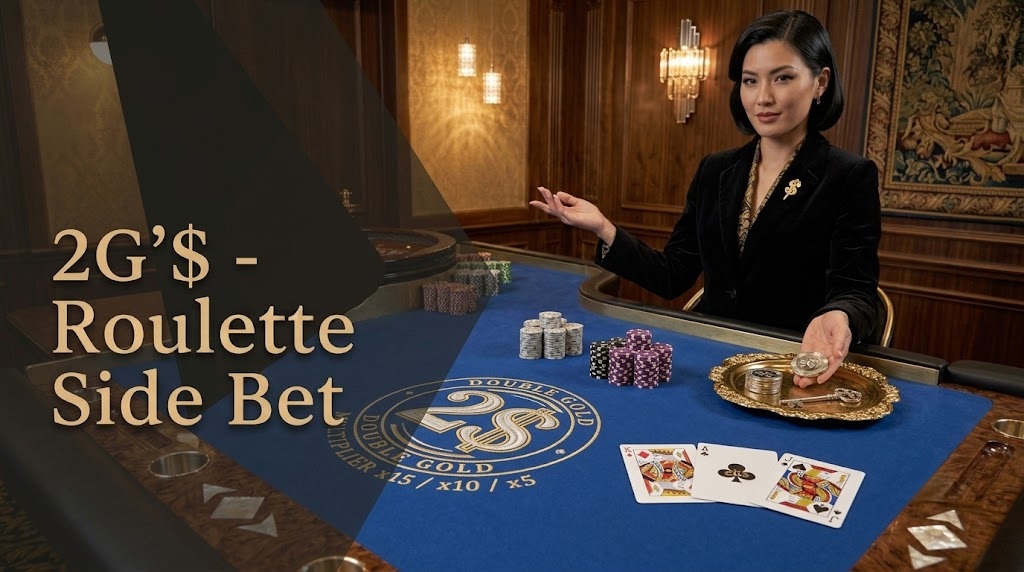
2G'$ Roulette Side Bet

Two greens. Back to back. That's the whole bet.
2G'$ is a roulette side bet you'll spot at select tables, and it either pays beautifully or rips you off depending on one thing: the pay table. Here's everything you need to know before you drop a chip on it.
What is 2G'$?
Pronounced "two greens," 2G'$ is an optional side bet that wins when the ball lands on a green pocket on two consecutive spins. On an American double-zero wheel, that means 0 or 00, then 0 or 00 again.
The name is a play on words. Two G's (greens) plus the dollar sign. Cute.
A few things to know upfront:
- Approved by the Nevada Gaming Control Board
- Available at select Las Vegas tables, not everywhere
- You'll see a dedicated 2G'$ spot on the layout if the table offers it
- This is not a standard roulette bet. It's a proprietary side wager
If you're playing crypto roulette online, you probably won't encounter this one yet. It's a land-based novelty for now.
How 2G'$ works
The mechanics span two spins. Not one. Here's the sequence:
- Spin 1: Place a chip on the 2G'$ spot before the spin. If the ball lands on any number 1 through 36 (red or black), your bet loses immediately. Done.
- If spin 1 hits green: Your bet survives. The dealer marks it with a locking marker. No other player can place a new 2G'$ wager until the next spin resolves.
- Spin 2: Green again? You win. Anything else? You lose.
That's it. First green keeps you alive. Second green pays you.
Probability and true odds
The math changes depending on the wheel. Let's break each one down.
Double-zero wheel (American, 38 pockets):
- Green on any single spin: 2/38 = 5.26%
- Green on two consecutive spins: (2/38) × (2/38) = 4/1,444
- That's 1 in 361
- True odds: 360 to 1
Single-zero wheel (European, 37 pockets):
- Only one green pocket, so both spins must hit that exact pocket
- Probability: (1/37) × (1/37) = 1/1,369
- True odds: 1,368 to 1
Triple-zero wheel (39 pockets):
- Probability: (3/39) × (3/39) = 9/1,521 = 1 in 169
- True odds: 168 to 1
The single-zero version is rare. The triple-zero version is frequent but pays terribly. More on that below.
Pay tables and house edge
This is where 2G'$ gets interesting, and where most players get blindsided.
Unlike standard roulette bets with fixed payouts, the casino chooses from a range of approved pay tables. The house edge swings wildly depending on which one they pick.
Double-zero wheel options:
At 350:1, the house edge is 2.78%. That's roughly half the 5.26% edge on every other American roulette bet. At 300:1, you're handing the casino a 16.62% cut. Same bet, wildly different value.
Single-zero wheel options:
At 1,350:1, the house edge drops to 1.39%. That's absurdly low for a roulette bet. One of the lowest edges you'll find anywhere on a casino floor. At 1,050:1, it's a bad joke.
Triple-zero wheel:
Common payout sits around 150:1 with a house edge near 10.65%. Skip it.
The rule is simple: check the posted payout before you bet. The difference between the best and worst pay table on the same wheel type is the difference between a sharp wager and a sucker bet.
The parlay alternative
Here's the angle most guides miss entirely.
On a single-zero wheel, you can replicate 2G'$ yourself:
- Bet on 0 straight up. If it hits, you get paid 35:1.
- Let everything ride on 0 again. All 36 units (your original bet plus winnings).
- If 0 hits twice, your total return is 36 × 36 = 1,296 units. Effective payout: 1,295 to 1.
The house edge on this self-parlay works out to 5.33% against your original wager.
So any 2G'$ pay table below 1,300:1 on a single-zero wheel is mathematically worse than just doing it yourself. Only take the side bet if it pays 1,300:1 or better.
On a double-zero wheel, the self-parlay is messier. You'd need to split across 0 and 00 on the second spin, which changes the payout structure. The 2G'$ bet adds more genuine value on American wheels because the DIY version doesn't replicate as cleanly.
Dealer Envy variant
A quick mention. There's a version called Dealer Envy 2G'$, also approved by Nevada Gaming:
- Same base rules
- When a player wins, the dealer gets a bonus payout too, usually a predetermined multiple of the player's original bet
- The player payout is slightly reduced to fund this, or it comes from a separate side bet
- Creates a fun dynamic where the dealer is actively rooting for your greens
Not widely spread. If you see it, now you know what it is.
Is 2G'$ worth it?
Depends entirely on the pay table. No other answer is honest.
Yes, at 350:1 on a double-zero wheel. The 2.78% edge beats every standard American roulette bet. The trade-off is frequency. You'll hit this roughly once every 361 spins. That could mean hours at the table with nothing. The math favors you, but your patience might not.
No, at 300:1 or 325:1 on a double-zero wheel. The edge balloons to 9.70% or 16.62%. You're paying a steep premium for a rare event.
Conditionally yes on single-zero wheels at 1,300:1 or above. Below that, the self-parlay is the smarter move.
No on triple-zero wheels at 150:1. A 10.65% edge on a bet that hits once every 169 spins is a losing proposition by any measure.
One number to remember: check the pay table. That single step separates a sharp bet from a bad one.