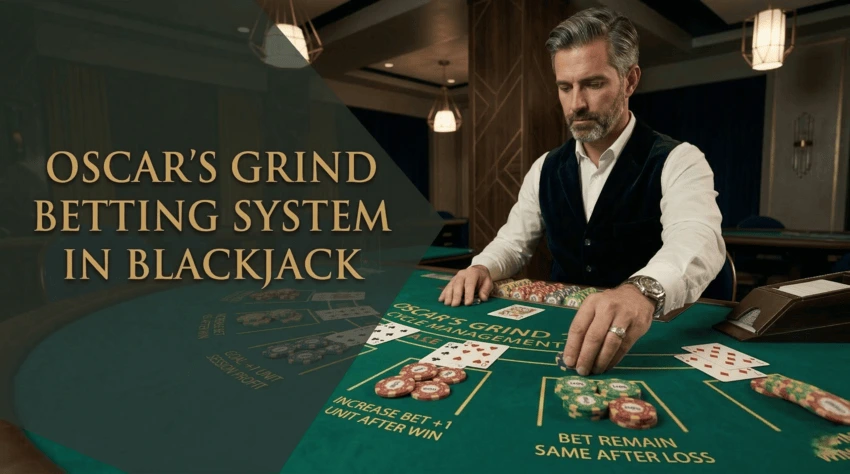
You'll learn one of the most disciplined betting systems in blackjack in about five minutes. Oscar's Grind is built for players who'd rather protect their bankroll than chase big swings. It's slow, it's methodical, and it targets exactly one unit of profit per cycle. That's it. One unit, then reset.
If you like structure over chaos, this one's for you.
The system showed up in Allan Wilson's 1965 book The Casino Gambler's Guide, where he wrote about a craps player named "Oscar" who used it for years. The idea was simple: grind out small, consistent wins while keeping losses shallow.
It's a positive progression system, which means you only increase your bet after a win. Losses don't change anything. You sit tight and wait.
Here are the rules:
That's the entire system. No doubling after losses, no escalating into the stratosphere.
If you're still getting comfortable with how blackjack hands play out, nail down the base game first. And if you're unsure how to size your units, our guide on chip values and colors breaks that down fast.
Let's say one unit equals $10.
Four hands. Two losses, two wins. You're up $10. Reset and start over.
Notice that on Hand 4, a $20 win would bring the cycle total to exactly +$10 (one unit). That's the target. If the math had you overshooting +1 unit, you'd lower the bet to land precisely on the target.
Let's run a longer session. Same unit size: $10. Starting bankroll: $200.
After 10 hands, you're up $30 (three completed cycles at +$10 each).
The key moment is Hand 6. After Hand 5, the cycle profit sat at $0. A $20 bet would have pushed the cycle to +$20 on a win, which overshoots the +$10 target. So you cap the bet at $10. That discipline is the whole point.
Worth noting: pushes (ties with the dealer) don't count as wins or losses in this system. Your bet stays the same and the cycle continues. If you run into any blackjack terminology that trips you up during a session, we've got a full glossary.
These three systems are compared a lot. They play very differently.
The Martingale looks great on paper until you hit a losing streak of six or seven hands. At that point, you're betting 64x your starting unit just to win back one. Oscar's Grind never asks you to do that. Your bets creep up slowly, and only after wins.
The 1-2-3-5 system sits somewhere in between. It chases winning streaks harder than Oscar's Grind does, but it also exposes more of your bankroll during those streaks.
Oscar's Grind is the boring, reliable one. And sometimes boring is exactly what you want.
What works well:
Where it falls short:
No betting system beats the house over infinite hands. Oscar's Grind just makes the ride smoother.
Pair it with basic strategy. Oscar's Grind handles your bet sizing. Basic strategy handles your playing decisions. One without the other is half a plan. Know when to double down and when to split before you worry about progression systems.
Set a session stop-loss. Pick a number before you sit down. If your bankroll drops by 20 units, walk away. Oscar's Grind is conservative, but it's not a force field. Give yourself a floor.
Pick the right table. If you play blackjack with crypto, you've got fast deposits and fast payouts already handled. Focus on finding tables with player-friendly rules: 3:2 blackjack payouts, dealer stands on soft 17, and the option to double after splits. Those small rule differences add up across hundreds of hands.
Track your cycles. This is a system that rewards attention. A notepad (or a mental count) of where you sit in the current cycle keeps you from over-betting or losing your place. On live online blackjack tables, the pace is fast enough that it's easy to lose track.
Don't mix systems mid-session. If you commit to Oscar's Grind, run it clean. Switching to a Martingale chase after a losing streak defeats the entire purpose.
Unit size matters. A good starting point: make one unit about 1-2% of your session bankroll. With $500, that's a $5-$10 unit. You want enough room to ride out cold stretches without pressure.
Here's the honest answer: Oscar's Grind is one of the safest structured betting systems you can use at a blackjack table. It won't make you rich. It won't overcome the house edge. But it gives your session shape, keeps your bets disciplined, and avoids the catastrophic blowups that negative progression systems invite.
It's best suited for players who enjoy the process. You like crypto blackjack because it's fast and frictionless. You want a system that lets you play longer without sweating every hand. Oscar's Grind does that.
For players who want to go deeper into blackjack math and theory, check out our list of recommended blackjack books. And if you're curious about systems that actually do shift the odds (and the risks that come with them), our card counting guide covers the real mechanics.
Oscar's Grind won't change the math. But it'll keep you in the game long enough to enjoy it.