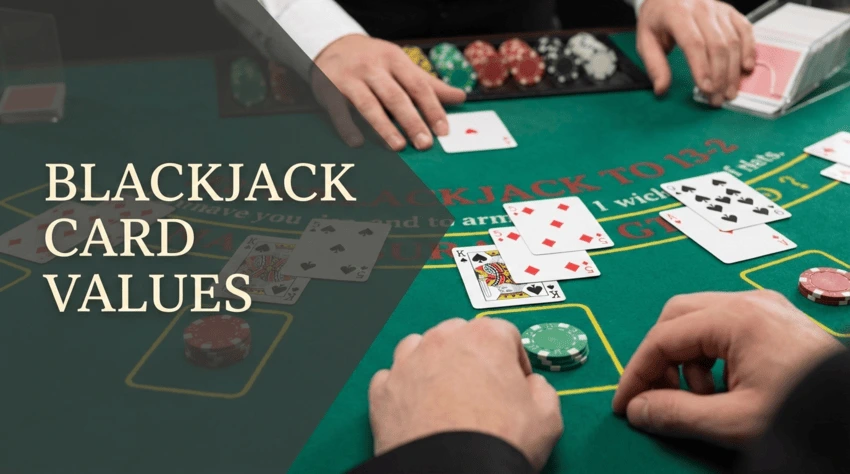
Here's all you need to know about blackjack scoring: number cards are worth what they show, face cards count as 10, and aces work as either 1 or 11. That's literally it. Once these values click, you'll make decisions way faster at the table.
You'll learn what each card is worth, how to add up your hand, and why soft hands play totally different from hard ones.
Every card fits into three simple categories. Number cards match their face value (so a 7 is worth 7). Face cards (King, Queen, Jack) all count as 10. And aces? They're worth 1 or 11, whichever helps you more. That's the entire system. Unlike poker, suits carry no weight here, so a 7 of hearts and a 7 of spades are identical in value.
Get this chart down, and you'll add up hands without even thinking about it. The game's simple enough for anyone to pick up. But that flexible ace? That's where beginners and pros start playing different games.
Let's dig into each card type. Once you've got card values down cold, you'll stop second-guessing yourself mid-hand.
Number cards from 2 to 9 couldn't be simpler. A 4? Worth 4 points. Same deal with a 9. No exceptions, no special rules.
The 10 card is a little different. Sure, it's a number card, but it's worth 10 just like all the face cards. Why does this matter? Because 10-value cards show up more than any other value in the deck.
Kings, Queens, and Jacks? All worth 10. No card ranks higher than another. A King's not worth more than a Queen, and a Jack's not worth less. All that royal artwork? Just for show.
Why does this matter? A standard deck has 16 cards worth 10: four actual 10s, plus four Jacks, four Queens, and four Kings. That's about 31% of the deck, which is why pros pay close attention to 10-value cards.
Aces are the most flexible cards you'll get. They count as either 1 or 11. The game picks whichever value helps you more. But knowing when the ace switches from 11 to 1? That helps you see where your hand's heading before you draw.
That flexibility makes aces the best cards in the deck. It's the only card that lets you chase 21 without committing to a specific total.
The ace's double-value trick shapes how you play every hand. Once you know when it's counting as 11 and when it drops to 1, you'll see your options way clearer.
Aces start at 11 as long as that doesn't bust you. You want this. Starting with 11 puts you in a better spot and keeps your options open.
When your ace is counting as 11, you've got protection built in. Even if you pull a high card, the ace drops to 1 so you don't bust.
The second an 11 would bust you, that ace becomes a 1. You don't pick this. It just happens.
Say you've got Ace + 6 (soft 17) and you draw an 8. Your hand's now 15, not 25. The ace dropped from 11 to 1, so you didn't bust. It happens without warning. Catch when it switches, and you'll play the rest of your hand smarter.
Adding up your hand is basic math once you know the card values. Just add up all your cards. The ace adjusts itself if it needs to.
Here's how a few common hands break down:
See how three different hands equal 16? They don't play the same way. The soft 16 (Ace + 5) lets you hit without risking a bust, unlike either hard 16. Understanding soft versus hard hands? That's one of the biggest things you need to get.
The terms "soft" and "hard" describe whether your hand contains a flexible ace. This changes how aggressive you can be.
A soft hand has an ace counting as 11. The hand is called "soft" because it can absorb a high card without busting; the ace simply converts to 1 if needed.
Like, Ace + 4 gives you soft 15. You can hit without worrying because even if you draw a 10, you're only at 15 (ace dropped to 1). Soft hands let you take risks. That's why basic strategy tells you to hit or double on soft totals when you'd normally stand on the same hard total.
A hard hand has no ace, or the ace's already counting as 1. You've got no wiggle room.
Like 10 + 7. That's hard 17. Same with Ace + 6 + Queen. The ace dropped to 1 so you didn't bust, making it hard 17. Hard hands are riskier. One high card and you're busted.
A blackjack, also called a "natural," is the best possible hand: an ace plus any 10-value card dealt as your first two cards. That's an instant 21 with just two cards.
A blackjack isn't special just because it's 21. It's the payout. Natural blackjacks usually pay 3:2. So a $10 bet gets you $15. Hit your way to 21 with three or more cards? That's just even money (1:1).
Here's the thing: a blackjack beats any other 21. You could hit to 21 with four cards, but if the dealer flips a natural blackjack, you lose. Two-card 21 beats a multi-card 21 every time.
Every move in blackjack comes down to one thing: your total versus the dealer's upcard. If you're still counting on your fingers, you won't make that call fast enough.
Basic strategy charts show you the mathematically best move for every hand, and they're all based on these values. The charts tell you when to hit, stand, double, or split by reading what the numbers say about your odds.
The faster you can calculate your total, the more smoothly you can follow the strategy across all table games. Most people hesitate because they're unsure about the math. Get card values down cold, and that goes away.
Full basic strategy has tons of situations, but a few simple rules cover what trips up most new players.
You probably won't improve a hard 17 or higher, and you'll probably bust trying. Just stand and protect what you've got.
You can't bust with 8 or lower. It's impossible. Every card you draw makes your hand better, so don't stand.
Starting with 10 or 11? You're sitting pretty, especially if the dealer's showing something weak (2 through 6). Double down when the math's on your side.
Split aces and you've got two shots at blackjack. Split eights to get out of hard 16, easily the worst hand you can start with.
Insurance comes up when the dealer's showing an ace. It pays 2:1 if they've got blackjack. The math's not in your favor long-term. That's why most pros skip it.
Simple math gets harder when you're playing fast, and the table's watching. Here's what trips up beginners:
If you're ready to put card values into practice, JB casino offers live online blackjack and RNG table games with fast crypto deposits and near-instant withdrawals. Tables run 24/7, and the setup's clean and fast.