Blackjack is the most popular table game in the world, and it started in French casinos over 300 years ago. Back then, players called it Vingt-et-Un, which translates to "twenty-one."
The game traveled from European royal courts to Nevada gambling halls to the crypto casinos players use today. You'll see how a French card game became a global obsession, where that weird name actually came from, and why card counters turned casino security upside down.
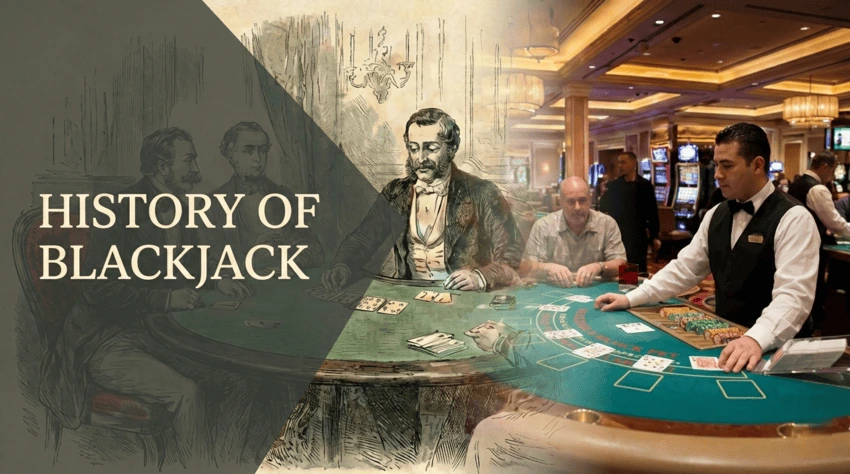
Blackjack was invented in French casinos around 1700, where players knew it as Vingt-et-Un, the French term for "twenty-one." The game didn't appear out of nowhere, though. The game came from older European card games with the same basic idea: get close to a number without busting.
No single person created blackjack. The game just kept changing as players and casinos tinkered with the rules. Today's blackjack? That's 300 years of tweaks, regional quirks, and casinos finally agreeing on the rules.
This game bounced from French kings to Vegas dealers to crypto players clicking away on their phones. That's why the game still works the way it does today.
Pinning down exactly where blackjack came from is tricky. Card games from the 1500s and 1600s all had similar setups, and historians still argue about which one came first.
Vingt-et-Un showed up in French casinos in the early 1700s. The rules looked a lot like modern blackjack: players drew cards, aimed for a total of 21, and tried to beat the dealer without busting.
French nobles played it in royal courts, and writers from that time mentioned it in their work. French colonists packed Vingt-et-Un in their bags when they sailed to North America.
Europe had tons of similar card games before Vingt-et-Un took off in France. They all worked the same way: draw cards and hit a target number.
These games borrowed from each other as they moved around Europe. Vingt-et-Un probably stole bits from all of them before turning into its own thing.
Here's where the timeline gets complicated. Miguel de Cervantes, the Spanish author famous for Don Quixote, wrote about a game called "veintiuna" in a short story from the early 1600s. That's nearly a hundred years before French casinos documented Vingt-et-Un.
He wrote about cheaters playing veintiuna. Aces counted as 1 or 11, and you tried to hit 21 without busting. Sound familiar? The mechanics sound almost identical to modern blackjack. If that game was real, blackjack might be older than historians thought.
The name "blackjack" is an American invention, and it came from a promotional bonus that casinos eventually abandoned.
American casinos wanted more people playing Vingt-et-Un, so they added a special bonus. Get an Ace of Spades with a black Jack (Spades or Clubs), and the casino paid you 10-to-1 instead of the normal rate.
Players started calling the game "blackjack" after that premium hand. The promotion worked so well that everyone kept calling it blackjack, even after casinos killed the bonus. Today, a "blackjack" refers to any ace plus any ten-value card, regardless of suit or color.
French colonists brought Vingt-et-Un to America in the 1700s. For over 100 years, the game bounced around gambling circles, riverboat casinos, and frontier saloons before settling down for good.
Nevada legalized gambling in 1931. Blackjack was one of the first games you could play in legal casinos. Once it was legal, casinos needed to agree on the rules, payouts, and how the game actually worked.
Vegas turned blackjack from a regional card game into something people play worldwide. Vegas casino culture in the '50s and '60s made table games look glamorous, and blackjack was right in the middle.
Unlike roulette or craps, blackjack gave players a sense of control. When you hit, stand, double, or split, it actually changes what happens. That feeling of control, plus decent odds, made blackjack the most popular table game in American casinos by the '70s.
The 1960s flipped everything. Math nerds figured out how to beat the house, and casinos had to change how they ran blackjack tables.
In 1962, mathematician Edward Thorp published Beat the Dealer, a book that proved players could gain a statistical edge over the house. The idea was simple: track which cards already got played, and you'd know when the deck was in your favor instead of the dealer's.
More high cards (tens and aces) left in the deck? You've got an edge. More low cards? Dealer's got the edge. Thorp's system let players change their bets based on what cards were left.
Casinos responded quickly. They threw more decks in the shoe, tweaked rules to cut player advantages, and taught dealers how to spot counters. Thorp didn't just change blackjack strategy. He changed how casinos think about security, period.
The most famous card counting team ran from the '80s through the early 2000s. MIT students and grads worked together to count cards and won millions from casinos worldwide.
Here's how they split it up:
Casinos eventually identified and banned team members, but the MIT Blackjack Team's story became the book Bringing Down the House and later the film 21. They proved that blackjack was a game you could actually beat if you knew what you were doing.
Blackjack's dominance among table games isn't accidental. The game nails a sweet spot that other casino games miss.
That last factor matters more than it might seem. Even when the house has an edge, you feel like you're in control. That keeps people playing. Blackjack isn't passive like slots or roulette. Every hand? You're making choices that actually change what happens.
Blackjack jumped online faster than pretty much any other casino game. Going from real tables to screens was easy because blackjack doesn't need fancy graphics or physics. Cards work just fine on screens.
Late '90s internet casinos meant anyone with a computer could play blackjack. The game didn't require complex physics simulations or elaborate graphics. Cards, numbers, and decisions were enough.
Online play added stuff you can't get at real tables. You could check strategy charts mid-hand, play multiple tables at once, and find lower minimum bets than any physical casino offered.
Streaming tech mixed online convenience with the feel of a real table. Live dealer blackjack features actual dealers, physical cards, and real-time video feeds. You watch what's happening and click your choices on screen.
Perfect if you want to play with real dealers without leaving your couch. Live tables also fix the whole 'is this rigged?' question because you see the actual shuffle and deal.
Crypto casinos added something traditional gambling couldn't offer: mathematical proof that games are fair.
Provably fair systems use crypto tech to prove the casino didn't mess with the results. Before each hand, the casino locks in a result using crypto math. After you play, you can check that the result matches what they locked in. You don't have to trust them. The math proves it.
Bitcoin blackjack and other crypto table games also offer faster transactions. Deposits show up in minutes, not days. And you can actually withdraw your money without waiting forever, like at regular online casinos.
Play blackjack at JB: Experience provably fair blackjack with instant crypto deposits and fast withdrawals at JB.com.