
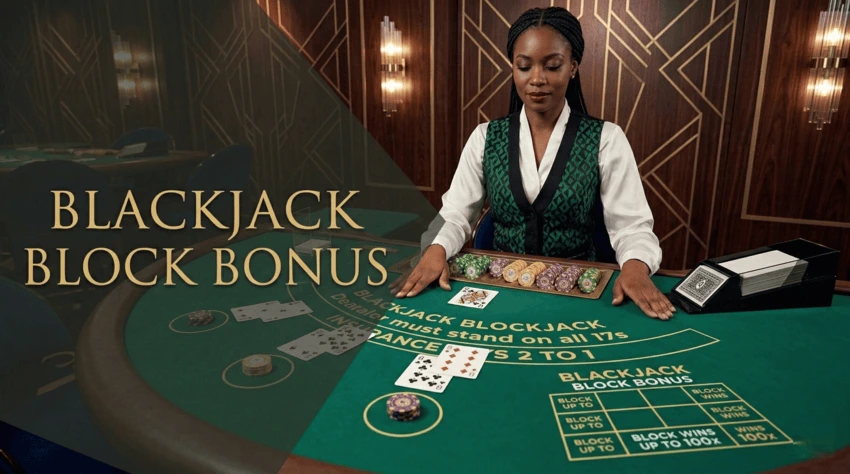
The Block Bonus is a side bet in blackjack that pays based on the combination of your first two cards and the dealer's upcard. That's three cards total forming a "block."
You're not trying to beat the dealer here. You're betting that those three cards will form a specific combination, like a suited pair, a straight, or three of a kind.
It sits right next to the main bet on the layout. You place it before the deal. And it resolves immediately after the first three cards hit the table.
Simple trigger. Fast result.
That's it. No extra decisions. No strategy adjustments. The block either hits or it doesn't.
Payouts vary by casino and table rules, but here's a common version you'll run into when you play blackjack with crypto or at live online blackjack tables:
Some tables add a "flush" tier (all three cards same suit but no straight) that pays around 5:1 or 8:1. Always check the specific paytable at your table. Payouts shift between providers, and those differences affect the math.
Here's where you need honest numbers.
The Block Bonus carries a house edge that typically lands between 5% and 12%, depending on the paytable version and the number of decks in play.
Compare that to the main blackjack bet, where solid basic strategy brings the edge down to around 0.5%. The gap is real.
Side bets in blackjack are designed to pay big on rare hands. That excitement comes at a cost: the house takes a larger cut over time. The Block Bonus is no exception.
So is it a terrible bet? Not if you understand what you're buying. You're paying for variance and the chance at a 100:1 hit. You're not paying for long-term edge.
Let's be direct. There's no player decision involved in the Block Bonus once the cards are dealt. You can't hit, stand, or split your way into a better block.
That means the "strategy" is really about bankroll management:
Betting too large on the side bet. This is the number one error. A player puts $5 on their main hand and $5 on the Block Bonus. That's a 50/50 split between a low-edge bet and a high-edge bet. The math doesn't support that ratio.
Ignoring the paytable. Not all Block Bonus tables are created equal. A weak paytable quietly drains more per hand. Spend 30 seconds scanning the payouts before you sit down.
Thinking the block is "due." Three suited trips didn't show up in 200 hands? That's normal. Probability doesn't have a memory. Each deal is fresh.
Skipping basic strategy on the main hand because the side bet hit. A Block Bonus payout feels great. But your main hand still needs the right play. Don't let a side bet win make you sloppy on the split or double decision.
The Block Bonus makes sense when:
It doesn't make sense when:
Knowing when to add the side bet and when to skip it is the real skill here.
Quick comparison to put this in context:
The Block Bonus and 21+3 share the same three-card trigger. The difference is in hand rankings and paytable structure. Some players prefer 21+3 for its poker-hand familiarity. Others like the Block Bonus for its specific payout tiers.
Neither is a "better" bet in absolute terms. Both carry a higher edge than the main game. Pick the one that fits your style.
The Block Bonus side bet is a fast, no-decision wager based on your first two cards and the dealer's upcard. It pays well on rare combinations and adds action to every deal.
The trade-off is a higher house edge than the main bet. Keep your Block Bonus small, check the paytable, and treat it as a fun layer on top of solid basic strategy play.
If you're playing crypto blackjack at JB, the provably fair system means you can verify every deal. That's the right setup for side bets: fast action, real transparency.
Now go play a block.









.webp)