
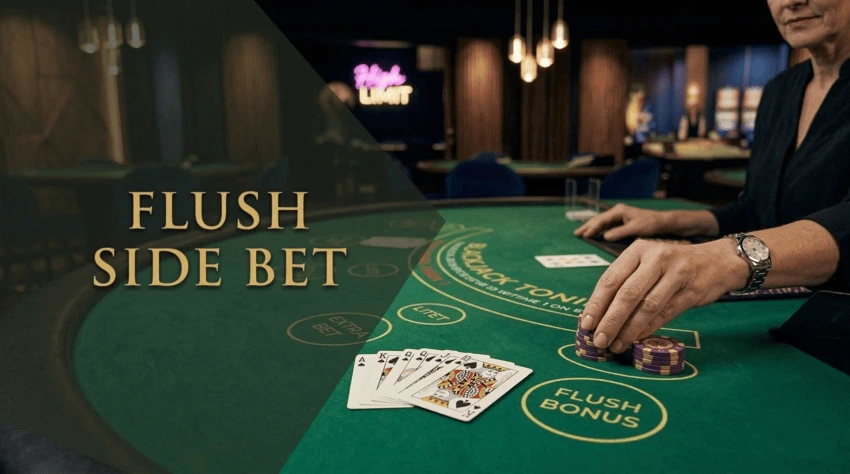
The flush side bet pays you extra when your first two cards share the same suit. If the dealer's upcard matches too, the payout gets even bigger. Here's everything you need to know: how it works, what it pays, and whether it's worth your chips.
Standard blackjack cares about one thing: card value. Hearts, diamonds, spades, clubs? Doesn't matter. A 10 of hearts and a 10 of clubs play identically.
The flush side bet flips that script. Suddenly, suits matter.
You're still playing normal blackjack. The main hand doesn't change. But before the deal, you drop an extra wager in the flush side bet circle. If your first two cards share a suit, you win that side bet regardless of what happens with your main hand.
Think of it as a parallel bet. Two games running at once on the same cards.
The main hand rewards good decisions. The flush side bet rewards good luck. That distinction matters when you're deciding how to spend your bankroll.
Before any cards hit the felt, you place your flush side bet in the designated spot. It's separate from your main blackjack wager.
Most tables set a minimum and maximum for side bets. These are usually lower than the main bet limits. You might see a $1 to $25 range at a table with a $10 minimum main bet.
Quick steps:
That's it. No extra decisions. No hit-or-stand choices affect this wager.
The simplest version: your first two cards need to share the same suit.
Some tables extend this to three cards by including the dealer's upcard:
A 3-card flush pays significantly more because the odds of three consecutive same-suit cards drop fast, especially in multi-deck shoes.
The flush side bet settles the moment all initial cards are visible. Your two cards are dealt, the dealer shows their upcard, and the side bet pays or doesn't.
You don't need to finish the hand. You could bust on your next hit and still collect the flush payout. The two bets live completely separate lives.
Payouts vary. This is one of those "always check the table placard" situations because different casinos, and different tables within the same casino, run different pay tables.
Here's a common structure you'll see at many live online blackjack tables and crypto casino games:
And a more generous variation:
The numbers shift, but the logic stays the same: more matching cards equals bigger payouts, and a natural 21 in the same suit sits at the top.
Most flush side bets consider either two or three cards.
2-card flushes hit more often. You're only matching your own hole cards. In a 6-deck shoe, roughly 1 in 4 hands will give you a 2-card flush. Not rare at all.
3-card flushes (adding the dealer's upcard) are tougher. You need three cards from the same suit in sequence. That probability drops to about 1 in 16, depending on deck count.
The payouts reflect this gap. A 2-card flush might only pay 2:1 or 3:1, while a 3-card flush jumps to 5:1 or higher.
Here's where reality walks in.
A well-played blackjack main hand carries a house edge around 0.5% with basic strategy. That's one of the best numbers in any casino, crypto or otherwise.
The flush side bet? The house edge sits between 2% and 5%, depending on the pay table and deck count. Some less generous tables push it above 6%.
That's a big gap. Your main blackjack bet costs you about 50 cents per $100 wagered. The flush side bet can cost $2 to $6 per $100 wagered.
Not catastrophic. But you should know what you're paying for. You're buying entertainment and the chance at an outsized payout, not making a math-positive play.
RTP is just the flip side of house edge.
A 97% RTP means that over thousands of hands, you'll get back roughly $97 for every $100 bet. Short-term variance can swing that number wildly in either direction, which is exactly why people play side bets. The spikes feel good.
If you play blackjack with crypto at a provably fair table, you can actually verify these percentages. Provably fair means the casino publishes cryptographic seeds before each round, so you can confirm the deal wasn't manipulated after the fact. It's blockchain-level transparency baked into the game.
Fewer decks = better odds for the flush side bet.
Why? In a single-deck game, once you see one heart, the remaining proportion of hearts in the deck shifts more dramatically. In an 8-deck shoe, removing one heart barely moves the needle.
Here's the rough breakdown:
Most live online blackjack tables use 6 or 8 decks. Single-deck blackjack with a flush side bet is rare, but if you find one, the math gets friendlier.
No.
That's the honest answer. Mathematically, the main hand is almost always the better place for your money. The flush side bet carries a higher house edge, and no amount of strategy changes that.
But "mathematically optimal" and "fun" aren't the same conversation.
If you enjoy the added action and you're comfortable with the cost, the flush bet adds a layer of excitement without slowing down the game. It's a fine call when you're running a healthy bankroll and want more variance.
The mistake is betting it every single hand without thinking about what it's costing over a session. A $5 flush bet on 60 hands per hour means $300 in action. At a 4% house edge, that's $12 per hour in expected cost from the side bet alone.
Small number. But it adds up if you ignore it.
A practical rule: keep your side bet small relative to your main wager. If you're playing $25 blackjack, a $1 to $5 flush bet keeps things proportional.
Some players like to bet the flush selectively. Maybe every fifth hand, or only when they're on a hot streak. There's no mathematical advantage to timing it this way (the odds reset every hand), but it does stretch your bankroll further and keeps the side bet feeling special.
For bitcoin blackjack players managing a crypto bankroll, this matters. Crypto balances fluctuate with market prices, so knowing your per-session cost helps you plan ahead.
Here's where things get interesting for the nerds in the room.
Traditional card counting tracks high vs. low cards. It doesn't care about suits. So a standard count system won't help you with the flush side bet.
A suit-specific count is theoretically possible. You'd track the proportion of each suit remaining in the shoe. When one suit is disproportionately represented, the flush bet becomes slightly more favorable.
The problem: tracking four suits across a 6-deck shoe is brutally hard. You'd need to run a separate count alongside your main count. Most people can't do that in real time without their head catching fire.
Online? Card counting is a non-factor. Crypto casino table games and live dealer blackjack use continuous shuffling or reshuffle after every shoe. There's no running count to exploit.
So while suit-counting exists in theory, it's not a practical strategy for most players. File it under "cool but impractical."
Lucky Lucky is a popular blackjack side bet that evaluates your first two cards plus the dealer's upcard. It pays for specific totals (like 19, 20, and 21) and suited combinations.
Some Lucky Lucky tables include flush payouts within their structure. You'll see suited 20s and suited 21s paying more than their unsuited versions. It's not a pure flush bet, but suit matching is baked into the payout table.
The house edge on Lucky Lucky typically runs 2–5%, putting it in the same ballpark as a standalone flush bet.
The 21+3 side bet borrows from poker. It looks at your two cards plus the dealer's upcard and pays for poker-style hands: flush, straight, three of a kind, straight flush, and suited trips.
The flush is just one winning hand within 21+3. So you're not betting on a flush specifically. You're betting that any poker hand will appear.
Key difference: 21+3 offers more ways to win but dilutes the flush payout. A standalone flush bet pays more for suit matches because that's the only thing it rewards.
If you specifically love chasing suited cards, the standalone flush bet is your lane. If you want more action on every deal, 21+3 gives you more bites.
Some platforms create their own spin on the flush side bet. You might see:
Always read the specific pay table before betting. Two tables labeled "Flush Side Bet" can have very different payouts.
The flush side bet appears at blackjack tables in major casino markets worldwide. Las Vegas, Macau, London, Singapore. It's most common on multi-deck shoe games.
Look for the extra betting circle on the felt. Not every blackjack table offers it. High-limit rooms sometimes skip side bets entirely, while mid-stakes tables tend to include them.
Ask the dealer if you're unsure. They'll tell you the pay table and minimum bet.
This is where the flush side bet really thrives. Live online blackjack tables from providers like Evolution, Pragmatic Play, and Ezugi frequently include flush or flush-adjacent side bets.
The advantages of playing online:
If you play blackjack with crypto, most platforms let you deposit and withdraw in minutes. No waiting three to five business days. Fund your account with Bitcoin, place your main bet and your flush side bet, and if you win big, cash out before your coffee gets cold.
The flush side bet won't make you rich. It will make every deal a little more interesting. And when three suited cards line up on the screen? Yeah, that hits different.









.webp)