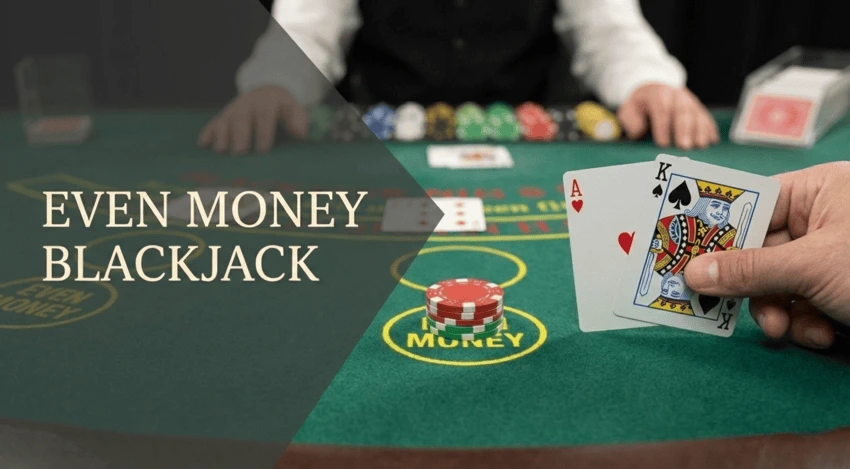
You're holding blackjack, the dealer shows an Ace, and suddenly you're asked to make a decision before the hand even plays out. That's the even money offer.
Even money is what the dealer offers when you've got blackjack (Ace plus a 10-value card), and they're also showing an Ace. If you accept, the casino pays you 1:1 on your bet right away, no matter what card the dealer has face down.
Why does this offer exist? When the dealer shows an Ace, there's a decent chance they're also sitting on blackjack. If that happens, your hand ties with theirs, and you walk away with nothing extra. Even money lets you skip the stress and take your win before the dealer peeks at their hole card.
Here's what you're giving up. A standard blackjack pays 3:2, so a $20 bet returns $30 in profit. Even money pays just $20 on that same wager. You're trading a bigger payday for certainty.
You'll run into this whether you're playing at a land-based or online casino, or at crypto blackjack tables. The rules stay the same everywhere, but dealers might word it a little differently.
Look, seeing both outcomes laid out makes it way clearer why this choice matters. What happens depends on your choice and what the dealer reveals.
The hand ends immediately. You collect a payout equal to your original bet, and play moves on. Whatever card sits face-down becomes irrelevant.
For a $25 wager, you pocket $25 in profit. No suspense, no waiting to see what the dealer flips over. The round simply closes.
Now two paths open up. If the dealer turns over a 10-value card and reveals blackjack, your hand pushes. You keep your original bet but don't win anything extra. It's a tie.
If the dealer doesn't have blackjack, you collect the full 3:2 payout. That same $25 bet now returns $37.50 in profit instead of $25. Play enough hands, and those extra $12.50 payouts start to stack up.
This is where most players feel stuck. The guaranteed win sounds smart, but the math points in a different direction.
Expected value is just what you'd win on average if you made the same choice a hundred times. It's not about any single hand but rather the pattern across dozens or hundreds of hands.
When the dealer shows an Ace, they'll have a 10-value card underneath roughly 30% of the time. That means about 70% of the time, they won't have blackjack.
Say no to even money, and you'll tie about 30% of the time, but collect that fat 3:2 payout the other 70%. Taking even money means you collect 1:1 every single time. Run those numbers across enough hands, and declining produces better results on average.
Basic strategy says to pass on even money every time. It's about making more money over time instead of protecting yourself on one hand.
Players often confuse even money with insurance, and for good reason. They're basically the same bet dressed up differently.
Insurance is a side bet anyone can make when the dealer's showing an Ace. You can wager up to half your original bet that the dealer has blackjack. If they do, insurance pays 2:1. If they don't, you lose the insurance bet and the hand continues normally.
The house edge kills you on insurance, which is why basic strategy says skip it almost always.
Here's the part that surprises people: taking even money gives you the same result as buying insurance when you've got blackjack.
Think through it step by step. When you've got blackjack and buy insurance, here's what happens:
Same result, different packaging. Casinos offer "even money" because it sounds more appealing than "would you like to take insurance?" The house edge is identical either way.
Players make the same mistakes over and over when they don't think this through.
Consistency feels like discipline, but not in this case. If you take even money every time, you're leaving money on the table every single session. The guaranteed payout is smaller than what you'd make on average by saying no.
Technically accurate, but misleading. Yes, you win something. But you're also locking in a smaller win than what you'd get most of the time if you passed. That guarantee? You pay for it.
One hand doesn't matter much. The pattern across dozens or hundreds of hands does. Most casual players only think about the current hand, and that mindset slowly chips away at what they could be winning.
The fix is simple: zoom out. Ask yourself what happens if you face this choice 100 times. Zoom out to your whole session instead of one hand and it makes way more sense.
If you're playing basic strategy, you should pass on it pretty much every time. Card counters might take it when the deck's loaded with 10s, but that's advanced stuff most people won't deal with.
Yes. Most live dealer tables and virtual blackjack games include the even money option when the conditions are met. Crypto blackjack tables follow the same rules you'd find at a physical casino.
In narrow circumstances, yes. When the true count shows the deck's stacked with 10s, the dealer's way more likely to have blackjack, so even money stops being a bad bet. This applies to experienced counters only.
Your hand pushes. You keep your original wager but collect no winnings. The round's over, and your chips stay the same.






.webp)