
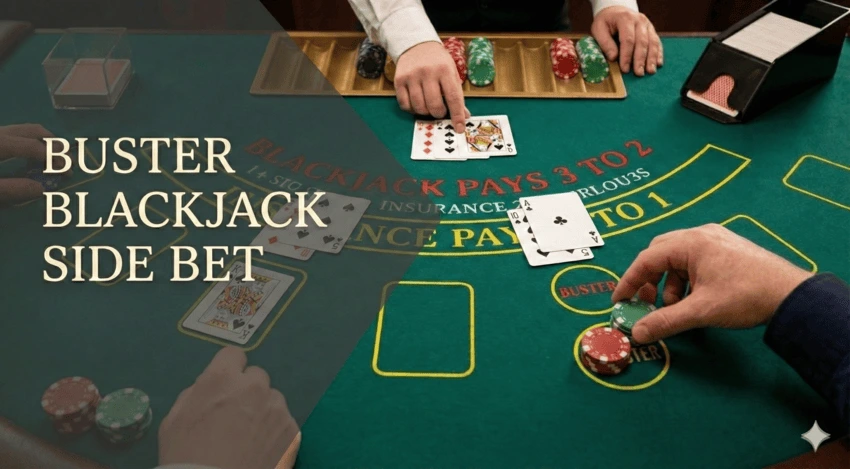
Most blackjack side bets pay based on your own cards. Buster blackjack flips that entirely, rewarding you when the dealer's hand falls apart.
The bet wins whenever the dealer busts, and the payout climbs higher the more cards it takes for the dealer to go over 21. Let's break down how it works, what you'll actually win, and whether it's worth your chips.
Here's how buster blackjack works. You win when the dealer goes over 21. The more cards it takes the dealer to bust, the bigger your payout. Three-card bust? Small payout. Seven or eight cards? That's where things get interesting.
You'll find buster blackjack at many live online blackjack tables. You'll see a separate betting circle for it right next to your main bet. Drop your chips there before the dealer starts dealing. Here's the weird part: your own cards don't matter. You could have 21, you could bust yourself. Doesn't change a thing. You could bust, stand on 20, or hit blackjack, and none of it changes whether your buster bet wins or loses.
The entire result depends on what happens to the dealer. Dealer goes over 21? You win. Dealer stays at 21 or under? Your buster bet's gone, even if you won your main hand.
Drop your buster bet in the marked spot before anyone gets cards. The minimum is usually lower than your main bet, but that changes from casino to casino.
Quick heads-up: you can't bet buster by itself. It's a side bet, which means you need a regular blackjack hand going too.
You get paid when the dealer goes over 21. How much you win depends on how many cards it took:
The logic's pretty simple. Three-card busts happen all the time. Seven or eight cards? That's rare, so the payout jumps way up.
If the dealer stands at 21 or under, your buster bet loses. Your main hand result doesn't touch this bet. You could win your main bet and lose the buster bet in the same round, or vice versa. They're completely separate bets.
In blackjack, certain dealer up-cards are called "bust cards" because they often lead to the dealer exceeding 21. The classic bust cards are 4, 5, and 6.
Why do low cards cause more dealer busts? Low up-card means the dealer's gotta keep hitting to reach 17 (the minimum in most blackjack games). More cards mean more chances to bust. Dealer's got a 6? They bust way more than with a 10, just because they're drawing more cards.
See a 4, 5, or 6 showing? The buster bet starts looking pretty good. And statistically, the dealer does bust more often when showing a 4, 5, or 6.
Here's the catch, though. The buster bet's bigger payouts come from multi-card busts, not just any bust. A dealer showing a 6 who busts with three cards pays the minimum 2:1. Those 50:1 and 250:1 payouts need the dealer to pull a ton of cards, and you can't predict that just from the up-card.
Every casino and game variant pays out differently. Check the pay table first so you know what you're actually playing for.
Most brick-and-mortar casinos and crypto blackjack tables use the standard six-deck pay table. Three-card and four-card busts both pay 2:1. The multiplier climbs from there.
Eight-deck games sometimes drop the 6-card bust to 15:1 instead of 18:1. Seems like a small difference, but it adds up over time.
Evolution's live tables, which are included in the JB crypto casino game portfolio, use a modified structure. Big change: 3-card busts only pay 1:1 instead of 2:1. Three-card busts happen the most, so cutting that payout gives the house a bigger edge than standard tables.
Buster bet's got a bigger house edge than regular blackjack, just like most side bets. Standard blackjack with basic strategy runs around 0.5% house edge. The house edge usually runs a few percentage points higher, but it depends on the exact pay table.
The trade-off is volatility. You're trading worse odds for a shot at those massive 50:1 or 250:1 payouts when the dealer needs a bunch of cards to bust. Love high-variance action? That trade-off might be worth it. Trying to grind small edges? Skip the buster bet.
That Evolution Gaming 1:1 payout on 3-card busts matters more than it might seem. Three-card busts win the most often, so cutting that payout from 2:1 to 1:1 really bumps up the house edge.
Two tables offering "buster blackjack" can have meaningfully different expected returns. A quick look at the pay table tells you exactly what you're getting into.
Soft 17 rules change how often the dealer busts. A "soft 17" is a hand totaling 17 with an ace counted as 11, like ace-6. Dealer hits on soft 17? That's one more card, which means more chances to bust.
Tables where dealers hit soft 17 give you slightly better buster bet odds than stand-on-17 tables. The difference is modest, but it exists.
EZ bust blackjack works almost the same way, just with different payouts. Some versions look at which cards the dealer busted with, not just how many. See both at a casino? Compare the pay tables to figure out which one fits how you play.
21+3 works totally differently. Your first two cards plus the dealer's up-card make a three-card poker hand. Payouts depend on whether you make a flush, straight, three-of-a-kind, or suited trips.
Unlike the buster bet, 21+3 rewards specific card combinations rather than dealer outcomes, making it one of several unique table game side betting options. You know if you won as soon as the dealer finishes the first round.
Perfect pairs wins when your first two cards match. Mixed pair? Lowest payout. Colored pair pays more. Perfect pair (exact match from different decks) pays the most.
This bet resolves instantly and has nothing to do with dealer actions. It's purely about your own initial draw.
Depends what you want out of your session.
Most players who've been around a while throw a few chips on it now and then for fun, not as a main strategy. Dealer shows a bust card? Toss a few chips on it. Won't wreck your session, but it makes things more interesting.










.webp)