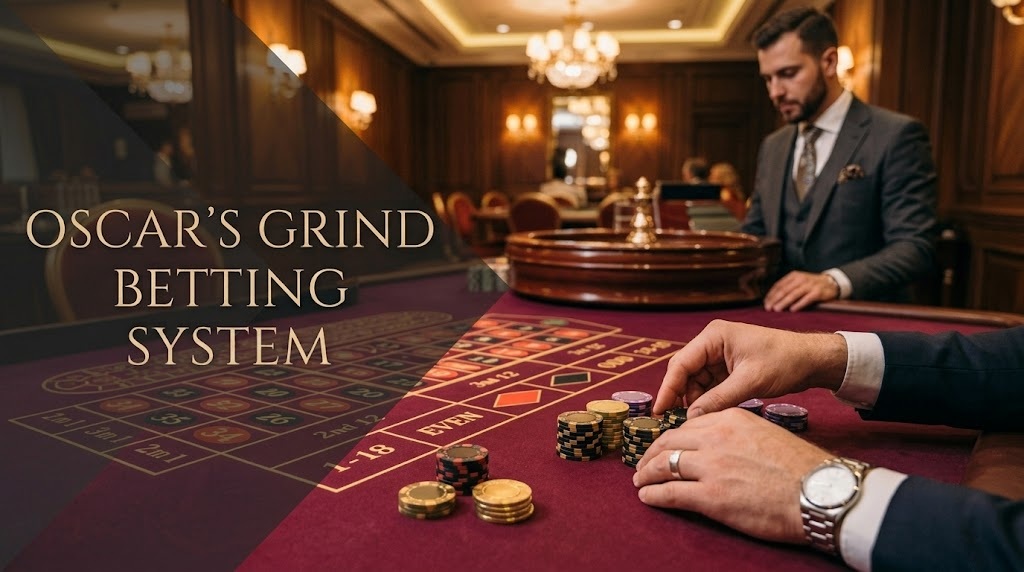
Every other betting system in this series chases a big recovery or a big streak. Oscar's Grind chases one unit. Win one unit of profit, stop the cycle, start over.
That's the entire ambition. And that modesty is exactly what makes it interesting.
Oscar's Grind is a positive progression system with a specific twist. After a loss, your bet stays flat. After a win, your bet goes up by one unit. But there's a catch: you never let the increase push your cycle's profit above +1 unit. If it would, you reduce the bet to whatever amount lands you exactly on the target.
The moment you hit +1 unit profit, the cycle is done. Reset to 1 unit. Start fresh.
First documented by mathematician Allan Wilson in his 1965 book The Casino Gambler's Guide. Wilson was exploring how computers could model casino games when he encountered a craps player known only as "Oscar." Oscar claimed to support himself using this system, quietly outlasting the casino through discipline and tiny targets.
The "Grind" part? That's the slow, patient accumulation of small wins. No fireworks. No dramatic comebacks. Just grinding.
You'll also see it called Hoyle's Press, or in European circles, the Pluscoup Progression. Same system, different names.
Standard disclaimer: this does not change the house edge. No system does.
Step by step. This system is simple, but it has one rule that most guides either miss or explain badly.
The cap rule is the thing that separates Oscar's Grind from a generic "increase after wins" approach. Without it, a winning streak would build the bet beyond what's needed, creating unnecessary risk. With it, every bet is calibrated to land on exactly +1.
Let's make this concrete.
You're betting red/black on a European wheel (48.65% win probability). Your base unit is $10.
Round 9 is where it gets interesting. Normal progression says bet $40 (previous was $30, +1 unit = $40). But winning $40 from a $0 position would put you at +$40. You only need +$10 to complete the cycle. So the cap rule kicks in and you bet $10 instead.
Cycle complete. +$10 profit. Reset.
That's the system working exactly as designed. Four straight losses, a messy middle, and a clean landing on +1 unit.
Two cycles, back to back. This is what actually happens at the table.
Cycle 1 (instant): You bet $10 on your first spin. Win. Cycle complete. +$10. Reset.
This happens roughly 48.65% of the time on European roulette. Nearly half of all cycles end after a single bet. One spin, one unit, done.
Cycle 2 (the grind): You lose four in a row at $10 each. Your bet stays at $10 through every loss. Then you win at $10 (cycle P/L: -$30), increase to $20, win again (cycle P/L: -$10), increase to $30 but the cap rule reduces to $20 because that's all you need. Win. Cycle complete. +$10.
That contrast is the system's signature. Half your cycles are instant 1-unit wins. The other half can stretch over many rounds as you grind back from losses one unit at a time.
The Pflaumer academic paper (2026) found the median session length is roughly 3 spins. But the distribution is heavily right-skewed. Most cycles are short. The occasional long cycle can drag past 20 or 30 rounds. That skew matters, and we'll get to why.
This is the mechanic that makes Oscar's Grind structurally different from every other system in this series. Most articles don't explain why it matters. Here's why.
In Martingale, D'Alembert, Fibonacci, and Labouchere, losses trigger an increase in bet size. That's the defining trait of negative progression. Oscar's Grind breaks the pattern completely. Losses change nothing. You keep betting the same amount.
The practical result: during a losing streak, your total loss grows linearly (1 unit per round). Not exponentially (Martingale). Not quasi-exponentially (Fibonacci).
After 10 consecutive losses with Oscar's Grind, you've lost 10 units and your next bet is still 1 unit. Under Martingale, you've lost 1,023 units and your next bet is 1,024.
Here's the full picture:
After 20 losses, Oscar's Grind has you betting 1 unit with 20 units lost. Martingale has you betting over a million. That table is the entire safety argument in one glance.
The trade-off: recovery is slow. After 10 losses, you need to climb back 10 units to close the cycle. Each win increases the bet by 1, so your winning bets go 1, 2, 3, 4... The profit from those wins grows: +1, +2, +3, +4 = +10 after four consecutive wins. But if wins and losses alternate, recovery stalls. The system needs clustered wins to close cycles efficiently.
This is the system's primary risk, and most guides skip it entirely.
Oscar's Grind has no built-in exit for losing cycles. The cycle continues until you reach +1 or until you decide to walk away. No mechanism says "after 30 rounds, give up and reset."
In practice, a cycle can get stuck. You lose 15 units during a rough stretch. Then you start winning, but wins and losses alternate. Each win adds 1 unit of bet size, so you're recovering slowly. Each loss resets progress within the recovery. The cycle drags on, never reaching +1, never triggering a clean stop.
Simulations confirm this. A Roulette77 simulation showed one player's bankroll dropping significantly during a stalled cycle that started around round 194 and extended for dozens of additional rounds before resolution.
The Pflaumer academic paper (2026) found extreme losses down to -296 units in long cycles. Median session: 3 spins. Worst-case tail: way, way beyond that. The distribution is not kind at the extremes.
Practical fix: Set a personal bail-out rule. If a cycle hasn't completed after 30 to 40 rounds, or if your cycle loss exceeds 20 to 25 units, abandon it. Accept the loss. Start fresh. This is not part of the original rules. But without it, a single stalled cycle can quietly consume your session bankroll while you sit there thinking "just a few more spins."
The Wizard of Odds ran Oscar's Grind through 37 to 45 billion simulated sessions. Not thousands. Billions. The data is about as robust as you'll find for any betting system.
The test structure: win goal of 10 units (meaning 10 completed cycles at +1 each), tested across different bankroll levels. Using the baccarat Player bet (1.235% house edge):
Those numbers sound incredible. And they are real. But there's a counterintuitive finding buried in the data.
Higher bankroll improves win probability per session but increases expected loss per session.
With a 10-unit bankroll, the expected loss is about -0.082 units per session. With a 250-unit bankroll, it jumps to about -0.354 units.
Why? A larger bankroll lets you survive longer sessions. Longer sessions mean more bets placed. More bets mean more total money exposed to the house edge. The system recovers from deeper holes, yes. But recovery requires more rounds, and each round costs a fraction of the house edge.
The Wizard's conclusion: "Like most betting systems, it usually results in a small win, at the cost of huge losses sometimes."
No free lunch. Just a well-designed system that distributes risk differently than others.
Both get called "conservative." The resemblance is mostly surface level.
Direction of bet increases. D'Alembert increases bets after losses. Oscar's Grind increases after wins. That's a structural difference, not a cosmetic one.
When your biggest bets happen. D'Alembert's largest bets hit during losing streaks, when your bankroll is most vulnerable. Oscar's Grind's largest bets hit during winning streaks, when your bankroll is strongest. This is the core safety argument for Oscar's Grind.
Recovery mechanic. D'Alembert recovers by winning at higher stakes. Oscar's Grind recovers through accumulated small wins after a flat-bet holding pattern.
Shared traits. Both target small, incremental profits. Both are gentler than Martingale or Fibonacci. Both feel disciplined at the table.
One more thing. The Wizard of Odds notes that flat betting 1 unit will actually last longer than Oscar's Grind starting at 1 unit. Oscar's Grind exposes more total money to the house edge because of the increasing bets after wins. The same critique applies to D'Alembert, which exposes more via increasing bets after losses. Neither system extends your bankroll further than just betting flat. They redistribute risk. That's it.
Crypto roulette: The natural home. Even-money bets, clean win/loss outcomes. European (2.70% edge) strongly preferred over American (5.26%). French with La Partage (1.35%) is ideal. The Pflaumer paper simulated La Partage and found improved outcomes. If you're playing crypto roulette at JB, stick to European or French wheels.
Crypto baccarat: Player bet (1.24%). Clean even-money action, lowest house edge of the bunch. The Wizard of Odds simulations used baccarat for a reason.
Crypto blackjack: Awkward fit. Variable payouts from blackjack naturals, splits, and doubles disrupt the clean +1/-1 unit tracking. Wilson's book explored it for blackjack, and some players adapt by treating each hand as a simple win/loss. It works, but the cap rule gets messy with 3:2 payouts.
Let's be honest with this one, because it deserves honesty.
What it does well: Oscar's Grind is the most conservative widely known betting system. It never increases bets during losing streaks. It caps profits to prevent overshooting. It produces a high percentage of winning sessions (90 to 99% depending on bankroll). It feels safe, structured, and disciplined.
For players whose biggest problem is emotional decision-making during losing streaks, Oscar's Grind solves that problem completely. Your bet doesn't change when you're losing. There's nothing to chase. Nothing to panic about. You just wait.
What it does not do: Beat the house edge. The Pflaumer academic paper (2026) confirmed what the Wizard of Odds simulations showed: "Oscar's Grind provides psychological appeal but no mathematical advantage." Expected loss over time equals total money wagered multiplied by the house edge. Same as every other system. Same as flat betting. Same as anything.
The honest framing: Oscar's Grind is the closest thing to financial tai chi in the betting systems world. Low impact, high control. It won't make you rich. It won't beat the casino. But it will keep your bets small during the worst stretches, give you a clear target per cycle, and produce a satisfying stream of small wins.
If what you want from a betting system is structure, discipline, and the longest possible runway for your bankroll at the table, Oscar's Grind is arguably the strongest option available.
Just set a bail-out rule for stalled cycles. The original system doesn't have one, and it needs one.