Teen Patti

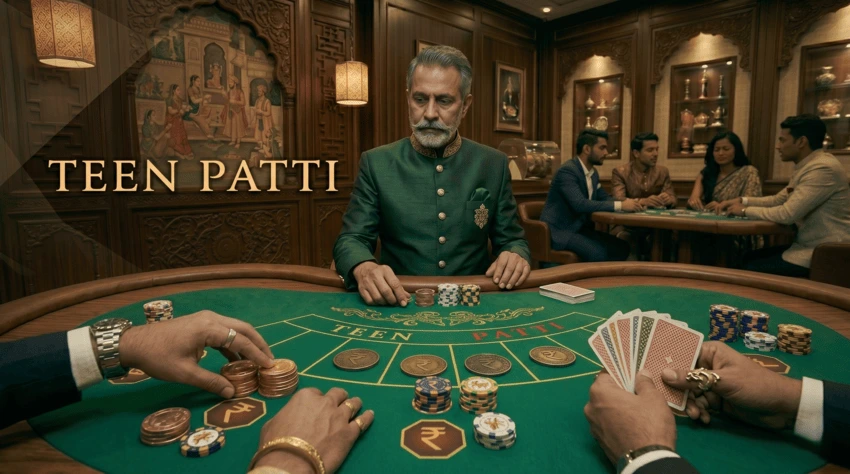
Three cards. One pot. A game that's been running through Indian culture for generations and now lives in crypto casinos worldwide. Here's everything you need to play smart.
What is Teen Patti?
Teen Patti means "three cards" in Hindi. You might hear it called 3 Patti, Indian Poker, or Flush, depending on who's dealing.
The setup is dead simple. Standard 52-card deck, no jokers, three to six players. Everyone gets three cards. Best hand wins the pot.
The game traces its DNA back to Three Card Brag, a British card game that itself came from Primero, a 16th-century European game. But Teen Patti became its own thing entirely. It's been played across India for generations, everywhere from living rooms to rooftops to high-stakes private rooms.
And the cultural roots run deep. During Diwali, Teen Patti isn't just a card game. It's a social ritual. Families sit together, play for small stakes, eat too much food, and keep dealing until someone's luck turns. The mythology connects gambling during Diwali to Lord Shiva and Parvati playing dice. Weddings, Holi, and other festivals carry the same tradition.
Two formats exist today, and they play very differently:
- Traditional (peer-to-peer): Players compete against each other. Bluffing is the engine of the game. This is the original.
- Casino version (player vs. dealer): No bluffing, no reads, no sideshow. You get three cards, the dealer gets three cards, best hand wins. Closer to Three Card Poker than the home game.
Both share the same hand rankings. But comparing them is like comparing pickup basketball to watching an NBA game. Same ball, different experience.
The online explosion has been massive. Evolution Gaming, Playtech, and several other providers now run live dealer Teen Patti tables. Mobile apps like Teen Patti Gold pull millions of daily players. And crypto casinos have picked up the game hard. If you're playing Teen Patti online with Bitcoin or any other crypto, you'll find both formats available.
How to play Teen Patti (traditional rules)
This is the original game. The one people actually grew up playing. If you only learn one version, make it this one.
Setup and boot
- Three to six players sit around a table
- Everyone agrees on a boot amount (the minimum ante) before cards are dealt
- Each player puts the boot into the pot
- The dealer gives three cards face down to each player, one at a time
- Nobody has to look at their cards right away
That last part matters. A lot.
Blind vs. seen
This is the mechanic that makes Teen Patti its own game. Nothing else in card games works quite like this.
Blind player: Doesn't look at their cards. Bets at the current stake or up to double it. Playing blind is cheaper per round.
Seen player: Looks at their cards. Must bet at least double the current stake (up to 4x). Information costs money.
You can switch from blind to seen at any time by peeking at your cards. But once you've looked, you can't go back.
Here's where the psychology kicks in. A blind player betting with confidence, round after round, without even glancing at their cards? That rattles seen players holding mediocre hands. You're paying less and projecting strength. It's a power move disguised as recklessness.
Experienced players stay blind for several rounds on purpose. It's a strategy, not a gamble.
Betting rounds
- Play moves clockwise from the dealer
- Each turn, you can: bet (call or raise), fold, or request a sideshow
- Rounds keep going until one player remains (they take the pot) or two players are left and someone calls for a show
- There's no cap on how many rounds the betting goes. Pots can balloon fast
Sideshow
This mechanic doesn't exist in standard poker, and it adds a tactical layer that changes how eliminations work.
- Only available to seen players
- You can request a sideshow with the player who bet right before you
- That player can accept or refuse. No penalty for refusing
- If accepted, both players compare cards privately. Lower hand folds immediately
- If refused, play continues like normal
Think of a sideshow as a private duel. You're trying to knock out one opponent without risking a full showdown with the table.
Show (showdown)
- Happens only when exactly two players remain
- If both are seen, either can pay for a show (costs equal to the current stake)
- If one is blind and one is seen, only the blind player can request the show. The seen player can't force it
- If both are blind, either can request a show at the blind bet amount
- Both players reveal cards. Higher hand wins the pot
One rule that catches people off guard: if both hands are identical in ranking, the player who didn't request the show wins. This discourages fishing for unnecessary showdowns.
Hand rankings
Six hand types, highest to lowest. Memorize these before you sit down.
Ranking quirks you need to know:
- A-2-3 is the highest sequence and pure sequence. Not the lowest. This trips up a lot of new players
- A-K-Q is the second-highest sequence
- When comparing pairs, the pair rank matters first, then the kicker card
- When comparing high card hands, check the highest card first, then the second, then the third
- Standard card order applies within each hand type (Ace high down to 2 low)
How the online casino version works
The casino version strips out everything that makes the traditional game psychological. No bluffing. No blind-or-seen decision. No sideshows. No reading your opponent's hesitation.
What's left is a clean comparison game: your three cards against the dealer's three cards. Best hand wins. The structure mirrors Three Card Poker closely, which is exactly why crypto casinos adopted it so easily.
Ante and play bets
- Place an Ante bet
- Both you and the dealer receive three cards
- Look at your hand. Decide: Play (match the Ante with an equal bet) or Fold (lose the Ante)
- If you play, both hands are revealed. The higher hand wins both Ante and Play bets at even money
- Some versions pay a bonus on the Ante for premium hands (Trail, Pure Sequence) regardless of what the dealer holds
That's the whole decision tree. One choice per round. Play or fold.
Side bets
Side bets bring back some of the excitement that the simplified format loses.
Pair Plus: Pays based on your hand quality alone. The dealer's cards don't matter. Pair or better wins. Typical payouts:
- Pair: 1:1
- Color (Flush): 4:1
- Sequence: 6:1
- Pure Sequence: 30:1
- Trail: 100:1
(Exact payouts vary by provider. Always check the pay table before placing this bet.)
Six Card Bonus: Combines your three cards and the dealer's three cards to form the best possible five-card poker hand. Pays on Three of a Kind or better, with payouts reaching up to 1,000:1 for a Royal Flush.
The trade-off with side bets: they're fun and can hit hard, but the house edge runs higher than the base game. Treat them as a bonus action, not your main play.
Teen Patti odds and house edge
Let's put real numbers on the table.
Casino version (Ante + Play):
- House edge sits around 3–5%, depending on specific rules and pay tables
- Comparable to Three Card Poker
Pair Plus side bet:
- House edge ranges from 2% to 8%, depending on the pay table
- Massive variance between providers. A generous pay table makes this worth a look. A stingy one eats your stack
Six Card Bonus:
- House edge runs 5–15% depending on payouts
- Higher risk, bigger swings
Traditional peer-to-peer game:
- No house edge. Zero. The skill gap between players determines who profits over time, same as poker
For context, here's how the casino version stacks up against other table games you'll find at crypto casinos:
The base game isn't bad. Side bets inflate the overall cost if you play them every hand.
Teen Patti strategy
Traditional game strategy
This is where the game gets genuinely deep.
- Blind play is a weapon. Staying blind costs less per round and puts psychological pressure on seen players. Don't think of it as gambling blind. Think of it as buying information cheaply while making everyone else pay more for theirs
- Fold early with garbage. You don't need to contest every pot. Folding weak cards preserves your stack for rounds where you actually have something
- Use sideshows to eliminate, not to gamble. Request a sideshow when you have a decent but not great hand and want to remove one opponent without a full showdown
- Watch betting patterns. A player who's been calling quietly for five rounds and suddenly raises? They either caught something strong or they're bluffing that they did. Either way, that shift means something
- Don't be predictable. If you always fold weak and raise strong, the table will read you within 20 minutes. Mix it up
- Respect the pot size. When the pot grows past what your hand justifies chasing, walk away from that round. Discipline beats bravery here
Casino version strategy
Much simpler since there's only one decision per hand.
- Play with Queen-high or better. Fold below that. This mirrors the optimal strategy for Three Card Poker and works for the same mathematical reasons
- Pair Plus can be played independently in some versions. If the pay table is generous (check the Trail payout especially), it's a reasonable side bet
- Side bets are entertainment. The house edge climbs fast. Play them for fun, not as a bankroll strategy
- There's no skill edge in the casino version. No bluffing, no reads, no opponent psychology. It's nearly pure chance filtered through one play-or-fold decision. Accept that going in
Popular Teen Patti variations
The base game spawns dozens of variants. These are the ones you'll actually encounter.
AK47
All Aces, Kings, 4s, and 7s become wild cards. Any wild card substitutes for any other card to complete a hand.
The effect is dramatic. Trails and Pure Sequences show up constantly. A hand that would be mediocre in standard Teen Patti suddenly becomes a monster. Strategy shifts toward aggression since strong hands are everywhere. The most popular variant in casual play by a wide margin.
Muflis (Lowball)
Hand rankings flip completely. The worst hand wins. A High Card hand beats a Trail.
Every instinct you've built playing standard Teen Patti becomes wrong. Getting dealt three unconnected low cards? Congratulations, you're sitting on gold. The psychological reversal makes this one of the most entertaining variants, especially when someone forgets the rules mid-hand and celebrates a Trail.
Joker (Random Wild)
Before each round, the dealer selects one or more random cards as wild. Every card of that rank becomes wild for that hand.
The wildcard changes every round, so you can't build a long-term read on which hands are boosted. Adds chaos without completely rewriting the game like AK47 does.
Best of four
Each player receives four cards instead of three. Pick your best three-card combination and discard one.
This adds a genuine skill element. Quickly identifying the optimal three-card hand from four cards separates strong players from average ones. Similar to the split decision in Pai Gow Poker. If you like decision-heavy card games, this variant rewards that.
999
A point-based variant where the goal is getting as close to 9-9-9 as possible. Face cards count as 0, Aces as 1, number cards at face value.
This feels more like baccarat than poker. The scoring system creates a completely different game where card combinations that mean nothing in standard Teen Patti suddenly become the best possible hand.
Discard one
Players receive three cards, discard one, and draw a replacement.
The draw element introduces a second decision point. You're not stuck with what you're dealt. Reduces the luck factor slightly and rewards players who can evaluate their hand's potential after the swap.
Teen Patti vs. Three Card Poker
If you've played Three Card Poker at a crypto casino, the comparison helps frame what Teen Patti brings to the table.
The casino versions of both games are nearly identical in structure. Ante, play-or-fold, compare hands.
The traditional version of Teen Patti is a different animal. The blind/seen dynamic, sideshows, and multi-round psychological warfare give it a depth that the casino format can't replicate. If you're drawn to Teen Patti specifically because of its reputation, the traditional version is what earned that reputation.
Teen Patti and Indian culture
The game carries weight beyond its mechanics.
Teen Patti is played across every economic class in India. Street-side games with tiny stakes. Family gatherings where the buy-in is a handful of coins. Private high-stakes rooms in cities. The game fits everywhere because the rules travel light and the social element is the point.
Diwali celebrations are the peak. Families gather, cards come out, and the evening runs until someone's luck or patience gives out. It's bonding disguised as gambling. Or gambling disguised as bonding. Depends on the family.
Bollywood picked it up too. The 2010 film "Teen Patti" starred Amitabh Bachchan and Ben Kingsley, weaving probability theory and card game drama together. The game pops up across Indian pop culture in ways that Western audiences might compare to how poker saturates American media.
Mobile gaming accelerated everything. Teen Patti Gold and similar apps became some of the most downloaded games in India, pulling millions of daily users. The jump from festival card game to mobile app to live dealer crypto casino table happened faster than most people expected.
That shift represents something bigger. A game rooted in family tradition now lives on blockchain-powered platforms where payouts settle in minutes and fairness is provably verifiable. The cultural DNA stays the same even as the delivery changes completely.
Tips for new players
Starting out? Play the casino version first. It teaches hand rankings without the pressure of reading opponents or managing blind/seen decisions. You'll internalize what beats what in a few sessions.
Ready for the real game? Move to the traditional version. The blind/seen mechanic is what separates Teen Patti from every other card game. Don't skip it.
Respect blind play. Staying blind isn't amateur hour. It's a legitimate, time-tested tactic that experienced players use deliberately. If someone at your table stays blind for five rounds, don't assume they're clueless.
Casino version decision-making is straightforward. Play with Queen-high or better. Fold below that. That's the whole strategy.
Budget each session. In the traditional game, pots escalate with no cap. In the casino version, side bets stack up quietly. Know your number before you sit down.
Learn AK47 and Muflis early. These two variations come up the most often and change the strategy significantly. AK47 makes everyone aggressive. Muflis makes everyone confused (in a good way).
Compare pay tables. If you're choosing between live dealer Teen Patti providers at a crypto casino, check the side bet payouts. The same Pair Plus bet can have a 3% house edge at one table and 7% at another. That gap adds up across hundreds of hands.