Andar Bahar

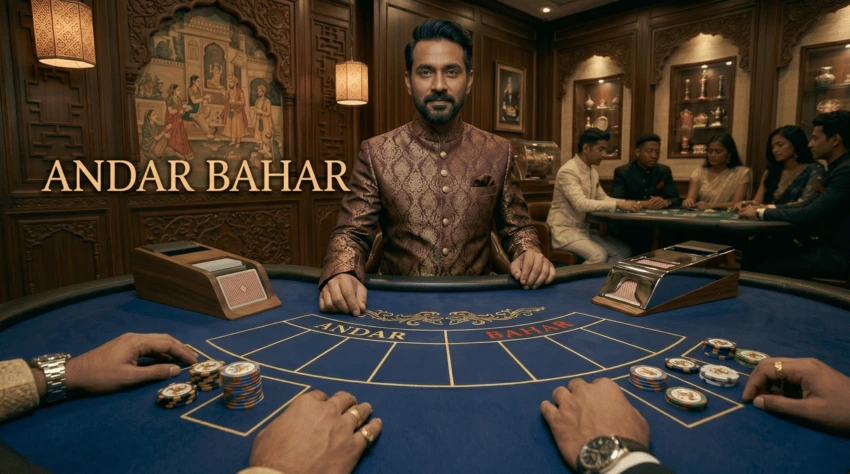
One card in the middle. Two sides. Pick the right one. That's the entire game.
Andar Bahar is one of the fastest, simplest card games you'll find at any live dealer table. It takes about 10 seconds to learn and roughly 15 seconds to play a round. No hitting, no splitting, no drawing extra cards, no poker face required.
But simple doesn't mean there's nothing to know. Most guides online get the odds wrong, confuse it with a completely different game, and skip the one piece of information that actually saves you money: the pay table.
This guide fixes all of that. Rules, real math, side bets, strategy (yes, there is some), and why that "also known as Katti" line you keep seeing is flat-out incorrect.
What is Andar Bahar?
Andar Bahar is one of India's oldest card games. One standard 52-card deck. One card placed face up in the center (called the middle card, house card, or joker card, though no actual joker cards are involved). The dealer then deals cards one at a time, alternating between two sides: Andar (inside/left) and Bahar (outside/right).
Your job: bet on which side gets a card matching the rank of the middle card first. Suit doesn't matter. Only rank.
That's it. No decisions after the bet. No second actions. Pure prediction.
The name comes from Hindi. Andar means inside. Bahar means outside. In Tamil (likely the game's original language), it's called Ullae Veliyae, which translates to the same thing. The game originated in Bangalore (Bengaluru), Karnataka, in southern India. It's been played for centuries at family gatherings, festivals, street games, and informal gambling dens across the country.
Now it sits in live dealer lobbies from Evolution Gaming, Ezugi, Tada, and other providers. If you play table games at a crypto casino, you've probably scrolled past it. Time to stop scrolling.
Andar Bahar is not Katti
This needs to be said directly because nearly every competing article on the internet gets it wrong.
You'll see the phrase "Andar Bahar, also known as Katti" repeated across dozens of guides. It's incorrect. Katti and Andar Bahar are related games from the same region. They share a resolution mechanic (dealing cards to two sides until a match appears). But they have a structural difference that changes the game:
- Andar Bahar: One card is dealt face up as the middle card. Dealing begins immediately to Andar and Bahar. Players bet on which side gets the match.
- Katti: 13 cards are dealt face up in the center at the start. Players choose one of those 13 cards as the target card, then the game proceeds. That selection step adds a decision layer Andar Bahar doesn't have.
Pagat.com, one of the most authoritative card game reference sites on the internet, explicitly separates the two games. Evolution Gaming's own documentation distinguishes them.
The confusion likely spread because both games come from South India and resolve in a similar way. But that's like calling Texas Hold'em and Omaha the same game because both use community cards.
If an article opens with "Andar Bahar, also known as Katti," it's already started with an error. Now you know what to look for.
How to play Andar Bahar
Here's the full walkthrough, step by step.
The middle card
A single card is drawn from the deck and placed face up in the center of the table. The rank of this card is the target. Every card dealt after this point is trying to match it. Suit is irrelevant for the main bet.
Quick note on naming: some providers call this the "game card" or "joker card." It has nothing to do with actual jokers. Jokers aren't in the deck.
Placing bets
Before dealing starts, you choose a side:
- Andar (inside)
- Bahar (outside)
Some tables also offer side bets on the middle card's properties (value, suit, color, over/under 7) and on the number of cards dealt before a match appears. More on those later.
Once betting closes, the dealer starts dealing.
The deal
Cards go face up, one at a time, alternating between Andar and Bahar. Which side gets the first card depends on the version you're playing:
- Some versions always start dealing with Andar
- Some versions start dealing to the same color side as the middle card (red middle card = first card goes to the red-designated side)
This detail matters mathematically. The side that receives the first card has a probability advantage. We'll break that down in the next section.
Dealing continues until a card matching the rank of the middle card appears on either side. That side wins. Bets are settled. Round over.
Quick example: The middle card is the 8 of hearts. Dealer deals: Andar gets a 3, Bahar gets a King, Andar gets a Jack, Bahar gets a 2, Andar gets an 8 of clubs. Match found on Andar. Andar bets win.
The median number of cards dealt before a match lands is roughly 11 (not counting the middle card). Most rounds wrap up in under 30 seconds.
Why Andar wins more often
Most Andar Bahar articles either skip this or state it without explaining why. Here's the actual math, kept clean.
The side that receives the first card after the middle card always has a slight probability edge. At every point during the deal, that side has had one more card dealt to it than the other side. One extra chance to contain the match. Over thousands of rounds, that compounds into a real, measurable advantage.
The numbers:
- First-card side win probability: ~51.5%
- Second-card side win probability: ~48.5%
Not a huge gap. But it's consistent and it's real.
Casinos know this. To compensate, they pay the first-card side at slightly less than even money (typically 0.9:1 or 0.95:1) while the second-card side pays at 0.95:1 or sometimes full 1:1.
The result: the house edge on the first-card side (usually Andar) sits at roughly 2.15%. The house edge on the second-card side (usually Bahar) ranges from 3% to 5.43%, depending on the payout structure.
The single most important strategic decision in Andar Bahar: always bet the side that receives the first card.
Payouts and house edge
This is where the article gets genuinely useful, because this is the information most guides ignore entirely.
Andar Bahar payouts are not standardized. Different providers set different pay tables, and the differences have a real impact on how much the game costs you per bet.
Common payout structures
Note: exact house edge shifts slightly depending on which side gets the first card and how the starting side is determined (always Andar vs. based on middle card color). Always check before you play.
Why this matters
At a table paying 0.95:1 on both sides, betting Bahar carries a 5.43% house edge. That's worse than American roulette (5.26%). Same game name, same round structure, significantly worse deal for the player.
At a table paying 1:1 on Bahar, the same bet carries only 3%.
Two minutes checking the pay table before your first bet saves real money over any session. This is the most impactful thing you can do as an Andar Bahar player. Full stop.
Side bets
Live dealer versions typically offer two categories of side bets.
Middle card bets (pre-deal)
These are placed before the middle card is revealed. You're betting on its properties:
- Color (Red/Black): Pays 1:1. House edge ~3.85%
- Suit: Pays 3:1. House edge ~3.85%
- Value (Over/Under 7): Pays 1:1. Loses on exactly 7. House edge ~7.69%. The 7 acts as a dead card that kills your bet regardless of which side you picked. Think of it like the zero on a roulette wheel, except worse.
- Exact Value: Pays up to 12:1. House edge varies by number.
Number of cards dealt (count bets)
Bets on how many cards hit the table before the match appears. Usually grouped into ranges:
- 1-5 cards: lower payout, higher probability
- 6-10 cards
- 11-15 cards
- 16-25 cards
- 26-30 cards
- 31-40 cards
- 41-49 cards: highest payout (up to 120:1), lowest probability
House edges on these range bets vary wildly. The extreme ranges (1-5 and 41-49) tend to carry the steepest edges. These are entertainment bets for players who want more action per round. They're not strategic wagers.
Can you count cards in Andar Bahar?
Short answer: In theory, yes. In practice, it doesn't help.
The longer version: Andar Bahar uses a single deck dealt without reshuffling during a round. As cards land on both sides, the remaining deck composition changes. If the middle card is an 8, there are three remaining 8s in the deck. As non-8 cards get dealt, the probability that the next card is an 8 ticks upward. If two of the three remaining 8s have already appeared on one specific side, the last 8 is guaranteed to land somewhere, and you could theoretically gain information from that.
Here's why none of this translates to an actual edge:
- You make one betting decision, and it happens before any cards are dealt (in most versions)
- Online live dealer versions shuffle after every round, so cross-round tracking is impossible
- No casino offers mid-round betting on the main Andar/Bahar wager
- Rounds are too fast and the information too thin to build any meaningful system
Card counting in Andar Bahar is a theoretical curiosity, nothing more. Blackjack gives a counter enough runway across multiple rounds with a gradually depleting shoe. Andar Bahar deals from a fresh deck, resolves in seconds, and offers no mid-round decisions. The runway isn't there.
Andar Bahar strategy
Let's be honest: this game is almost entirely luck-based. But "almost" leaves room for a few real edges.
Always bet the first-card side
The only mathematically grounded strategy in the game. Whichever side receives the first dealt card has a ~51.5% win probability. In most versions, that's Andar. In some versions, it depends on the middle card's color. Check the rules of the specific table you're playing.
This one move reduces the house edge by 1-3% compared to always betting the other side. Over a session, that gap adds up.
Check the pay table before playing
Worth repeating because it's the most actionable advice in this entire guide. The difference between 0.9:1 and 0.95:1 on Andar, or between 0.95:1 and 1:1 on Bahar, can double the house edge on the exact same bet. Two minutes of reading saves real money.
Skip the value side bets
The over/under 7 bet carries a 7.69% house edge thanks to the dead 7. Exact value bets aren't much better. The main Andar/Bahar wager at a good table gives you a 2.15% edge against you. Why voluntarily triple that?
Betting systems
Martingale, Paroli, and similar progression systems work mechanically on Andar Bahar's near 50/50 split. They can structure a session and give it a rhythm. They don't change the house edge.
The usual warnings apply: Martingale escalates losses dangerously during losing streaks, and table limits will cap the system before it can recover. If you use a system, treat it as session management, not as a path to profit.
Super Andar Bahar and other variations
Super Andar Bahar (Evolution Gaming)
Evolution's enhanced version bolts multiplier mechanics onto the base game. Random multipliers are assigned to Andar and Bahar positions each round. When the matching card lands on a multiplied position, the payout jumps.
The trade-off: base payouts are reduced to fund those multipliers. This is the same design philosophy behind Lightning Baccarat and Lightning Roulette. You get bigger potential wins but more variance per round. Exciting if you have the bankroll for swings. Less ideal for grinding at low stakes.
Live dealer standard versions
Providers like Ezugi and Tada run the classic format. Real dealers, clean interfaces, straightforward pay tables. These tend to offer the lowest house edge without multiplier volatility baked in. If you're playing Andar Bahar with crypto and want the cleanest math, start here.
RNG versions
Faster than live dealer. Lower minimums. No social element. RNG versions use certified random number generators and shuffle after every round. Good for learning the game's flow before moving to live tables. The math is identical; the experience is just less engaging.
Andar Bahar vs. Teen Patti
Both are Indian games. Both show up in the same casino lobbies. They serve completely different player needs.
Andar Bahar is the game you pick when you want zero decisions, fast results, and low complexity. Teen Patti (3 Patti) is the game you pick when you want social interaction, bluffing, and a deeper experience. Both sit at the center of Indian gambling culture. They just scratch different itches.
Andar Bahar in Indian culture
Andar Bahar isn't just a casino product. It carries real cultural weight.
The game has been played across all classes in India for centuries. Roadside sessions with coins or tamarind seeds as stakes. High-stakes private rooms. Kids play it without money at family gatherings during festivals. Its extreme simplicity made it accessible to everyone, regardless of education or background.
Street gambling with Andar Bahar was historically run by local operators, sometimes with underworld connections. Andar Bahar cheating devices are still sold openly in parts of India. That's part of the game's raw, unpolished identity. It didn't come from a sanitized casino floor.
The cards themselves have history. Andar Bahar was originally played with Krida-Patram, cloth pieces decorated with motifs from the Mahabharata and Ramayana. Two design traditions that eventually evolved into the four suits we recognize today. Long before Western playing cards reached India, these games were already running.
On legal status: gambling in India is a state matter. Land-based casinos operate legally only in Goa, Daman, and Sikkim. Online play through offshore-hosted casinos, including crypto casinos, occupies a legal gray area. Most Indian players access Andar Bahar through online platforms.
The name itself traces the game's journey. Ullae Veliyae in Tamil (the original). Andar Bahar in Hindi (the name that went national and then global through online casino lobbies). Same game, different languages, same two-sided bet that's been running for generations.
Tips for new players
- Always bet on the side that receives the first card. This is the only strategic edge available to you in the main game.
- Check the payout table before your first bet. Provider differences can double your house edge without you realizing it.
- Ignore pattern tracking. Scoreboards showing recent Andar/Bahar results have zero predictive value. Each round uses a freshly shuffled deck.
- Skip the over/under 7 side bet. A 7.69% house edge is significantly worse than the main game's 2.15%.
- Start with standard live dealer versions (Ezugi, Tada) to learn the flow. Try Super Andar Bahar later if you want the multiplier variance.
- Set a session budget. Rounds take 15-30 seconds. You can burn through bets much faster than at blackjack or baccarat. Plan for the speed.
- If someone tells you Andar Bahar is the same as Katti, they're wrong. Now you know why.