Pachinko

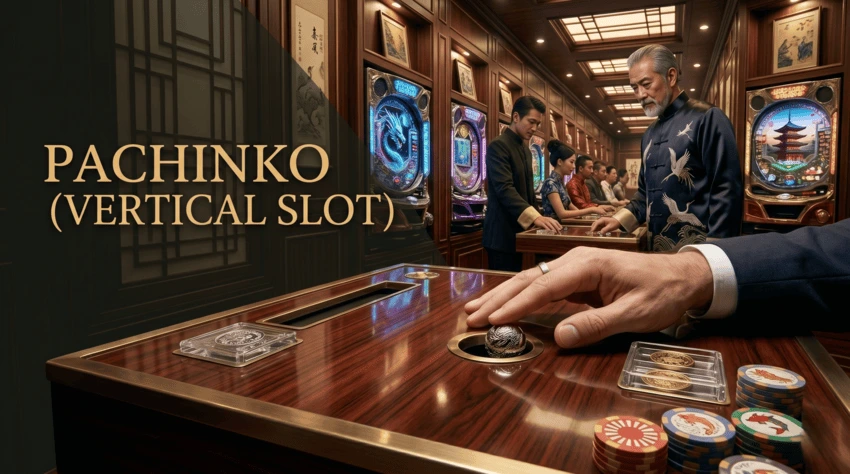
Japan's noisiest obsession pulls in more money than Las Vegas, Macau, and Singapore combined. Here's how the machines actually work, why the cash exchange system is a legal masterpiece, and how to play the online version at JB.
What is Pachinko?
Pachinko is Japan's most popular form of legal gambling. Except Japan doesn't call it gambling. Officially, it's "amusement." The legal gymnastics behind that classification are worth a whole section on their own, and we'll get there.
The name is onomatopoeia. "Pachin" mimics the sound steel balls make bouncing off brass pins. That's basically the game: small steel balls (about 11mm each) launched into a vertical playing field, ricocheting through hundreds of pins, trying to land in specific pockets that trigger jackpots and spit out more balls.
Vertical pinball meets slot machine, dressed up in anime graphics and played at volumes that'll make your ears ring.
Players collect balls. Balls become prizes. Prizes become cash through a loophole that's kept the whole industry humming for decades. We'll break down that system too.
The scale is hard to process. Around 7,655 parlors still operate across Japan as of 2024. Revenue at its peak hit roughly 35 trillion yen, about $300 billion, back in 2005. One game. One country. More than the combined casino revenue of Vegas, Macau, and Singapore.
Not a typo.
A brief history of Pachinko
The game didn't start in Japan.
Its ancestor was a 1920s American children's toy called Corinthian Bagatelle. A tabletop thing where you flicked marbles through pins. That toy landed in Nagoya and got reworked for adult play. The first commercial Pachinko parlor opened there in 1948, right in the thick of post-war reconstruction.
The timing was perfect. Japan was rebuilding. People needed cheap thrills. Pachinko fit the bill.
Through the 1950s and 70s, parlors spread everywhere. Affordable, accessible, deeply habit-forming. When Japan's economic boom kicked into gear in the 1980s, Pachinko revenue started rivaling the country's automobile exports. Let that one sit for a second.
Peak Pachinko hit in the mid-1990s to early 2000s. Nearly 30 million players. Over 18,000 parlors. Revenue touching roughly 7% of Japan's entire GDP. Staggering numbers for a game most of the world had never heard of.
The Korean-Japanese community built much of this industry from scratch. Many parlor owners came from that community, and the cultural thread runs deep. Far deeper than the machines.
Things have cooled since. Player count dropped to about 7.2 million by 2021. Aging demographics, tighter government regulations, smoking restrictions, smartphones eating into leisure time. The parlor count has been cut by more than half.
If you've heard "Pachinko" recently, it's probably from the Apple TV series based on Min Jin Lee's novel. That show is about Korean-Japanese identity across generations, not the game itself. But it put the word on a global stage.
How a Pachinko machine works
The machine
Imagine a vertical playing field behind glass, about the size of a large monitor. Hundreds of brass pins cover the surface. Scattered among them: special pockets, gates, and entry points called 入賞口 (start chasers).
Modern machines have a digital LCD screen right in the center. That's where animated bonus sequences play out during jackpot rounds. We're talking full anime cutscenes, character battles, dramatic countdowns.
Bottom of the machine: a ball tray. Lower right: a launch knob. That knob is your only real input.
Every machine has a theme. Evangelion. Fist of the North Star. Re:Zero. Movie tie-ins. Pop culture IPs with production values that rival actual video games.
Playing the game
The flow is straightforward:
- Feed cash in. A 1,000-yen note (about $7) buys you roughly 250 balls at the standard rate of 4 yen per ball.
- Turn the launch knob clockwise. Balls fire into the playing field one at a time.
- Watch them cascade. Some fall into winning pockets. Most drain to the bottom. Gone.
- Balls that hit specific "start" pockets trigger the center LCD to spin. Looks like slot reels.
- Three matching symbols? Jackpot. A special gate called the "attacker" opens up and rapidly collects balls over an extended stretch.
- Jackpots can chain together. That's where serious ball accumulation happens.
- Play until you're out of balls or decide you've had enough.
Here's the thing about the knob: position matters. Experienced players dial in the launch angle to target specific areas of the board. There's a real skill component to finding the right trajectory. The pin field introduces enough randomness that nobody controls outcomes completely, but it's not pure luck either.
The prize exchange system
This is the part that makes international visitors' heads spin.
Japan runs a three-store system called 三店方式 (santen hoshiki). And it's beautifully absurd.
- Inside the parlor: You take your accumulated balls to the prize counter. Exchange them for "special prize" tokens. Small gold-colored items, cards, and branded pieces.
- Right outside: Walk to a separately operated exchange booth. Usually, a tiny window around the corner. Sometimes literally three steps from the parlor entrance.
- At the booth: They buy your special prizes for cash. Fixed rate.
Behind the curtain, the exchange booth sells those tokens back to the parlor through a wholesaler. Loop closed. Everyone paid.
Three legally separate businesses. No single transaction where a player hands over money and gets money back from the same entity. So no gambling. On paper.
This setup has been running for decades. Never been successfully prosecuted. Everyone from players to police to politicians knows exactly what's going on. The formality persists anyway. It's kind of beautiful in its brazenness.
Pachinko vs. Pachislot
You'll see both in any Japanese parlor. They're different games.
- Pachinko: Ball-based. Vertical field. Launch knob. Skill element in aiming.
- Pachislot (パチスロ): Reel-based slot. Uses tokens instead of balls. Three spinning reels with stop buttons that you press manually. That manual stopping adds a perceived skill element, though outcomes are still determined by internal RNG.
Same parlors. Same prize exchange system. Pachislot has been eating into traditional Pachinko's market share in recent years.
The distinction matters online. Games like Evolution's Crazy Pachinko borrow from the peg-board drop concept, not from Pachislot's reel mechanics.
What it's like inside a Pachinko parlor
Throw out everything you know about casino atmospheres. This is a different world.
The noise. 80 to 95 decibels. That's standing next to a motorcycle territory. Hundreds of machines firing at once, each blasting its own soundtrack, bonus jingles, and effects. Your first 30 seconds inside will feel like walking into a wall of sound.
The visuals. Flashing LEDs on every surface. Animated screens on every machine. Neon signage everywhere you look. Picture every arcade in Tokyo crammed into one room.
The vibe. This is the weird part. Rows of players seated silently, locked onto their machines, sometimes for hours. Despite the absolute chaos of noise, there's an almost meditative quality to it. Nobody talks. Everybody's in their own world.
Who plays. Traditionally older, traditionally male. Parlors have been pushing to attract younger players and women with themed machines, cleaner floors, and designated non-smoking sections.
Etiquette worth knowing:
- Don't touch someone else's machine
- Don't photograph without permission
- Don't grab balls off the floor
- Keep to your own space
Is Pachinko legal?
The most common question from anyone outside Japan. Short answer: yes. With an asterisk the size of Tokyo Tower.
Cash gambling is illegal in Japan. Narrow exceptions exist for certain public sports betting: horse racing, bicycle racing, motorboat racing, and the national lottery. That's the list.
Pachinko gets classified as 遊技 (amusement). Players receive prizes. Not cash. The three-store exchange system keeps the whole operation inside legal lines.
The 2018 Integrated Resort Promotion Act cracked the door open for Japan's first legal casinos. Osaka is expected to open a resort around 2030. But Pachinko's legal standing hasn't budged. It operates under its own regulatory framework, managed by the National Police Agency. They control machine specs, payout rates, and parlor operations. Everything.
The arrangement works because everyone agrees it works. And nobody with authority has wanted to break it.
Pachinko in online casinos
Traditional Pachinko doesn't translate to the internet cleanly. The physical machine, the knob control, the ball trajectory, the whole prize exchange ritual. All of it is tied to being there in person. You can't replicate 90 decibels through headphones. (Technically, you could. Nobody should.)
What does carry over: the visual core. A ball dropping through a field of pegs, bouncing unpredictably toward prize zones. That concept works digitally. Game developers grabbed it and built online formats around the idea.
The biggest example is Evolution Gaming's Crazy Pachinko, playable at JB. It takes the pegboard drop and wraps it in a live game show format. If you've spent time in crypto casino live dealer lobbies, the production quality will feel right at home.
Crazy Pachinko by Evolution Gaming
How Crazy Pachinko works
Three distinct phases. Each one has a different feel.
Phase 1: Qualification
A 5-reel, 3-row video slot with 10 fixed paylines. Standard symbols: J, Q, K, A, Cherry, Bell, Wild. Plus scatter symbols. Your target is three scatters in a single spin to punch your ticket to the bonus round.
Sticky Scatters make the grind more forgiving. When a scatter lands, it slides down one row per spin before disappearing. So you get multiple chances to stack up three instead of needing them all at once.
Phase 2: Top-up
After qualifying, you're offered extra spins to build up your multiplier stack before entering the bonus round. Totally optional.
The trade-off is real. More spins here mean a bigger potential multiplier in the bonus. But each spin costs money. You're gambling on how much fuel to load before the rocket fires. Sometimes the lean approach pays off. Sometimes you wish you'd invested more.
Phase 3: Pachinko bonus round
The main event.
You're dropped into a live studio. A host stands in front of a large vertical Pachinko wall covered in pegs and landing zones. Each zone shows a multiplier, from 10x up to 200x. All the multipliers you stacked during qualification and top-up combine with the wall multipliers.
The host drops a puck from a randomized position at the top. It bounces through the pegs until it settles into a zone. That's your payout.
Everyone watching the stream sees the same drop. Individual payouts differ because each player's accumulated multipliers are different.
The DOUBLE zone
If the puck lands on DOUBLE, every multiplier on the wall increases. Then the puck drops again. Multiple DOUBLE hits can chain. This is where the monster wins live.
You can't aim for it. Can't predict it. You just watch the puck bounce and hope physics cooperates.
Key details
- Bet range: $0.10 to $1,875
- RTP: 96.21%
- Volatility: High. Long qualification grinds, occasional big bonus payouts
- XXXtreme Spins: A feature-buy option that speeds up qualification. Costs a premium.
- Origin: Spun off from the Pachinko segment in Crazy Time. Expanded into a full standalone game.
Playing Crazy Pachinko with crypto at JB means deposits and withdrawals happen fast. No waiting around between sessions. The provably fair setup lets you verify the RNG behind each slot spin and puck drop position. You're not flying blind. You can check the math yourself.
Strategy tips
Let's be straight about what you control here. And what you don't.
- The qualification slot is pure RNG. No pattern, no system, no trick changes the outcome.
- Skipping the Top-Up phase saves bankroll but thins out your multiplier stack going into the bonus. A real tension point.
- The DOUBLE zone creates the biggest wins. It's 100% random. No timing element. No prediction.
- Budget for the qualification phase specifically. Landing three scatters can take a while. That's where most of your money goes.
- The straightforward approach, no feature buys, no top-up, just riding natural scatter accumulation, is the kindest option for your bankroll. Less fireworks. More runway.
High volatility means this game rewards patience over aggression. If you're playing Pachinko online with crypto, set a session limit before the first spin. The qualification slot has a sneaky way of pulling you in for "just a few more."
Pachinko vs. Plinko
People mix these up all the time. Fair. Both have a disc dropping through pegs. Different games.
- Plinko (from The Price Is Right): Adjustable volatility. You pick risk levels and row counts. Higher risk means bigger multipliers but narrower winning zones.
- Pachinko: Fixed board. Designated destination pockets. Gravity-guided pathing toward specific prize zones.
Crypto casino games labeled "Plinko" (Stake's version, BGaming's version, and others) are Plinko. Not Pachinko.
Crazy Pachinko uses the Pachinko wall concept with set multiplier landing zones. Not the Plinko risk-tier model. Different math. Different experience.