Fan-Tan

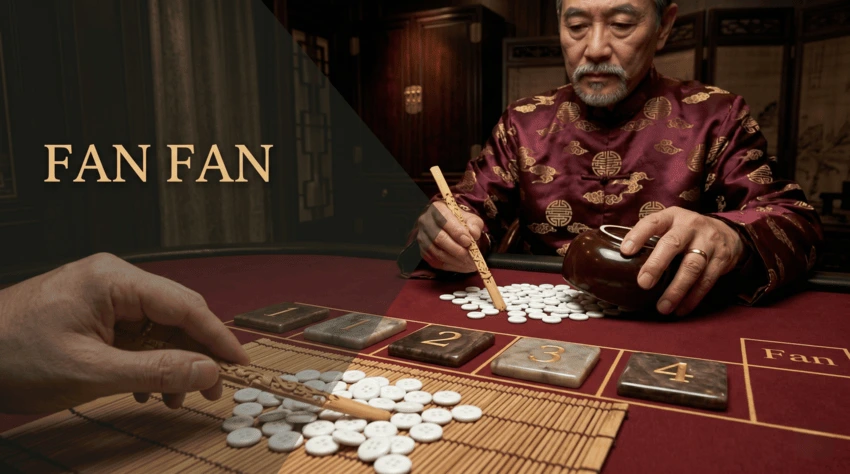
Fan-Tan is a game where the entire point is counting to four. Sounds boring until you realize it's been running for 1,700 years and carries a house edge that makes baccarat players do a double-take.
What is Fan-Tan?
Fan-Tan goes back to 3rd or 4th century China. The name roughly means "repeated divisions." And that's literally the game.
A dealer grabs a pile of small objects. Traditionally coins or beans. Modern casinos use white plastic buttons. The dealer separates a chunk from the pile, then removes them four at a time until 1, 2, 3, or 4 remain.
You bet on that final count. That's the whole game.
Around 1900, Macau had over 200 Fan-Tan saloons. Two hundred. It was the dominant gambling game in the city, not some side attraction. Chinese workers who built the transcontinental railroad carried it to gambling houses in San Francisco, New York, and London throughout the 1800s. For decades, if you walked into a Chinatown gaming parlor anywhere in the English-speaking world, Fan-Tan was probably the loudest table.
Today it's a ghost of that. Four casinos in Macau still run tables: Jai Alai, Lisboa, Oceanus, and the Sands. The game pulled just 0.21% of Macau's total gaming revenue in 2025.
But here's what's interesting. Evolution Gaming built a full live dealer version with real beads and the traditional bamboo wand. So a game that was fading out of physical casinos found a second life online. If your crypto casino carries Evolution's live portfolio, you can probably pull up a Fan-Tan table right now.
How to play Fan-Tan
You don't need a strategy chart. You don't need to memorize hand rankings. You need to watch someone sort buttons into groups of four and see what's left over.
The setup
The table is roughly craps-sized. A clear plastic dome covers the dealer's working area in the center. Inside the dome: about 200 small white buttons, a metal cup, and a thin bamboo wand.
A square in the middle of the table marks the four possible outcomes: 1, 2, 3, 4.
How a round plays out
The dealer drops the cup over a section of the button pile. This separates maybe 60 to 100 buttons from the rest. Nobody knows the exact count. That's where the randomness lives.
You place your bets on the numbered sections and bet-type areas around the layout.
A bell rings. Betting closes.
The cup lifts. Now the dealer uses the wand to sweep buttons away four at a time, lining them into neat rows. It's rhythmic. Almost meditative. Four, four, four, four.
This keeps going until four or fewer buttons remain. If three are left, 3 wins. Two left, 2 wins. If exactly four remain, number 4 takes it.
Winning sections on the table light up. Winners get paid minus a 5% commission. Losers get collected.
Every outcome carries exactly a 25% chance. Four possibilities, all equally likely. You're not going to find a more transparent probability structure in any casino anywhere.
Fan-Tan table layout
The physical table fits about six players per side, with betting areas running along both edges. The dealer works in the center under the dome.
Betting surfaces are split into sections for each bet type, arranged around that central 1-2-3-4 square:
- Fan bets land directly on the numbers
- Nim, Kwok, Nga Tan, and Sheh-Sam-Hong bets occupy designated spots between and around the numbers
Electronic scoreboards display recent results in grid patterns. If you've tracked baccarat road maps, same idea. Players watch for "skips," numbers that haven't appeared for a stretch.
Evolution's online version reproduces all of this digitally. Red-and-gold studio. Real beads. Traditional wand. The stats panel tracks the last 500 rounds, which gives you way more data than any physical Macau table.
Fan-Tan bet types, payouts, and house edge
Five bet types total. No side bets. No bonus rounds. No progressive jackpots.
Every win at a traditional Macau table gets hit with a 5% commission. Keep that in mind as we walk through each one.
Fan (single number)
Pick one number. 1, 2, 3, or 4.
- Pays 3:1 before commission, 2.85:1 after
- Wins 25% of the time
- House edge: 3.75%
The most straightforward bet on the table and the most expensive one to make. You're picking one out of four and hoping. Not terrible by casino standards, but compared to what else is available on this same table? You're overpaying.
Nim (one win, one push)
Pick one number to win and one number that gives your bet back.
- Pays 2:1 before commission, 1.9:1 after
- Wins 25% of the time, pushes 25%
- House edge: 2.50%
The push outcome is what makes this interesting. Half the time you lose, a quarter of the time you win, a quarter of the time your money comes back. Less volatile than Fan. Better edge too.
Kwok (two numbers win)
Pick two numbers. Either one hits, you win.
- Pays 1:1 before commission, 19:20 after
- Wins 50% of the time
- House edge: 2.50%
Coin-flip territory minus the commission. Same house edge as Nim but feels completely different in practice. You're winning more often at smaller payouts instead of winning rarely at bigger ones. Same math, different experience.
Nga Tan (two win, one push)
Two numbers win for you. A third number pushes.
- Pays 1:2 before commission, 19:40 after
- Wins 50%, pushes 25%
- House edge: 1.25%
Now we're talking. You lose on only one out of four possible outcomes. Three-quarters of the time, money either comes back or grows. The individual payouts are small. The edge is sharp.
Sheh-Sam-Hong (three numbers win)
Pick three numbers. Any of them hit, you win.
- Pays 1:3 before commission, 19:60 after
- Wins 75% of the time
- House edge: 1.25%
You win three out of every four rounds on average. The payout per win is a fraction of your wager. But that 1.25% house edge? That sits right next to baccarat's Banker bet. On a game most Western players have never even seen.
Nga Tan and Sheh-Sam-Hong both carry that 1.25% number. These are the bets that make Fan-Tan worth paying attention to.
All five bets at a glance
Fan-Tan odds and house edge summary
The spread here is what matters. Fan-Tan's house edge runs from 1.25% to 3.75% depending entirely on which bet you choose. Same game. Same table. Wildly different cost.
A player making nothing but Sheh-Sam-Hong bets is playing a sharper game than most roulette players. A player making nothing but Fan bets is giving up nearly triple the edge. The game doesn't change. Your bet selection does all the work.
How Fan-Tan stacks up against games you probably already know:
Look at where the best Fan-Tan bets land on that list. Between baccarat's Banker and craps' Pass Line. That's elite company for a game most crypto casino players scroll right past.
The worst Fan-Tan bet is still more reasonable than American roulette. You're not walking into a trap no matter what you pick. But the gap between 1.25% and 3.75% compounds over a session. Smart bet selection is the only real edge you have.
Fan-Tan strategy
Let's be honest about what "strategy" means in a game where every round is independent and every outcome has a flat 25% probability. No system changes the math. No pattern makes the next result more predictable.
What you control: which bets you place, how much you wager, and when you walk away. That's your entire toolkit.
Pick the right bets
Nga Tan and Sheh-Sam-Hong cost you 1.25% per dollar wagered. The Fan bet costs 3.75%. That's three times the price for the same game.
If you're playing Fan-Tan with any kind of bankroll awareness, the single-number Fan bet should be an occasional spice play, not your default. Build your session around the low-edge bets. Dip into Fan when you feel like gambling with a capital G.
The skip pattern thing
Macau regulars track skips. A skip is a number that hasn't appeared for an unusually long stretch. Some players describe watching a number go missing for 80 consecutive rounds. That's over four hours at a live table.
When a number stays cold for that long, players bet against it using Sheh-Sam-Hong, covering the other three numbers. The reasoning feels solid: if 3 hasn't appeared in 60 rounds, surely it's "due."
Here's the reality. Each round is still 25% per number. The buttons don't remember what happened last round. This is pattern-betting. Same family as baccarat road-following. It doesn't change the probability. What it does do is give you a framework for making decisions, which is more useful than betting randomly. Just don't confuse structure with edge.
Watch your bet sizing
Sheh-Sam-Hong wins 75% of the time. Feels great. But it pays only 1:3, so a single loss wipes out three wins clean.
If you run twenty Sheh-Sam-Hong bets at $10 each, you'll probably win around fifteen and lose five. That's $50 in winnings and $50 in losses (before commission). The margin is razor-thin. One extra loss in that stretch and your session goes red.
Size your bets so a losing round doesn't erase a long winning run. And set a number for when you stand up and leave. A session budget and a stop-loss aren't optional with this payout structure. They're the whole game plan.
Know your commission
The 5% commission on wins is baked into every payout at a Macau table. Online? It depends on the platform.
Some sites post payouts with the commission already deducted. Others show the pre-commission number and take the cut afterward. The difference between seeing "1:3" and "19:60" on your screen matters over a hundred bets. Check the fine print before you start sizing wagers.
Super Fan-Tan (card version)
Some live dealer platforms run a card-based version that swaps out buttons for a deck.
The dealer pulls six or twelve cards. Each card has a point value. Add them up, divide by four, and the remainder determines the winning number. Zero remainder means 4 wins.
Same bet types. Same math underneath. Different presentation.
Where it diverges: some card versions tack on side bets based on the raw card total or specific card combinations. Those side bets can carry substantially higher house edges, so check the numbers before you start placing chips there.
The pace is quicker than traditional button Fan-Tan. Gameplay Interactive offers this variant at several online casinos.
If you want the authentic experience, Evolution Gaming's live version uses beads with the traditional wand. Closer to what you'd see in a Macau casino, just through a screen.
Fan-Tan vs. other casino games
If you're coming from baccarat, roulette, or Sic Bo, here's how Fan-Tan fits into the picture:
Baccarat is Fan-Tan's closest cousin. Both are pure chance. Both draw pattern-tracking players. Both mix low-edge and high-edge bets on the same table.
The trade-off: Fan-Tan is simpler to learn but dramatically harder to find. If you're already comfortable at a baccarat table and you've spotted a Fan-Tan option on your crypto casino's live dealer page, it's worth a session. The best bets cost roughly the same as Banker, and you'll be playing something 99% of players have never tried.
Where to play Fan-Tan
Macau
Jai Alai, Lisboa, Oceanus, and the Sands. That's the full list. Four tables in a city that had over 200 a century ago.
The Fan-Tan section is quiet. The pace is slow. It feels nothing like the baccarat pits twenty meters away. If you're visiting Macau and you want to see a piece of gambling history that's still breathing, it's worth a walk through.
Online (live dealer)
Evolution Gaming's live Fan-Tan is where most players will encounter this game. Full studio setup, real beads, traditional wand. Available at crypto casinos and other online platforms running Evolution's live dealer suite.
The big advantage online: statistics. The interface tracks the last 500 rounds, giving skip-watchers and pattern-trackers way more data than a physical scoreboard.
Some platforms carry Super Fan-Tan (the card version) as a faster alternative.
Anywhere else
Fan-Tan surfaces occasionally in other markets. The Venetian once had a rule booklet for it. But finding a live table outside Macau or an online lobby is like finding a craps table in Tokyo. Technically possible. Practically unlikely.
If you're playing from the West, online is your path in.
Tips for new players
- Start with Kwok. Two numbers, 1:1 payout, wins half the time. It teaches you the flow of a round without punishing you for learning.
- Graduate to Nga Tan or Sheh-Sam-Hong. That 1.25% house edge is where the real value sits. Once the game makes sense, move your money there.
- Don't default to Fan bets. Picking a single number feels exciting. Paying 3.75% on every wager doesn't. Save it for the occasional shot, not your bread and butter.
- Use the scoreboard. Skip-tracking won't change the math, but it gives you a system for making decisions instead of guessing. Structure beats randomness for session management, even if the probabilities stay flat.
- Confirm the commission setup. Before your first real bet online, figure out if the posted payout already includes the 5% cut. One version pays 1:3. The other pays 19:60. Both say "Sheh-Sam-Hong" on the layout. Only one matches what actually lands in your account.
- Budget for the payout structure. Sheh-Sam-Hong's 75% win rate feels generous right up until one loss deletes three wins. Set a session limit. Stick to it. The game rewards patience, not chasing.
Fan-Tan is maybe the simplest casino game you'll ever sit down to. Count to four. Pick your bet. Watch the wand. The skill, if you want to call it that, is knowing which bets treat your bankroll with respect and which ones quietly drain it. Now you know the difference.