Sic Bo

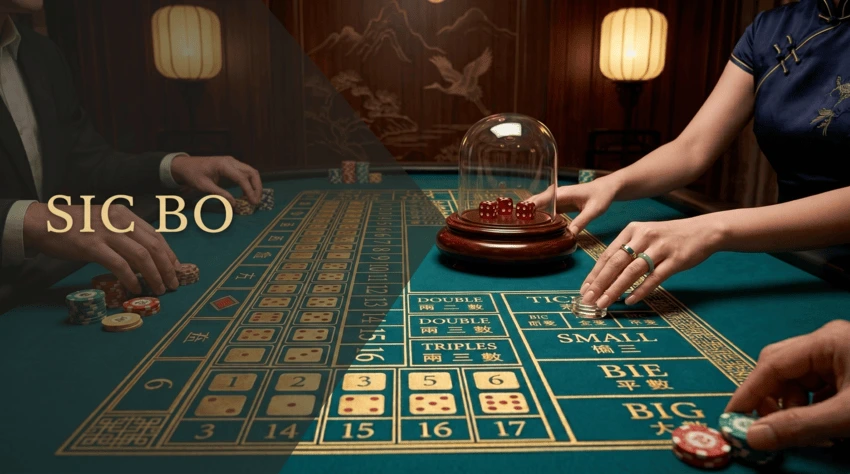
Three dice, a sealed chest, and a board full of bets you've probably never seen before.
Most people walk past the Sic Bo table because the layout looks like someone spilled a spreadsheet onto green felt. Numbers everywhere. Payouts are printed in every box. Lights flashing after each round. It's a lot to take in.
But here's what nobody tells you: the game itself is one of the simplest things in the casino. You put chips down, the dealer shakes three dice, and the result either matches your bet or it doesn't. No cards to track. No decisions mid-round. No other player affects your outcome.
The catch? Most of the bets on that giant board carry a brutal house edge. Knowing which ones to touch and which ones to ignore is the entire game within the game.
This guide covers all of it. Every bet type, every payout, every house edge, and the honest truth about strategy in a game that runs entirely on chance.
What is Sic Bo?
Sic Bo is a Chinese dice game that's been around for centuries. The name translates to "precious dice." Depending on where you're playing, you might hear it called Tai Sai, Dai Siu, Big and Small, or Hi-Lo. Same game, different labels.
It's huge in Macau. Has been for a long time. Atlantic City legalized it in 2001. Las Vegas tables started appearing in the 1990s. And now? It's all over online casinos, especially live dealer rooms at crypto casinos, where the game plays fast and settles instantly.
The easiest way to think about Sic Bo: it's roulette with dice.
You place bets on outcomes before a random event. In roulette, a ball spins on a wheel. In Sic Bo, three dice get shaken in a sealed chest. Both games offer a range of bets from conservative to reckless. Both games resolve each round independently.
The big difference from craps? No multi-roll bets. No shooter. No one else at the table affects your result. Every round starts fresh and ends in a single shake.
That's it. That's the whole premise.
How to play Sic Bo
A single round plays out like this:
- You place chips on the table layout. Any section, any number of bets. Want to put chips on five different outcomes at once? Go ahead.
- The dealer shakes three dice inside a sealed chest or mechanical shaker. Online versions use RNG or a live dealer with an electronic shaker.
- The chest opens. Three dice values show.
- Winning sections on the table light up.
- Winners get paid. Losers get swept.
- Next round starts.
No hitting. No standing. No drawing. You make your choices before the shake, and then the game runs itself.
The whole skill component of Sic Bo lives in one decision: which bets to place. Once your chips are down, you're just watching.
Sic Bo table layout
First time looking at a Sic Bo layout, your brain says, "too much." Fair reaction. But strip away the visual noise and you're looking at a menu. Every possible bet is printed right there on the felt with its payout next to it.
Here's how it breaks down:
- Top row: Total sum bets, running from 4 through 17. Payouts printed beside each number.
- Middle area: Two-dice combination bets (domino-style pairs), double bets, triple bets. This is the high-variance section.
- Bottom and sides: Big and Small areas, single number bets, any triple. The safer zone lives here.
- Center: The dice chest or electronic shaker sits at the dealer's position.
After each roll, winning sections light up on modern tables. Online and live dealer layouts work identically but you tap or click to place chips. Some live dealer crypto Sic Bo tables overlay stat panels and heat maps showing recent results.
Those look slick. They mean nothing mathematically. More on that later.
Every Sic Bo bet explained
This is the section that pays for itself. Every bet on the board, what it costs you, how often it hits, and what the house takes. Bookmark this part.
Big and Small
These are the bets that keep you in the game.
- Small: Total lands between 4 and 10 (triples excluded)
- Big: Total lands between 11 and 17 (triples excluded)
- Pays: 1:1
- Win probability: 48.61%
- House edge: 2.78%
Closest thing to a coin flip on the Sic Bo table. The reason it's not a true 50/50? Triples don't count. Roll three 1s and the total is 3, but Small doesn't pay. Roll three 6s and the total is 18, which doesn't even qualify. That carve-out is the casino's margin. Without it, these bets would break even over time and the house would make nothing.
At 2.78%, Big and Small are the only bets on this table that compete with other popular casino games. Everything else on the board costs more. Often a lot more.
Odd and Even
Same math as Big and Small, just framed differently. The total of three dice comes in odd or even, triples excluded.
- Pays: 1:1
- House edge: 2.78% (when triples are excluded, which most tables do)
Pick Big/Small or Odd/Even based on what feels right. The numbers behind them are identical.
Specific totals
This is where the board gets interesting and where the regional differences start to matter.
You're betting on the exact sum of all three dice. That sum can land anywhere from 3 to 18, but 3 and 18 are covered by triple bets, so the specific total range runs 4 through 17.
Payouts vary depending on where you play:
- Totals of 4 and 17: 50:1 in Macau, 60:1 in Atlantic City, 62:1 in Australia
- Totals of 5 and 16: 18:1 in Macau, 30:1 in Atlantic City, 31:1 in Australia
- Totals of 6 and 15: 14:1 to 18:1 depending on the casino
- Totals of 7 and 14: 8:1 to 12:1
- Totals near 10 and 11: Lower payouts because they show up more often
The house edge swings hard based on these pay tables. A total of 17 bet at 50:1 in Macau costs you a lot more per dollar wagered than the same bet at 62:1 in an Australian-style game. We're talking a difference that can more than double the house edge on what looks like the same wager.
Always check what's printed on the table before you bet specific totals. This is the single biggest variable in Sic Bo that most players don't know about.
Single number (any one number)
Pick a number between 1 and 6. If it appears on one of the three dice, you win. More matches, bigger payout.
- One die matches: 1:1
- Two dice match: 2:1
- Three dice match: 3:1 (some tables pay 12:1 for all three)
- House edge: 7.87% under standard rules, 3.70% under Australian rules
That Australian pay table makes this bet significantly cheaper. If you're at a crypto casino running Australian-style Sic Bo, the single number bet becomes one of the better options on the board outside Big/Small. Under standard rules, 7.87% is already a jump up from where you want to be.
Also called "Chuck Number" bets at some tables.
Two-dice combination (domino)
Pick two different numbers. Say 2 and 5. If at least two of the three dice show those numbers in any order, you win.
- Pays: 5:1
- House edge: 16.67%
- 15 possible combinations
That's a steep cut. The payout looks attractive at 5:1, but you're giving up nearly 17 cents on every dollar over time. These add variety to your round. They don't add value.
Double (specific double)
Bet that at least two of the three dice land on the same specific number. Two 4s. Two 1s. You pick.
- Pays: 8:1 to 11:1 depending on the casino
- House edge: Varies, but generally falls between 11% and 19%
The spread between 8:1 and 11:1 on the same bet is massive across a session. A table paying 11:1 on doubles is a very different proposition from one paying 8:1. Check before you play.
Specific triple
All three dice land on the exact number you chose. Three 2s. Three 5s. The whole set.
- Pays: 150:1 in Macau, up to 180:1 at most Western casinos
- Win probability: 0.46%. That's once in roughly every 216 rolls.
- House edge: 16.20% at 180:1. Balloons to 30.09% at 150:1.
The biggest payout on the board. Also one of the worst bets mathematically. True odds sit at 215:1. Even the best payout of 180:1 falls well short. At Macau's 150:1? You're just handing chips to the house at an alarming rate.
Fun to hit. Terrible to chase.
Any triple
All three dice show the same number, but you don't have to guess which one.
- Pays: 24:1 to 30:1
- Win probability: 2.78% (six winning combos out of 216 total)
- House edge: 13.89% at 30:1
Better than a specific triple, but 13.89% is still a serious cost per round. This is a spice bet. Sprinkle it on occasionally. Don't build your session around it.
Four-number combination (where available)
Pick four numbers. If three of those four appear on the dice, you win.
- Standard combos: 1-2-3-4, 2-3-4-5, 2-3-5-6, 3-4-5-6
- Pays: 7:1
- Not available at all tables
A middle-ground option when you want more action than Big/Small without jumping straight into the high-edge territory. Check your table layout to see if these are offered.
Sic Bo odds and house edge summary
Everything in one place. This is the table you come back to.
For comparison:
- European roulette: 2.70% house edge
- American roulette: 5.26%
- Craps pass line: 1.41%
- Blackjack (well-played): ~0.5%
Big/Small at 2.78% holds up against European roulette. Everything else on the Sic Bo board runs between 8% and 33%. That gap is enormous. Bet selection isn't a part of Sic Bo strategy. It IS the strategy. The single choice that determines how fast or slow your bankroll moves.
Sic Bo strategy
Here's the honest version: Sic Bo is pure chance. The dice sit inside a sealed chest. Nobody touches them. No skill changes the outcome of any shake. No system adjusts the house edge on any bet. The math is fixed before you sit down.
What you do control: which bets you pick and how you size your bankroll across a session. That's where every smart decision lives.
Stick to Big/Small
At 2.78%, Big and Small give you the longest ride for your money. If your goal is to play for an hour without burning through chips, park here. It's not glamorous. It gets the job done.
Players who stick to Big/Small can sit through dozens of rounds with relatively small swings. The payout is modest at 1:1, but the cost per round is low enough that you're getting real value from your bankroll.
Mix safe bets with occasional shots
Some players run 80% of their chips on Big/Small and throw 20% at a specific total or double bet. A small side wager on a total of 14 or 7 adds a potential payout without wrecking your bankroll if it misses.
This doesn't improve your expected value. The math doesn't change. What changes is how the session feels. You get steady returns from Big/Small and occasional spikes from the side bet. It's the difference between a flat line and a line with a few interesting bumps.
The approach only works if you keep that ratio honest. The moment your "20% shot" turns into half your stack on specific triples, you're in trouble.
Avoid triple bets as a regular play
Specific triples pay up to 180:1. They hit once every 216 rolls on average. They carry a 16%+ house edge even at the best payout.
Any triple at 30:1 takes 13.89% of your money per bet over time.
These are entertainment bets. Drop a chip on a triple when you feel like it. Have fun watching three matching dice pop up on the rare occasion it connects. But players who build their session around chasing triples end up with empty chip trays and a bad taste.
The numbers don't lie here. A 180:1 payout sounds massive until you realize true odds demand 215:1 to break even.
Betting systems (Martingale, Paroli, 1-3-2-6)
Big/Small's near 50/50 odds make Sic Bo a natural fit for flat progression systems. Martingale (double your bet after a loss) and Paroli (double after a win) both apply the same way they do in roulette.
Real talk: these systems shape how your session plays out. They don't touch the house edge. Martingale feels like a safety net until you hit a losing streak and your required bet doubles five or six times in a row. If you use it, set a hard ceiling on how many times you're willing to double. Decide that number before you start. Not during.
The 1-3-2-6 system is less aggressive and caps your risk at two units per losing cycle. It's a reasonable way to structure bets if you want some shape to your session without the exponential risk Martingale brings.
No system turns a 2.78% house edge into a player advantage. They manage risk. That's all.
Check the pay table before you play
This point deserves its own section because it's the single most practical piece of advice in Sic Bo and the one that most guides skip past.
Sic Bo payouts are NOT standardized. The same bet at two different tables can carry wildly different house edges. A specific triple pays 150:1 in Macau and 180:1 at most Western casinos. That's the difference between a 30% house edge and a 16% house edge. On the same wager.
Specific totals swing just as hard. A total of 4 at 50:1 versus 62:1 isn't a minor variation. It changes the entire cost equation.
Before you sit down at any Sic Bo table, at a physical casino or a live dealer room at a crypto casino, look at the printed payouts. Compare them to the numbers in this guide. You'll know within 30 seconds if the table is giving you a fair shot or squeezing extra margin on every bet.
Can you count dice in Sic Bo?
No. And here's exactly why.
Card counting works in blackjack because cards leave the shoe. Each dealt hand changes what's left in the deck. A depleted shoe creates situations where the remaining cards favor the player. That's real, exploitable information.
Dice don't deplete anything. Every shake of three dice produces 216 equally likely outcomes. The last roll has zero connection to the next one. Roll three 6s ten times straight, and the probability on shake number eleven is exactly the same: 1 in 216 for that specific triple.
Those scoreboards at Sic Bo tables showing the last 50 results? The ones with color-coded patterns and running totals? They're there because human brains love spotting patterns, even in randomness. There's no data in those panels that tells you anything about the next roll.
This is the hard dividing line between Sic Bo and games like blackjack. In blackjack, the past affects the future because cards are finite resources. In Sic Bo, every shake resets the universe to the same 216 possibilities. If someone claims they have a dice-counting method for Sic Bo, they're selling you something that contradicts how probability works.
Sic Bo variations
The base game has spun off several versions over the years. Here's what you might run into online or on a casino floor.
Grand Hazard
English origin. Three dice get thrown into a cup or rolled down an inclined chute with panels that tumble them randomly. The layout and bet options differ from standard Sic Bo. "Raffles" (three of a kind) pay 18:1. You'll spot this in some European casinos, mostly as a historical curiosity.
Chuck-a-Luck (Birdcage)
The American version, sort of. Three dice sit in a wire-frame cage shaped like an hourglass, and the dealer rotates it. Betting is stripped down to single-number and triple wagers. More carnival booth than casino floor. The house edge runs higher than standard Sic Bo on most bets. If you see one at a county fair, enjoy it for what it is. Don't confuse it with real Sic Bo odds.
Super Sic Bo (Evolution Gaming)
This is the variant getting the most attention at live dealer crypto casinos right now. Standard Sic Bo rules with one twist: random multipliers land on certain bet positions each round, up to 1000x.
The trade-off is that base payouts drop below traditional Sic Bo to compensate for the occasional multiplier hit. On rounds where no multiplier lands on your bet, you're getting paid less than you would at a normal table. On the rare round where a 500x multiplier connects with your specific total? That's a moment.
Super Sic Bo adds serious variance. If you're comfortable with longer dry stretches punctuated by occasional big hits, it fits. If you prefer steady returns, standard Sic Bo or Big/Small plays are a better match.
Yee Hah Hi (Fish Shrimp Crab)
Numbers get swapped for symbols: fish, shrimp, crab, coin, gourd, rooster. Players bet on which symbols appear. Wildly popular across Southeast Asia. Same underlying math as standard Sic Bo wearing a different outfit. Know one, and you know both.
Bac Bo (Evolution Gaming)
A crossover between Sic Bo and baccarat. Two sets of dice roll separately, one for the "Player" side and one for "Banker." Highest total wins. It borrows baccarat's bet structure and applies dice mechanics.
If you already play crypto baccarat and want something that keeps the same Player/Banker framework but swaps cards for dice, Bac Bo sits right in that gap. Relatively new, found mainly through live dealer tables online.
Sic Bo vs. Craps
Both are dice games in the casino. People compare them constantly. Here's where they actually differ.
If odds are your priority, craps wins that comparison. A pass line bet with full odds is the best deal in the house, and Sic Bo can't match it.
If you want to sit down, learn fast, and play independently without needing to understand shooter etiquette or multi-roll sequences, Sic Bo gives you that. Five minutes of reading this guide, and you know more than most people who've stood at the table.
Both games run at live dealer crypto casinos. Sic Bo tends to show up more in Asia-facing rooms and through Evolution's live studio. Craps has been growing in Western-focused online rooms.
The games appeal to different players for different reasons. Neither one is wrong. The choice depends on what you value: simplicity and speed, or better odds and social energy.
Tips for new players
Quick hits. No filler.
- Play Big/Small for your first session. Learn the rhythm of the game on the cheapest bet. Get comfortable with the pace before you spread chips across the board.
- Ignore the scoreboard. Past results have zero predictive value. None. The dice don't remember what happened last round.
- Read the pay table before your first bet. Especially on specific totals and triples. Two minutes of checking saves you from unknowingly sitting at a table with inflated edges.
- Set a number for the session and respect it. Rounds move fast. You can burn through 30 shakes in 15 minutes if you're betting every round. Decide your budget before you start and walk away when you hit it.
- Multiple small bets are fine. Spreading a few chips across Big, a specific total, and a single number gives you action on three different outcomes per shake. Just know your total exposure per round goes up with each added bet.
- If the odds matter most, look at craps. Sic Bo's best bet at 2.78% doesn't beat the craps pass line at 1.41%, and it doesn't come close to craps with full odds. Sic Bo sells speed and simplicity. Craps sells better math. Pick what matters to you.
The Sic Bo table stops looking complicated about five rounds in. All that felt is doing is showing you every bet at once. You don't have to use most of them. Stick to the ones that respect your bankroll, check what the table pays before you play, and remember that the dice don't owe you anything based on what happened two shakes ago.
You know the layout now. You know the math. That puts you ahead of almost everyone else at the table.