Bac Bo

Two dice vs. two dice. Higher total wins. That's the entire game.
Bac Bo strips baccarat down to its bare mechanics, swaps cards for dice, and removes every confusing rule that makes new players hesitate at the table. No third-card draws. No commission. No memorizing when the Banker stands on 7.
If you can add single-digit numbers, you can play this game. Here's everything you need to know about Bac Bo rules, payouts, the tie bet structure, house edge, and how it stacks up against baccarat and Sic Bo.
What is Bac Bo?
The name gives it away. Bac(carat) + (Sic) Bo = Bac Bo.
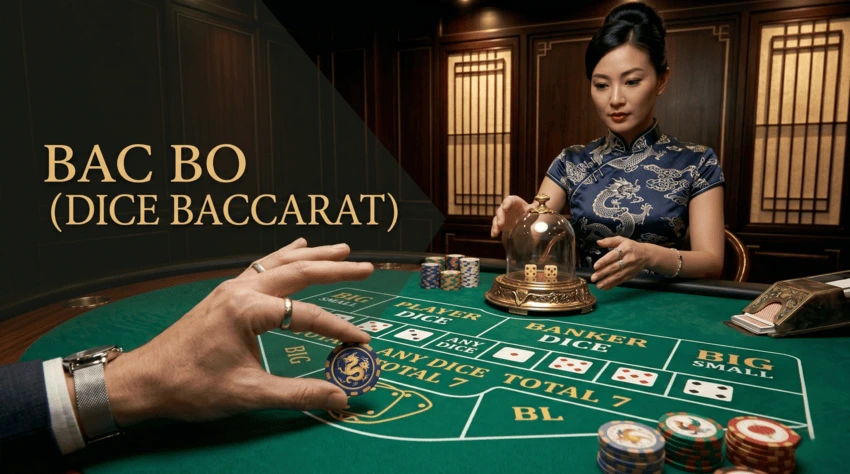
Evolution Gaming launched this hybrid in 2022 as a live dealer exclusive. Four dice replace the card shoe. Two blue dice represent the Player side, two red dice represent the Banker side. Each side's dice are totaled, and the higher number wins.
That's it. No drawing rules to memorize. No commission shaved off winning Banker bets.
The studio setup leans into an Asian-inspired aesthetic with gold and red accents. Each die sits inside its own transparent automatic shaker built into the table surface. The transparent design is intentional: you can see there's nothing inside the dice. No magnets, no weights, no tricks.
Rounds clock in under a minute. The shakers stop one at a time, building tension as each number locks in. It plays like baccarat but feels like craps' calmer, more composed sibling.
How to play Bac Bo
Placing bets
Three options. That's the entire bet menu.
- Player — betting the blue dice will have a higher total
- Banker — betting the red dice will have a higher total
- Tie — betting both sides will land on the same total
No side bets in standard Bac Bo. No pairs, no dragons, no bonus wagers. Clean and minimal.
Minimums typically start at $0.50 (especially in the First Person version), with maximums reaching $10,000 depending on the platform. You can place multiple bet types at once. Player + Tie is a common combo.
The dice roll
All four dice begin shaking simultaneously inside their individual containers. They stop in sequence, usually:
- Player's first die
- Banker's first die
- Player's second die
- Banker's second die
Each side totals its two dice. The range per side runs from 2 (double 1s) to 12 (double 6s).
Outcomes
- Player total is higher: Player bets pay 1:1
- Banker total is higher: Banker bets pay 1:1
- Both totals match: It's a tie
Here's the part most people miss on ties. Your Player or Banker bet isn't fully returned. You get back 90% of your stake. The house keeps 10%.
That 10% clip on ties is where the entire house edge on main bets comes from. It's not a commission. It's not a fee. It's just what happens when nobody wins.
Quick example:
You bet $10 on Player. Blue dice show 4 + 5 = 9. Red dice show 3 + 2 = 5. Player wins. You pocket $10 profit.
Next round, same $10 on Player. Blue dice total 6, red dice total 6. Tie. Your $10 bet comes back as $9. You just lost a dollar to a tie.
Bac Bo payouts
Player and Banker bets
Both bets carry identical math. Unlike baccarat, where the Banker bet has a slight statistical edge, there's zero advantage to choosing one side over the other in Bac Bo. Pick your color and go.
Tie bet
This is where Bac Bo gets interesting. Baccarat pays a flat 8:1 (or 9:1) on any tie. Bac Bo pays on a sliding scale based on the combined total of all four dice when a tie occurs.
The rarer the combined number, the bigger the payout. A combined total of 4 means both sides rolled double 1s (1+1 vs. 1+1). A combined total of 24 means double 6s on both sides (6+6 vs. 6+6). Both scenarios pay 88:1.
The headline number. The one Evolution put on the marketing material. It hits rarely, but when four dice all land on the same extreme, the table lights up.
Ties occur roughly 9.51% of the time across all rounds. The tie bet house edge sits at approximately 4.48% according to Wizard of Odds analysis. That sounds high compared to the main bets, but compare it to baccarat's tie bet at 14.36% house edge and it looks generous.
House edge and odds
Here are the numbers that matter:
The 1.13% edge on main bets comes entirely from that 10% haircut on ties. If ties returned your full stake (like baccarat does), the game would be mathematically fair. Zero edge. Evolution needed to build margin somewhere, and this is how they did it.
How does that compare?
Bac Bo's main bets land right between baccarat's Banker and Player bets. Competitive, not better, not worse by any meaningful margin.
The standout: Bac Bo's tie bet blows baccarat's tie bet out of the water. A 4.48% edge vs. 14.36% makes the Bac Bo tie bet roughly three times more player-friendly. If you enjoy tie wagers, this is the better game for it.
The trade-off? That 10% tie loss on your main bet. Baccarat gives you a full push on ties (Player bet, at least). Bac Bo quietly takes 10%. Over hundreds of rounds, that adds up. Most competing guides barely mention this.
Bac Bo strategy
Let's be honest: this is pure dice. No decisions after the bet is placed. No cards to count, no optimal plays to memorize. Strategy here is about choosing the right bets and managing your bankroll.
Stick to Player or Banker
At 1.13% house edge, these are the only mathematically sensible core bets. And since both are identical (no Banker advantage like baccarat), you're free to switch sides, follow streaks, or pick one color for your entire session. Makes no difference to the math.
The tie bet as a side wager
The 88:1 max payout pulls people in. And at ~4.48% edge, it's not a terrible bet by casino standards. The common approach: place your main wager on Player or Banker and add a small tie bet worth roughly 1/10th of your main stake.
Why? When a tie lands, the tie payout covers the 10% you lose on your main bet and potentially puts you ahead. If a high-total tie (25:1 or 88:1) hits, it's a significant session boost.
This doesn't change the house edge. It just reframes ties from "quietly losing money" to "potentially winning money." A structural choice, not a mathematical one.
Betting systems
Bac Bo's near 50/50 main bets work with Martingale, Paroli, 1-3-2-6, and similar progression systems. Same disclaimer as always: none of these change the house edge over time.
One wrinkle worth knowing. Most 50/50 systems assume ties are neutral. In Bac Bo, ties cost you 10%. A Martingale player who doesn't account for this will find their progression interrupted by small losses they didn't expect. Factor it into your planning if you use a system.
Road maps and pattern tracking
Bac Bo includes baccarat's full road map suite: Bead Road, Big Road, Big Eye Road, Small Road, and Cockroach Road.
One difference from baccarat: the roads never reset. There's no shoe change because there's no shoe. The road just keeps going.
Each dice roll is independent. Past results don't predict future outcomes. The dice don't remember what happened two rounds ago. But road maps give structure to your session. Many players enjoy spotting streaks and using them as a framework for bet sizing. That's a legitimate way to play, as long as you know the patterns are descriptive, not predictive.
Lightning Bac Bo
Evolution's multiplier variant takes the base game and adds voltage.
How it works:
- Same rules as standard Bac Bo
- A 50% Lightning fee is added to every bet. A $1 bet deducts $1.50 from your balance.
- After betting closes, a random die number (1 through 6) is selected as the "Lightning number" and assigned a multiplier between 2x and 8x
- If the Lightning number appears on any winning die, that die's contribution to the payout is multiplied
- If both of your winning dice show the Lightning number, multipliers stack. Double 5s with a 3x multiplier = 9x payout.
The ceiling:
- Maximum Player/Banker payout: 64:1 (8x × 8x on both dice)
- Maximum Tie payout: 1,199:1 (capped)
The 50% fee and adjusted base payouts mean the effective house edge runs similar to or slightly above standard Bac Bo. You're paying for variance. The highs are higher, the lows are more frequent, and every round has a jackpot possibility baked in.
Lightning Bac Bo suits players who want slot-style excitement from a table game. For grinding with a small bankroll? Standard Bac Bo is the cleaner choice. The extra variance from Lightning needs room to breathe.
Bac Bo vs. baccarat vs. Dragon Tiger
If you're choosing between these three, here's the full comparison:
Bac Bo sits in the middle. Simpler than baccarat, better odds than Dragon Tiger. If baccarat's third-card rules have ever made you second-guess what just happened at the table, Bac Bo gives you the same head-to-head format without the confusion.
Dragon Tiger is faster but costs more per round in edge. Baccarat offers slightly better main bet odds on the Banker side, but comes with commission and rules you need to learn.
For crypto casino players who want a quick, low-edge game with a simple bet structure, Bac Bo hits a sweet spot.
Bac Bo vs. Sic Bo
The name suggests a close relationship. The gameplay says otherwise.
- Bac Bo uses four dice (two per side, compared head-to-head). Sic Bo uses three dice with dozens of betting options.
- Bac Bo has 3 bet types. Sic Bo has 10+.
- Bac Bo's best house edge (1.13%) beats Sic Bo's best (2.78% on Big/Small) by a wide margin.
- Sic Bo offers more variety and higher max payouts (up to 180:1 on specific triples).
Despite sharing half a name, they play nothing alike. Bac Bo feels like baccarat with dice. Sic Bo feels closer to roulette with dice. If you want simplicity and a low edge, Bac Bo wins. If you want a sprawling bet layout with more options, Sic Bo is your game.
Tips for new players
- If you know baccarat, you already know this game. Dice instead of cards, no drawing rules. Done.
- Player and Banker are identical here. No reason to favor one side. Pick based on gut, streaks, or a coin flip. The math doesn't care.
- Watch for the 10% tie loss. It's the entire source of the house edge on main bets, and it's easy to miss until you notice your balance slowly dipping on "push" rounds.
- The tie bet payout structure (4:1 up to 88:1) gives the game its personality. Worth a small side wager if you enjoy the sweat. Not worth making your primary bet.
- Road maps won't tell you what's coming next. They will tell you what's happened, and some players find that useful for pacing their bets.
- Lightning Bac Bo is the high-variance option. The 50% fee means you're buying excitement, not edge. Know what you're paying for.
- This might be the simplest live dealer game available at any crypto casino. Two numbers. Bigger one wins. Start here if table games feel intimidating.