How to Deal Craps: Complete Dealer Guide

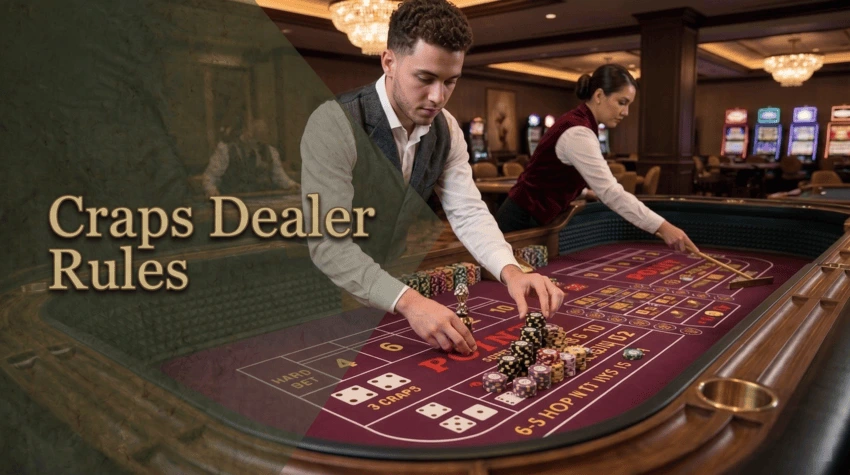
You know what makes craps dealers different? They're juggling more bets at once than any other game in the casino. While a blackjack dealer tracks one bet per player, a craps dealer might handle dozens of wagers across multiple bet types, each with different payout ratios, all while the dice are in the air.
We're breaking down crew positions, chip handling basics, dealing procedures, payout math, and how to actually land this job.
What does a craps dealer do
As a craps dealer, you're managing bets and calculating payouts on the fly. Plus you're keeping the game moving as part of a four-person crew. Here's what matters most: chip handling. You're cutting stacks of two, three, four, or five chips with both hands. And you're not looking down. Dealers call this skill 'good hands.' It's what separates fast, accurate dealers from everyone else.
There's a specific order dealers follow: 'take, pay, move, pay.' You collect losing bets first, pay winners second. Always work from the outside of the table toward the center. Stick to this sequence and you'll keep things organized. Plus you'll catch fewer mistakes.
Craps is widely considered the hardest table game to deal. You're tracking multiple bets across different players, each paying out differently. And you've got to keep the energy up because that's what makes craps fun. It's a lot to juggle, which is exactly why the job pays better than dealing most other games.
Craps table positions explained
The craps crew? You're a four-person team. Four people rotate through different positions during a shift. Each spot has its own job.
Boxman
The boxman? That's the person sitting at the center of the table, right across from the stickman. The boxman supervises everything. They're watching for dealer mistakes, settling arguments, and counting cash buy-ins. When you're new and unsure about a payout, the boxman is who you ask.
Stickman
The stickman stands at the center of the player side. They control the dice with that long curved stick and call out every roll. They also handle all the prop bets in the center of the layout. The stickman sets the pace and energy. It's probably the most visible job on the crew.
Base dealers
Then you've got two base dealers covering the left and right sides. Each dealer handles player bets, payouts, and chip exchanges for their side. New dealers usually start as base dealers. You get hands-on experience with the basics before dealing with center action or supervising the game.
Chip handling skills every dealer needs
Good hands make a good dealer. Being able to cut checks (that's casino talk for chips) into exact stacks without looking down? That's what separates dealers who are ready from those who aren't.
- Cutting checks: Dealers practice picking exact stack sizes until the motion becomes automatic. Twos, threes, fours, and fives are the standard cuts.
- Stack organization: Chips sit in stacks of five in the rail, organized by color. Red chips ($5) and white or gray chips ($1) follow consistent arrangements across properties.
- Two-hand coordination: The inside hand works closest to the boxman, while the outside hand stays closest to the player. Each hand has specific duties during payouts.
Experienced dealers pass down a simple mantra: slow and correct is fast. Rushing leads to mistakes, and mistakes slow everything down. You build muscle memory through repetition. Speed comes later.
Craps dealing procedure step by step
Let's walk through a complete round from the dealer's side. You'll see the rhythm that keeps everything moving.
1. Set up the table
Before the dice start flying, check your setup. Pucks positioned right? Chips organized in the rail? Dice ready for the shooter? One quick look saves you from headaches later.
2. Handle the come-out roll
The come-out roll does one of two things. It establishes a point (that's 4, 5, 6, 8, 9, or 10). Or it creates an instant win or loss (7, 11, 2, 3, or 12). Point gets established? Move the puck to ON and drop it on that number.
3. Manage bets during play
You're tracking bets, placing them, adjusting them throughout the round. When you book a bet, say the amount and type out loud. That's your verbal record. "Twenty-five on the six" — now everyone knows exactly what's happening.
4. Call the roll
Dice settle, stickman calls the number. Base dealers hear the call and get ready to settle bets.
5. Pay winners and collect losses
This order matters. Take losing bets first, pay winners second, and work from the outside toward center. That 'take, pay, move, pay' rhythm? It keeps your layout clean.
6. Reset for next roll
Give the dice back to the shooter. If the point hit or they sevened out, move your pucks. Get ready for the next roll.
How craps payouts work
Payout memorization is non-negotiable. Hesitate on payouts and you slow down the game. Players lose confidence too.
Pass line and don't pass
Both pay even money (1:1). High volume but straightforward math.
Odds bets
Odds bets pay at true odds with no house edge. That's why they're the best bets players can make. For 6 and 8, dealers learn something called the 'cap' concept. You pay the total bet plus whatever dollar amount's sitting on top.
Place bets
Payouts vary by number. Place bets on 6 and 8? Those pay 7:6. The 5 and 9 pay 7:5. And 4 and 10 pay 9:5. Dealing tests frequently cover place bet payouts, essential skills for live casino environments.
Proposition bets
Those single-roll bets in the center? They pay higher. Think 31-for-1 and 16-for-1. The stickman handles prop bets, but every dealer needs to know the payouts for common amounts.
Payout math shortcuts
Dealers don't calculate from scratch every time. They use mental shortcuts.
- 7:6 place bets: Divide the bet by 6, multiply by 7. A $30 bet pays $35.
- True odds on 6 or 8: Pay 6:5. A $25 odds bet pays $30.
- Breaking down odd amounts: For non-standard bets, dealers break them into familiar components and add the payouts together.
The goal is instant recall, not arithmetic. Flashcards and repetition get you there faster than figuring out math at a live table.
Common craps dealing mistakes
Every new dealer makes the same mistakes. Know what to avoid and you'll learn faster.
- Paying before taking: Always collect losing bets first. Reversing the order creates confusion and potential security issues.
- Forgetting to book bets: Verbalize every bet. "Fifty on the hard eight" protects both the dealer and the player.
- Miscounting stacks under pressure: This is why chip handling drills matter. Pressure reveals weak fundamentals.
- Ignoring the boxman: The boxman exists to help. New dealers who try to handle everything alone make more mistakes.
How to become a craps dealer
You've got a few ways to become a dealer. All of them take serious practice.
Dealing school programs
Training facilities (you'll find a ton near Vegas) run programs that cover all table games. Craps gets the most training time because it's the hardest game. Some programs run a few weeks. Others take months.
Casino in-house training
Some properties train dealers internally, though this often requires starting on simpler games like blackjack first. Show you're solid on easier games and they'll let you train on craps.
Licensing and certification
Every state's got different requirements. You're usually looking at gaming commission registration, background checks, and work permits.
Craps dealer salary and earning potential
Base pay changes depending on where you work. But tips (dealers call them tokes) usually make up most of your income. Craps dealers frequently earn more than dealers on other table games because the skill requirements are higher and the action tends to attract bigger bettors.
What you make changes a lot. A busy weekend shift at a major property looks very different from a Tuesday afternoon at a smaller casino.
How to practice craps dealing at home
Actually practicing with chips beats reading or watching videos.
Chip cutting drills
Get a rack of chips and practice cutting pick sizes while watching TV or listening to podcasts. The goal is making the motion automatic.
Payout flashcards
Create cards with bet amounts and quiz yourself on payouts. Focus on props and place bets since these trip up new dealers most often.
Mock table runs
Walk through the procedures out loud. Practice making the calls and getting the sequence right. You don't even need a physical table. Just practicing the rhythm helps you learn.
Why learning to deal craps makes you a sharper player
Once you understand the dealer's side, you notice stuff casual players never see. You start seeing bet timing, how the table flows, and which bets actually make mathematical sense.
Everything you learn works online too. Understanding craps from the dealer's side? You'll make better calls at crypto craps tables where knowing the game actually matters. Platforms like JB offer craps with instant deposits and withdrawals, letting you apply what you've learned without friction.
FAQs about dealing craps
Is dealing craps harder than dealing other casino table games?
Ask around: craps is the hardest table game to deal. You're tracking a ton of bets at once, each with different payouts, while keeping the game moving fast. Dealing schools spend more hours on craps than any other game.
What is the 3 4 5 rule in craps?
This rule decides how much you can bet on odds based on your pass line bet. On points of 4 or 10, players can take 3x odds. For 5 or 9, it's 4x. And 6 or 8 get 5x. The rule makes maximum payouts the same for all point numbers.
How long does it take to become proficient at dealing craps?
Most dealing schools run several weeks of intense craps training. Real floor confidence though? That takes months of actually dealing live tables after you finish school.
Can someone learn craps dealing skills through online resources?
Videos and apps help you memorize payouts and learn the procedures. But chip handling? You need actual chips in your hands. That's the only way to build the muscle memory floor work requires.