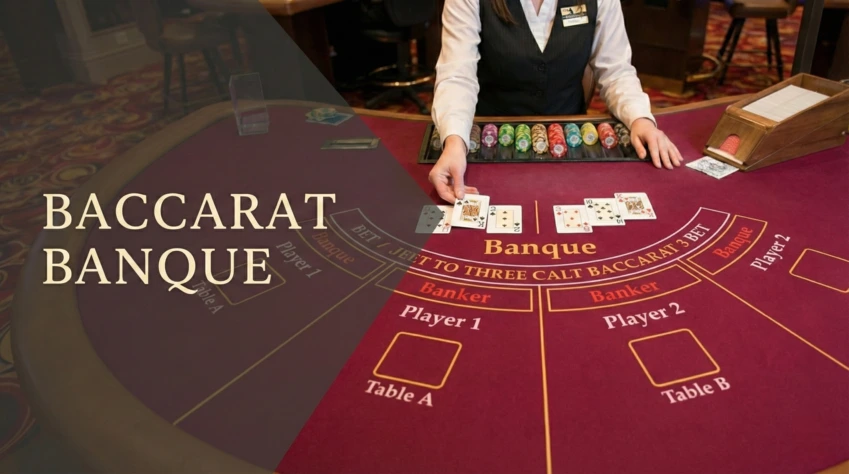
Imagine a baccarat table where one player controls the bank and faces off against two competing hands at once. That's Baccarat Banque. In Punto Banco, the house runs the show, and a rulebook controls every move. Baccarat Banque flips that. You get actual choices, and whoever banks gets to watch everyone else act first before deciding what to do.
One player runs the bank while two separate hands bet against them. Some people call it "Baccarat à Deux Tableaux" (two tables in French). What matters is this: you don't just sit there watching cards hit the table. You decide what happens next.
The banker role goes to whoever commits the largest stake at the start of a session. Take the bank, and it's yours until you walk away or go broke. It feels completely different from normal baccarat. At most tables, the casino banks everything, and you're just choosing red or blue. Here, a real person sits across from you, holding all the risk.
Two things set Baccarat Banque apart: you get to make real calls, and position matters. The banker goes last. They see what everyone else did before choosing whether to draw. That's a massive edge.
Baccarat comes in three flavors, and the banker role works differently in each one. Here's a quick comparison:
Punto Banco is what most people picture when they hear "baccarat." The house banks every hand, and a rulebook eliminates all your choices. You bet on Player, Banker, or Tie. Then the dealer follows a chart and finishes the hand. That's it. This version dominates both land-based casinos and online casino platforms because it runs quickly and requires no player skill.
Chemin de Fer started in France. The bank rotates around the table instead of staying with one person. Lose a hand while banking, and the next player takes over. Both sides make actual decisions about drawing cards. Punto Banco doesn't give you that. Since the bank keeps moving, nobody holds an advantage for long.
In Baccarat Banque, one player holds the bank until their money runs out. Two hands play against the banker. The banker watches both of them act before deciding what to do. Going last is what makes Baccarat Banque different. That advantage matters more than anything else.
The table's oval. Some people say it looks like a figure-eight or a cello shape. Players sit on two curved sections along the sides. The banker sits in the middle, facing the croupier (the person dealing and running the game).
Each side is its own betting zone. If you're sitting on the right, you usually bet on the right-hand side. Left side bets left. That said, you can bet on either side. Or split your money across both if you want.
The layout fits up to ten players, five on each side, though games often run with fewer people, given how rare Baccarat Banque has become.
Card values work the same way across all baccarat variants:
So a hand with a 7 and a 6 totals 13, which counts as 3. A hand with a 4 and a 5 totals 9, the best possible score. If you've played any version of baccarat before, the card values will feel familiar.
Here's the big difference: you're betting against another player holding the bank. Not the casino.
Everyone bets before the cards come out. Pick one hand or spread your money across both. Bet the most on a side, and you usually get to make the calls for that hand. House rules change depending on where you play. Smaller bettors ride along with whatever the controlling player decides.
Any bet you make is a bet against the banker. When you hear "fading the bank," it means you're matching some or all of what the banker put up. If everyone's bets add up to more than the bank can cover, the biggest bettors go first. Small bets might get rejected.
Call "banco," and you're saying you'll match the whole bank yourself. A banco call beats everyone else's action.
The banker's edge comes from acting last. Both hands decide whether to draw. The banker sees what they pulled before choosing what to do.
Seeing everyone's cards first matters. A lot. If one hand draws garbage, the banker knows exactly what to do. Both hands stand with strong totals? The banker sees the full picture before acting. Some places give ties to the banker, too. That pushes the edge even higher.
Here's the catch: banking means putting up serious money before anything starts. Plus, you're facing two hands at once. Hit a bad run, and your bank disappears fast.
Each round breaks into six steps. It's slower than Punto Banco, but making real choices adds pressure you don't get otherwise.
Everyone puts money on one or both player hands. Once betting closes, you're locked in.
The dealer gives two face-down cards to each player spot and two to the banker. The cards go to the betting spots, not individual people.
Whoever controls the right hand checks their cards. Got a 6, 7, 8, or 9? You usually stand. Weak totals mean drawing a third card. That one shows face up.
The left hand does the same thing. Both player hands finish before the banker touches anything.
This is where that edge shows up. The banker saw what everyone drew. Now they decide with full information. A good banker can boost their chances here by playing smart.
Each player hand gets compared to the banker's. Win, and you get paid even money. Los,e and the banker takes it. Ties usually mean you get your bet back, but rules change from place to place.
Payouts are simple:
The banker makes money by winning more than they lose. That position advantage does the work instead of a commission structure.
Strategy actually matters in Baccarat Banque. Luck still runs the show, but your decisions affect outcomes more than in Punto Banco.
Get the bank, and you act last. That's huge. Watch what the player hands draw and adjust. Don't just follow a chart like a robot.
Pay attention to how both sides play over time. It helps you figure out when to push your bets. Yeah, every hand is independent. But noticing patterns helps you know when to bet big or back off.
Baccarat Banque runs slower than Punto Banco. The money on the table is usually bigger, though. Set a limit before you play. It keeps you from chasing losses when the banker already has the edge built in.
Baccarat Banque isn't for everyone. It works if you want real decisions and don't mind higher stakes.
You won't find traditional Baccarat Banque online much. But JB runs multiple baccarat variants with crypto deposits and quick payouts. Punto Banco tables run around the clock, and live dealer options bring the social element of table play to your screen.
Yes. Call "banco" and you're matching the whole bank by yourself. That bet goes ahead of everyone else's.
The bank goes up for auction again. Whoever puts up the most money gets it.
Not in the traditional version, no. Most online crypto casinos offer Punto Banco, though some live dealer rooms feature Chemin de Fer-style games with player decisions.
Depends on who's banking and how good they are. A good banker playing smart can match or beat Punto Banco's banker edge.