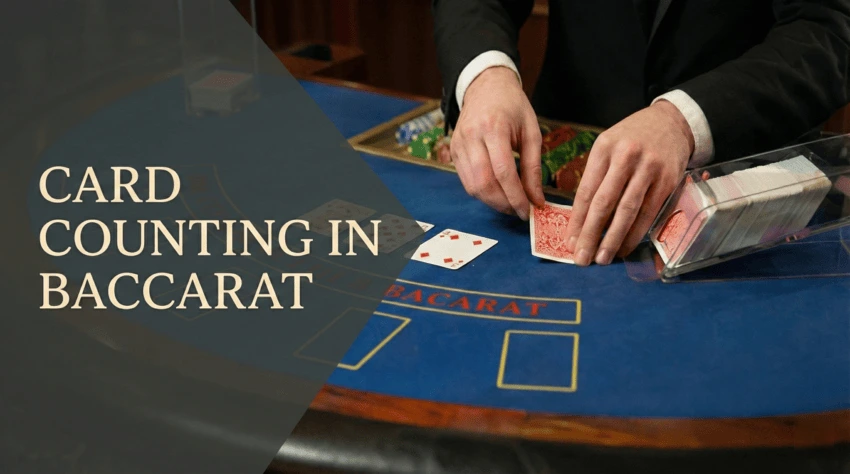
Card counting in baccarat involves tracking dealt cards to predict whether remaining cards favor the Player or Banker bet. It's a real technique borrowed from blackjack, but the results are dramatically different.
The math behind baccarat counting is sound, but the practical payoff just isn't. This guide covers how the systems work, what edge you can realistically expect, and why most advantage players don't bother with baccarat counting at all.
Card counting in baccarat is a method where players track which cards have left the shoe to estimate whether the remaining cards favor the Player bet, the Banker bet, or neither. The idea comes from blackjack, where counting cards can give skilled players a real edge over the house. In baccarat, however, the math tells a different story.
The core concept relies on something called "effect of removal," which describes how much the odds change when specific cards leave the deck. In blackjack, removing certain cards dramatically shifts the advantage. In baccarat, removing any single card barely moves the needle because the game follows rigid drawing rules that limit how much deck composition actually matters.
So does baccarat card counting work? Technically, yes. The math is sound. But the practical edge is so small that most gambling experts consider the effort pointless. You're looking at fractions of a percent in theoretical advantage, which translates to pennies per hour even under perfect conditions.
The process itself is straightforward, even if the payoff is minimal. Here's how baccarat card counting works step by step.
Every counting system gives each card rank a positive, negative, or zero value. As cards appear on the table, you add or subtract their assigned values from a running total in your head.
A basic system might look like this:
The specific values change depending on which system you use, but the principle stays consistent: track what's been dealt to estimate what remains.
As each hand plays out, you update your mental tally based on every card revealed. Baccarat typically uses eight decks shuffled together, which means tracking through several hundred cards per shoe.
Unlike blackjack, where you're also making decisions about hitting or standing, baccarat counting is pure mental bookkeeping. The game plays itself according to fixed rules, so your only job is to watch and count.
When your running count hits certain thresholds, it theoretically signals a slight advantage for either the Player or Banker bet. Most baccarat counters wait for extreme counts before changing their wager size.
The problem? Favorable counts appear rarely. And even when they do show up, the edge is measured in tiny fractions of a percent.
Three main complexity levels exist for baccarat card counting. Each assigns different point values to card ranks, trading simplicity for theoretical precision.
The Level 1 system uses simple +1, -1, and 0 values. You can learn it in an afternoon, which makes it accessible for anyone curious about the concept. The tradeoff is that it provides the smallest theoretical edge of the three systems.
Level 2 adds more granular point assignments, with some cards worth +2 or -2. The added complexity aims to improve accuracy, though the real-world difference remains marginal. Executing this system smoothly under casino conditions takes more practice than Level 1.
The most complex system assigns unique values to nearly every card rank. Mastering Level 3 takes significant dedication, and even then, the theoretical advantage barely increases. Most people who explore baccarat counting don't bother progressing past Level 1.
Here's the honest answer: the math works, but the practical application falls apart.
Under perfect conditions, flawless counting, optimal bet sizing, and deep deck penetration, baccarat card counting might yield an edge somewhere around 0.01% to 0.02%. That's not a typo.
Compare that to blackjack, where skilled counters can achieve edges between 0.5% and 1.5%. The gap is enormous. In baccarat, you're working incredibly hard for almost nothing.
Professional advantage players focus their energy where it actually pays off. Baccarat counting doesn't make the cut for several reasons:
Setting honest expectations matters here. Even perfect execution produces underwhelming results.
When the count reaches certain positive thresholds, the Player bet theoretically becomes slightly favorable. However, favorable situations occur infrequently, perhaps a few times per shoe, and the advantage when they appear is microscopic.
You'd need to play thousands of shoes to see any statistical benefit, and even then, normal variance would likely mask it completely.
The Banker bet can also become theoretically favorable at extreme negative counts. Yet the 5% commission on Banker wins still eats into any edge you might gain from counting.
In practice, the Banker bet remains the better choice regardless of the count because its base house edge of 1.06% is already the lowest in the game.
Understanding why counting works in blackjack but not baccarat clarifies the whole picture.
The fundamental difference comes down to player agency. Blackjack players make decisions that interact with the remaining deck composition. In baccarat, the game plays itself according to fixed rules, so knowing what's left in the shoe barely matters.
Online play introduces additional complications for anyone interested in counting.
Live dealer games use real cards dealt from physical shoes, which theoretically allows counting. However, most platforms shuffle frequently or use automatic shuffling machines that reset the count constantly.
Deck penetration, how deep into the shoe the dealer goes before shuffling, is typically shallow in live online baccarat. This further limits any counting advantage because you rarely see enough cards to reach meaningful count thresholds.
Standard online baccarat uses random number generators that effectively create a fresh shuffle for every hand. Counting is completely impossible here because there's no persistent shoe to track.
If you're playing crypto baccarat at platforms like JB.com, the RNG versions offer provably fair verification, which means you can confirm each hand's randomness through cryptographic proof. Counting simply doesn't apply to RNG games, but the transparency ensures fair outcomes.
Rather than chasing marginal theoretical edges, a few straightforward approaches actually improve your baccarat experience:
Tip: The best baccarat approach is accepting that it's a game of chance with a low house edge. The Banker bet already gives you one of the best odds in the casino.
Sustainable baccarat play comes from discipline, not gimmicks. Setting clear limits on losses and wins per session protects your bankroll far more effectively than any counting system ever could.
The house edge in baccarat is already among the lowest in the casino. Trying to shave off another fraction of a percent through counting isn't worth the mental effort when simple bet selection, Banker over Player, never Tie, gets you most of the way there.
For players ready to experience baccarat with transparent odds and fast crypto payouts, JB offers both live dealer and RNG options with provably fair gameplay.
Card counting is legal everywhere. It's a mental exercise, not cheating. Casinos can ask suspected counters to leave or refuse their bets, but no criminal charges apply. In practice, casinos rarely bother monitoring baccarat counters because the technique poses no real threat to their profits.
The 1 3 2 6 system is a positive progression betting pattern unrelated to card counting. You bet 1 unit, then 3, then 2, then 6 after consecutive wins, resetting after any loss or after completing the sequence. It's a bankroll management approach, not an advantage play method.
Basic Level 1 systems take a few hours to understand and a few more to practice. Achieving accuracy under real casino conditions requires significantly more dedication. Most people find the effort-to-reward ratio discouraging once they understand the minimal edge involved.
Casinos rarely ban baccarat counters. The technique provides such a negligible advantage that surveillance teams don't consider it worth monitoring. You're far more likely to be watched for past-posting (placing bets after the outcome is determined) or other actual cheating methods than for counting cards at the baccarat table.