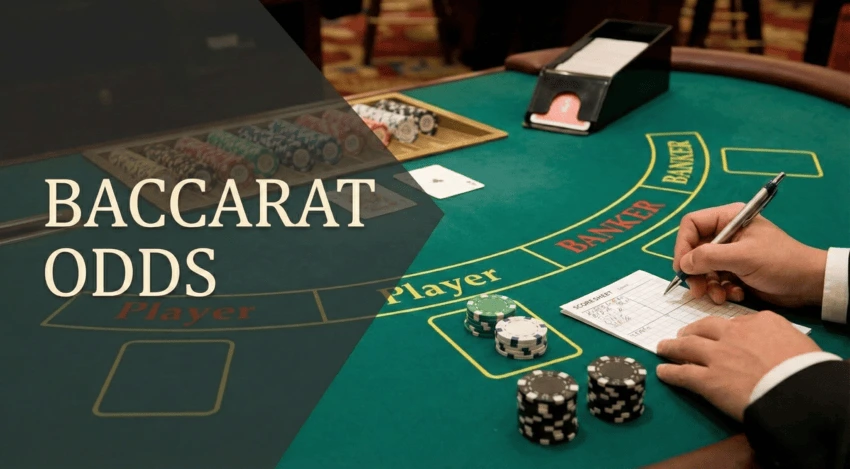
Banker wins about 46% of the time. Player's close behind at 44.6%. Ties? They show up roughly once every ten hands. That's why you'll see baccarat tables packed with first-timers and whales betting five figures per hand.
We’re going to break down the logic behind the best bets and the reality of what actually works at the table.
You've got three bets to choose from, and they don't all play the same. Banker hits about 46% of the time. Player hits at 44.6%. Ties happen around 9.5% of hands. Play a few thousand hands, and you'll see these numbers show up like clockwork.
What sets baccarat apart is that your decisions don't affect the outcome. The cards run the show. Doesn't matter if you're a rookie or a pro.
Banker wins more than anything else you can bet on. Pull ties out of the mix, and Banker still wins just over half the time. The drawing rules give the Banker this edge. More on that in a second.
Player wins almost as much as Banker. We're talking just over 1% difference. Play for an hour, and you probably won't see it. But stretch it out to 500 hands? Yeah, you'll feel it in your bankroll. Player bet has one thing going for it: you keep everything you win. No commission.
You'll see a tie maybe once every ten hands. That 8:1 or 9:1 payout looks sweet until you realize how rare ties actually are. Ask anyone who's been playing for years. They'll tell you the same thing: skip the Tie bet. The numbers don't lie.
People always ask this. Short answer: nope. Take ties out of it, and Banker vs. Player looks almost even. Almost. Banker still wins a bit more. When there's no tie, Banker takes about 50.7%, and Player gets 49.3%.
Look, I know what you're thinking. That's basically nothing. And yeah, for one night at the tables, you're right. Play 20 hands, and you won't even notice it. But hit 1,000 hands? That 1.36% gap starts eating into your money.
Banker's edge comes down to how the third-card rules work. When a third card hits the table, the player goes first. Then the Banker decides what to do based on what the Player got.
That order matters. It's why Banker has the advantage. Banker sees what Player drew before making a move. Sure, it's all automatic, but that extra info counts. Small edge, but it's baked into the rules.
Casinos know about this edge. That's why they take 5% when Banker wins. Without the commission, you'd have the edge over the house. And no casino's letting that happen.
House edge is the casino's cut, basically. It's how much they expect to keep from every bet you make over time. Got a 1% house edge? Casino's keeping about a buck for every hundred you bet. Lower house edge means better odds for you.
Baccarat's main bets are some of the best you'll find anywhere in the casino. This is one reason the game has remained popular for centuries and continues to attract serious players at both traditional and crypto casinos.
Banker sits at 1.06% house edge. That's with the 5% commission already factored in. Pretty much everyone agrees it's the smartest bet at the table. The commission is already factored into that 1.06% figure.
Player bet? 1.24% house edge. A little higher than Banker, but still way better than most things you can bet on in a casino. No commission means you don't have to do math in your head when you win.
This is where things get ugly. Tie bet's sitting at 14.4% house edge if it pays 8:1. With a 9:1 payout, it drops to 4.85%. Either way, the casino's taking way too much. Anyone who's played long enough won't touch it. That big payout doesn't make up for how rare ties are.
Payouts are what you get when you win. Baccarat doesn't complicate it. The only thing that confuses new players is the commission on Banker bets.
Drop $100 on Banker and win? You're walking with $195. That's your hundred back, plus a hundred win, minus five bucks commission. Win with a $100 Player be,t and you get the full $200.
Casinos take commission on Banker wins because Banker already has an edge built in. Without that commission, you'd have the edge over the house instead of the other way around.
Some tables offer "no commission" baccarat variants, but the trade-off usually appears elsewhere. Like if Banker wins with a 6, you might only get half your money instead of the full payout. Run the math, and you'll see no-commission games end up about the same over time.
Baccarat consistently ranks near the top among table games for player-friendly odds when you stick to Banker or Player bets. Not many games give you sub-1.5% house edge without making you memorize a bunch of charts or think through every decision.
Blackjack can drop below 0.5% house edge, but only if you play perfect basic strategy. Mess up a few plays, and that edge shoots up fast. Baccarat's odds never change, whether you're sharp or clueless. Great if you don't want to memorize anything.
Downside? You've got zero control. Blackjack lets you change what happens. Baccarat? You bet and watch. That's it.
Baccarat crushes roulette when it comes to house edge. European roulette's at 2.7%. American roulette hits 5.26% because of that double zero. Banker's 1.06% beats both of them by a lot.
Side bets mix things up, but the house edge jumps way higher. They're extra bets you can throw down next to your main bet. They pay when specific card combos hit.
Those big payouts look good, but the math hammers you way harder than the regular bets. Throw a few bucks at them for fun if you want, but don't make them your main play. Your bankroll will last longer.
People have been using betting systems like Martingale, Paroli, and Fibonacci forever. They all change how much you bet after wins and losses, but none of them touch the house edge.
House edge hits every bet you make. Doesn't matter what happened before. The game doesn't remember what just happened. Sure, a system might help you feel like you've got a plan. But it's not changing the odds.
Best house edge you're gonna find. Gives you the most value over time. The commission is already factored into the 1.06% edge, so there's no hidden cost.
Yeah, that payout looks sweet. But the odds make it a sucker bet.
Baccarat moves quickly. Set a limit before you sit down. When things start moving fast, you'll be glad you did.
Side bets will eat your money way faster. Want the best shot? Stick with Banker and Player. That's it.
You've got the odds breakdown now. You know what you're walking into. Banker's your best bet. Player's right there with it. Tie? Forget about it.
JB's got crypto baccarat. Deposits hit instantly, withdrawals move fast, and everything runs on provably fair systems. Provably fair means you can actually check the math behind each hand. No one's rigging anything. Regular casinos can't touch that kind of transparency.
Explore baccarat tables at JB and put this knowledge into practice.
Banker sits at 1.06% house edge. Can't beat it if you're in it for the long haul. The 5% commission is already factored into that figure.
Standard baccarat odds remain consistent across online and physical casinos, including live dealer games.
Card counting barely helps in baccarat. Any edge you'd get is so small it's not worth it. Plus, casinos shuffle enough that you can't track anything anyway.
Drop $100 on Banker, and you're losing about a buck per hand on average. American roulette costs you $5.26 on that same bet. Slots can run you over ten bucks. Baccarat's one of the best deals you'll find in any casino.