Face Up Pai Gow Poker

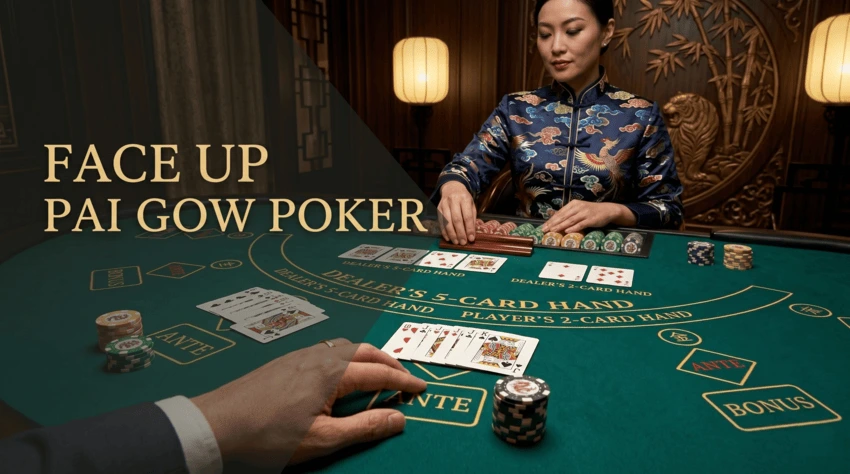
The dealer shows every card. You build your hand knowing exactly what to beat. No commission when you win.
Three sentences. That's the game. Now here's the rest: the ace-high push rule nobody explains well, hand-setting strategy when you can actually see the dealer's cards, side bets worth knowing about (and a couple you should probably ignore), plus how this stacks up against traditional Pai Gow Poker.
What is Face Up Pai Gow Poker?
Robert Wang introduced this variant in 2005. The core change from standard Pai Gow Poker is dead simple: the dealer's seven cards go face up. Every player at the table sees them before making a single decision.
Two rules shift to compensate:
- Zero commission on winning bets. Win and keep the full 1:1 payout.
- Ace-high push rule. Dealer's best five-card hand is ace-high with no pair, no straight, no flush? Main bet pushes for the entire table. Automatically.
The deck has 53 cards. Standard 52 plus one joker. That joker is semi-wild. It counts as an ace, or it can fill in to complete a straight, flush, straight flush, or royal flush. Can't sub for anything else.
You'll spot Face Up Pai Gow across Las Vegas, Atlantic City, California cardrooms, and a growing list of live dealer online platforms. Plenty of crypto casino table games now feature it too. The format has quietly replaced traditional Pai Gow Poker at many properties because players like seeing what the dealer holds. Less mystery. More control. Easier on-ramp for anyone who's never split a seven-card hand before.
How to play Face Up Pai Gow Poker
Full round. Every step.
Placing bets
Drop a main wager. That's the ante. Table minimums usually land between $5 and $25 depending on the venue or platform.
Two optional side bets before the deal:
- Push Ace High — pays when the dealer's hand triggers the ace-high push
- Fortune Bonus — pays based on your best possible hand
Both run independently from the main wager.
The deal
Seven cards to each player. Seven cards to the dealer. Dealer's cards go face up. Yours stay face down.
The dealer arranges their hand first using the house way. That's a fixed set of rules the casino follows. No judgment involved. Pure autopilot.
The ace-high check
Before anyone picks up their cards, the dealer's hand gets inspected.
Dealer's best five-card hand is ace-high junk? No pair, no straight, no flush? Main bet pushes. Every player gets their wager back. Round's done for the main bet.
Side bets still resolve even when this triggers. Holding trips with a Fortune Bonus bet? You still collect.
If the dealer doesn't have ace-high pai gow, play continues.
Setting your hand
You split your seven cards into two hands:
- Five-card hand (the high hand)
- Two-card hand (the low hand)
The five-card hand must rank higher than the two-card hand. Set them backwards and your hand fouls. You lose the wager. No second chances.
The dealer's cards sit there face up the whole time. Look at them. That's literally the point.
Comparing hands
Your five-card hand squares off against the dealer's five-card hand. Your two-card hand against the dealer's two-card hand.
- Both yours win? Paid 1:1. No commission taken.
- Both yours lose? Bet gone.
- Split? Push. Money comes back.
Exact tie on either hand? Dealer wins it. That's one of the house's two edges.
The ace-high Pai Gow rule
This needs its own section because almost nobody explains it clearly the first time.
An ace-high pai gow means the dealer's best five-card hand is garbage. Ace on top, nothing connecting, no pair, no draw completed. Just five random cards with an ace leading them.
When this shows up, every player at the table pushes on the main bet. You could be holding a straight flush. Doesn't matter. Push.
Happens roughly 8-9% of rounds.
Why does this rule exist at all? Math. Remove the 5% commission without adding something else, and players would have about a 4% edge. The ace-high push is the counterweight. It takes away wins you would have collected, and that keeps the house edge positive.
How it actually feels: Annoying. You'll sit there with a full house, watch the dealer flip over absolute trash, and get your bet returned instead of doubled. That sting is the price of never paying commission.
The Push Ace High side bet was designed for exactly this moment. Whether it's a good idea is a separate conversation. (Short answer: the math says it isn't, but feelings aren't math.)
Hand rankings
Standard poker rankings with a couple of Pai Gow-specific wrinkles.
Five-card hand (top to bottom): Royal flush → Straight flush → Four of a kind → Full house → Flush → Straight → Three of a kind → Two pair → One pair → High card
Two-card hand: Pair or high cards. That's it. No straights. No flushes. Two cards can only make a pair or not.
The wheel (A-2-3-4-5): At most casinos, this ranks as the second-highest straight. Sits above K-Q-J-10-9. Weird rule. Some casinos have dropped it. Check before you play.
The joker: Ace, or completes a straight/flush/straight flush/royal flush. If it can't do any of those things, it's an ace. No exceptions.
Side bets
Two show up at most Face Up Pai Gow tables. A third pops up at certain properties.
Push Ace High (Ace-High Bonus)
Pays when the dealer catches an ace-high pai gow hand.
House edge lands around 9.29% on the 5-15-40 pay table. Jumps to 10.52% on 5-12-40.
Psychologically satisfying. Mathematically expensive. It pays when your main bet pushes, which feels like a rescue. Over hundreds of hands, it quietly drains chips.
Fortune Bonus
Pays based on your best possible five-card hand from all seven cards. Doesn't matter how you set them. Doesn't matter what happens on the main bet.
Bet at least $5 on the Fortune Bonus, and you unlock the Envy Bonus. That means you get paid when any other player at the table hits four of a kind or better. Even if your hand is terrible.
House edge runs well above the main game. This is a volatility injection into what's otherwise the calmest table game around. Treat it like what it is: entertainment spending.
Progressive jackpot (where available)
Certain properties (Caesars casinos in Vegas, for instance) attach a $5 progressive jackpot side bet. Pays on premium hands. Royal flush territory and up.
The house edge is steep. Worth a look only if the jackpot has been climbing for a while. If it just reset, your money has better places to be.
House edge and odds
Numbers that matter:
- Main game house edge: ~1.81% with optimal strategy
- Traditional Pai Gow Poker (not banking): ~2.72%
- Push probability: Close to 50%
- Standard deviation: 0.72
That 0.72 standard deviation is absurdly low. This might be the least volatile table game you can sit at. Online, live, crypto, or fiat. Doesn't matter. Nothing else plays this flat.
Your bankroll lasts. Swings stay small in both directions. You won't go on a legendary heater, and you probably won't blow through a buy-in in half an hour either.
Quick comparison against other low-edge games:
Quick comparison against other low-edge games: Face Up isn't the cheapest seat in the house. It is the longest one. If session length per dollar matters to you, this game is hard to argue with. And if you're playing bitcoin table games with instant deposits, you spend zero time waiting and more time in hands.
Face Up Pai Gow Poker strategy
You can see the dealer's cards. Use them.
Read the dealer's hand first
Study both the dealer's five-card and two-card hands before you look at your own cards. Two questions:
- Can I beat the five-card hand? Yes? Then build the strongest two-card hand possible. You need both wins.
- Is the five-card hand out of reach? Then shift. Focus on winning the two-card hand. A push beats a loss every single time.
Balance both hands
Biggest mistake at this table: loading the five-card hand and leaving the two-card hand empty.
Your five-card hand could crush the dealer's. But if your two-card hand loses, that's a push. Not a win. Both hands need to compete. Always.
Hand-setting rules
One pair. Stays in the five-card hand. Two highest remaining cards go up front in the two-card hand.
Two pair. Split them. One pair per hand. One exception: you have an ace or king kicker available. Then you can keep both pairs in the five-card hand and play A or K in the two-card hand.
Three of a kind. Keep all three in the five-card hand. Exception that trips up beginners: three aces. Split those. Pair of aces in the five-card hand. Single ace in the two-card hand. A pair of aces still handles most dealer five-card hands, and a single ace gives the two-card hand real weight.
Full house. Split every time. Trips in the five-card hand. Pair in the two-card hand. Two competitive hands instead of one dominant and one dead.
Four of a kind, jacks or higher. Split into two pair, one in each hand.
Four of a kind, tens or lower. Keep together in the five-card hand. Those pairs individually won't hold up in the two-card hand reliably enough to justify splitting.
Straight or flush with a pair. Play the pair in the two-card hand. Straight or flush goes in the five-card hand. Only works if the remaining cards cooperate.
No pair (pai gow hand). Five-card hand is going to be weak no matter what you do. Accept it. Put your two highest cards in the two-card hand and give yourself the best shot at winning at least one hand for a push.
Concrete example
Your cards: A♠ A♦ K♣ Q♥ J♦ 9♠ 4♣
Dealer's five-card hand: two pair, kings and sevens. Dealer's two-card hand: Q-10.
A single pair of aces can't beat two pair. So the five-card comparison is a loss no matter how you arrange things.
Shift strategy. Accept the five-card loss. Stack the two-card hand. Play A-K as your two-card hand. Your five-card hand becomes A-Q-J-9-4. Loses to the dealer's two pair. But A-K crushes Q-10.
Result: push. Better than losing both.
That read-and-react decision is the game.
The "no skill" debate
Some analysts claim Face Up Pai Gow involves zero skill because the exposed dealer hand makes optimal play obvious. Partially true. The information advantage strips out a lot of ambiguity.
But "less ambiguity" and "zero decisions" aren't the same thing. You still need to know poker rankings cold. Splitting pairs correctly still takes knowledge. Recognizing when to sacrifice the five-card hand for a push still takes discipline.
Lower skill floor than traditional Pai Gow? Absolutely. Zero skill? No.
Face Up Pai Gow Poker vs. traditional Pai Gow Poker
The comparison most people come here for.
Face Up gives a lower house edge and simpler decisions for players who never bank. Traditional Pai Gow gives a lower house edge for players who bank regularly and play well. Pick whichever matches how you actually sit down.
Where to play Face Up Pai Gow Poker
Las Vegas
All over the Strip and off-strip. Caesars Entertainment properties commonly deal it with the progressive jackpot side bet. Emperor's Exposed (same concept, different name) has replaced traditional Pai Gow at some rooms.
Table minimums: $10-$25 on the Strip, $5-$10 at locals casinos. As of recent surveys, only one Vegas casino still spreads traditional Fortune Pai Gow with banking. The face-up format runs the town.
Atlantic City and regional casinos
Ocean Casino Resort, Rivers Casino (Des Plaines and Philadelphia), and other major rooms have it. Rules match Vegas. Pay tables on Push Ace High vary by property though. The gap between 5-15-40 and 5-12-40 changes the side bet math.
California cardrooms
Stones Gambling Hall, California Grand Casino, and others deal Face Up under the state's player-dealer banking rules. The rotating dealer position gives the game a slightly different rhythm than a standard casino table.
Online and live dealer
Growing presence on live dealer platforms, including sites where you can play Pai Gow with crypto. Bitcoin deposits settle fast. Withdrawals clear without the usual waiting period at fiat casinos.
Solid way to learn at low stakes before putting real money down at a live table. One thing to verify: some online versions tweak the ace-high push rule or adjust side bet pay tables. Read the game rules. Every time.
Connection to Pai Gow (tiles)
Quick context.
Sam Torosian created Pai Gow Poker in 1985 in Los Angeles. He borrowed the concept from Pai Gow, an ancient Chinese domino game played with 32 tiles and a completely different ranking system. Torosian's move was translating the "split your hand into high and low" structure into poker cards. Made it immediately accessible to Western players.
Face Up Pai Gow Poker is a further step along that line. More information on the table. No commission. Lower barrier for new players.
The original tile game still exists at some casinos. Steeper learning curve. Better banking rules in many rooms. Different animal entirely.
Tips for new players
- Face Up is the easiest way into Pai Gow. You see the target before you shoot. Start here.
- The ace-high push will frustrate you. Let it. It's doing the same job as the 5% commission, just in a different way. The math works out.
- Balance both hands. Every time. A five-card monster with a dead two-card hand gets you a push, not a win.
- Push Ace High carries a 9-10% house edge. Fine as an occasional thing. Bad as a habit.
- Fortune Bonus is fun money. The Envy Bonus is a nice surprise when it hits. Neither one is a strategy.
- Pace is slow. That's the point. Take your time arranging hands.
- Playing online first makes sense. Crypto Pai Gow tables at live dealer sites let you practice at low minimums. Get comfortable with splitting hands before you sit at a $25 table in person.
- Want a lower house edge and you're comfortable taking on banking? Traditional Pai Gow Poker gives experienced players more room to work with.
Face Up Pai Gow Poker won't produce huge wins in a short session. The design points the other direction entirely. Long sessions. Small swings. Steady decisions based on visible information. Your bankroll stretches further here than almost anywhere else in the casino.
And you always know what the dealer's holding. That alone changes the game.