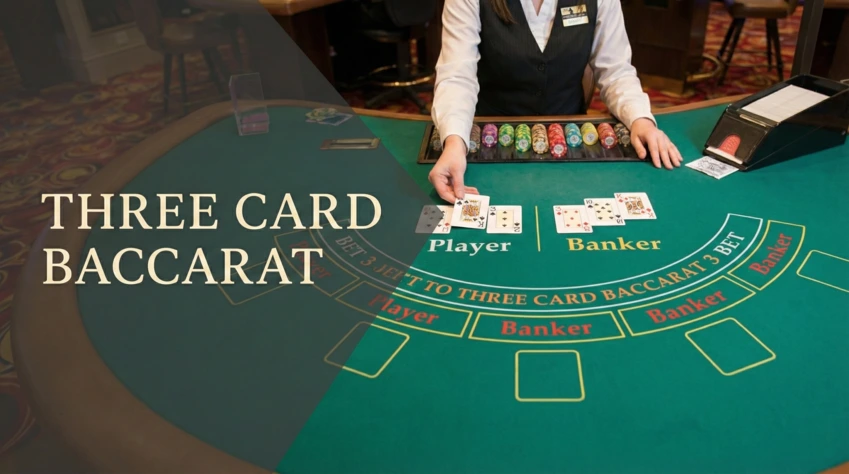
Three-card baccarat cuts straight to the chase: six cards hit the table, both hands get three each, and you're done. No extra draws, no waiting around. You'll mostly find this version in Macau's smaller casinos. That's where it started, and that's still its home base. Some online casinos are integrating it, but it's not yet available everywhere.
Here's everything you need to know: how the game works, what the cards are worth, where you can bet, and what those bets actually pay.
Three-card baccarat is a simplified version of traditional baccarat where both the Player and Banker hands receive exactly three cards, with no additional draws during the round. The game first appeared in Macau's smaller casinos as a faster alternative to standard punto banco, and it remains most common in that region today.
The whole appeal here? It's simple. Really simple. Regular baccarat has this whole complicated system about when you draw a third card. It's a lot to track. This version? None of that. Six cards come out, you count 'em up, and you're done. The whole process takes just a few seconds.
One quick clarification: three-card baccarat is not the same as the "baccarat third card rule" that governs standard baccarat. If you're looking for information about when the Banker draws in regular punto banco, that's a separate topic. This is a different game, plain and simple.
It's not just about the number of cards. The whole game plays differently. Here's what sets the two apart.
In standard baccarat, the dealer starts with two cards per hand, then follows a detailed tableau to determine whether a third card gets drawn. three-card? Skips all that. You get three cards face-up right away. No suspense, no waiting to see what's coming.
The baccarat drawing rules in traditional punto banco can feel intimidating. When does the Player stand? What Banker totals trigger a draw based on the Player's third card? In three-card baccarat, none of that applies. The baccarat dealing rules here are simple: deal six cards, count the totals, pay the winners.
Three-card baccarat offers side bets that don't exist at standard tables, including Three Faces and various Dealer Total wagers. These bets can pay out bigger, but the house edge is way higher. That's the trade.
You count the cards the same way you would in regular baccarat. Only that last digit matters, so 9 is as high as you can go.
A hand of 7-8-9 totals 24, but the score is 4 (the last digit). A hand of K-5-3 totals 8. The math stays easy, even with three cards on the table.
Here's how fast this goes once you get it. Here's how each hand plays out.
First thing: place your bet. Cards come after. The main options are Player, Banker, or Tie. You can throw down side bets here, too, if you want. Three Faces, Dealer Total, stuff like that. Betting closes. Cards come out.
Dealer drops three cards for Player, three for Banker. Everything's face-up. There's no waiting to see if additional cards will come. What you see is what you get.
The hand closest to 9 wins. If both hands show the same total, it's a tie. Main bets on Player or Banker push when a tie occurs, meaning you get your wager back but don't win anything. Tie bets? Those actually pay.
Winners collect immediately. No decisions, no waiting. That's why people play this version. It's fast. No complicated rules, dragging things out.
These bets work like regular baccarat, but the three-card setup shifts the odds a bit.
Win on Player? You get even money. Bet 100, win 100. Bet 100, win 100. No commission taken out, so it's easier to track than Banker.
Banker also pays even money, but the house takes 5% off your win. Why? Banker wins slightly more often when you run the numbers long-term. The 5% evens things out for the casino.
Win 100 on Banker? You're walking away with 95. Yeah, it's annoying. But Banker's still usually your better bet, even with the cut.
Tie bets pay way more than the main bets—usually 8:1 or 9:1, depending on where you're playing. Here's the catch: Ties don't happen that often, and the house edge is way steeper than Player or Banker.
Tie bets are basically lottery tickets. Sure, the payout looks nice. But the house has a much bigger edge. Throw one in for fun once in a while, sure. But don't make it your main move. That's how you burn through cash fast.
Three Faces pays out when one hand gets three face cards—Jacks, Queens, or Kings. It doesn't happen much, so when it does, it pays big. Usually 16:1 or better.
You're not betting on the hand total here. You're betting on what cards show up. Getting three face cards in one hand is pretty rare. That's why it pays so much, and why you'll probably lose. This is for people who like going after big wins and don't mind the swings.
With Dealer Total, you're betting on the Banker hand's exact number. Doesn't matter if it wins. Different totals offer different payouts based on their probability.
You're betting the Banker hand comes up exactly zero. That means three cards adding up to 10, 20, or 30. Pays out big since it doesn't happen often.
These cover the totals in the middle. The more common the total, the less it pays. Pretty straightforward.
You're betting on those high, natural-looking totals here. These hit more often than Dealer 0, so they pay less. Still better than the main bets when you nail it, though.
Payouts vary by casino. Always check the table limits and pay tables before placing side bets.
Here's what the house edge looks like for each bet. Helps you know where your money's going. Lower edge, better odds for you over time.
Bottom line: stick with Player or Banker if you want decent odds. Side bets are fun, but they'll drain your stack faster.
There's no real strategy system here. It's all about managing your cash. You can't control the cards, so control what you bet.
Looking for info about the baccarat third card rule? Wrong game. That's for regular punto banco. Different thing.
Regular baccarat has this whole complicated deal about when you get a third card. Player draws on 0 through 5, stands on 6 or 7. Banker's more complicated. It depends on what the Banker has AND what the Player drew. Yeah, it's a lot.
Three-card doesn't do any of that. You always get three cards per hand. Every time. No chart to follow. Nothing to memorize. Deal the cards, count 'em up, pay out. That's it.
Crypto casinos work great for three-card baccarat. The game's fast, and crypto moves fast too. Deposits are quick, withdrawals don't drag on forever, and a lot of sites use provably fair systems. Provably fair means you can actually check that each hand was random. It uses crypto tech to prove it wasn't rigged.
JB.com supports instant crypto deposits and withdrawals, which pairs well with the quick-resolution nature of three-card baccarat. The interface is clean. You're playing the game, not fighting through menus.
Yeah, some crypto casinos have it. They get it from specialty game providers. But it's way less common than regular baccarat. Availability varies by platform, so check the table games section before signing up if this variant is specifically what you're after.
It started in Macau's smaller casinos because people wanted something faster than regular baccarat. Caught on in Macau, but never really made it to Western casinos. Standard baccarat and mini-baccarat run those tables. Online casinos are starting to carry it more, but you still won't find it everywhere.
Card counting doesn't really help in three-card baccarat. Hands go too fast, and most tables use fresh shoes or those continuous shuffle machines anyway. Even if you tracked every card perfectly, you'd barely gain anything. Not worth it.
Player and Banker give you the best odds. Usually around 2.5% to 2.8% house edge. For the actual side bets? Every casino is different with its payouts and edges. Check the pay table before you put anything on a side bet. Don't just guess.