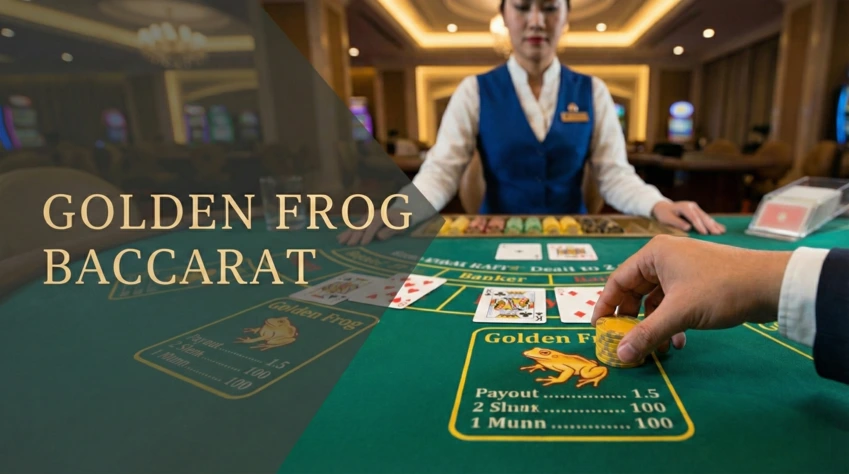
Golden Frog Baccarat ditches the 5% commission on Banker wins. You get paid even money straight up. There's one catch: if the Banker wins with a three-card 7, your bet pushes instead of paying out. The real draw, though, is the set of side bets that can pay up to 200 to 1 on specific hand outcomes.
We'll walk through the rule changes, break down what each side bet pays, and show you which wagers give you the best shot.
Golden Frog Baccarat is a commission-free version of classic baccarat where winning Banker bets pay even money instead of the usual 95% (after the standard 5% commission). Here's the catch. If the Banker wins with a three-card 7, you don't lose, but you don't get paid either. The bet just pushes.
But the commission-free structure isn't the main attraction. But the real reason people play Golden Frog? The side bets. These are optional wagers that pay big when rare hand combinations show up. Some pay up to 200 to 1. That kind of money changes the energy at the table in ways regular baccarat never does.
Here's what defines Golden Frog:
Everything else plays exactly like regular baccarat.
Golden Frog follows the same structure as standard baccarat. Two hands get dealt: Player and Banker. You're betting on which one gets closer to nine. You're not playing your own cards or making decisions during the hand. Your only choice happens before the deal: where to place your chips.
The cards count the same way they do in regular baccarat. Aces are worth 1. Cards 2 through 9 are face value. Tens and face cards are zero. If your total goes over 9, drop the first digit. So a hand containing a 7 and an 8 totals 15, which becomes 5.
Whichever hand lands closer to 9 wins. Ties happen too, and you can bet on them if you want. Neither hand "belongs" to you or the dealer in any meaningful sense. The names Player and Banker are just labels for the two positions.
Whether a third card gets drawn follows fixed rules for both hands. The Player hand acts first. Player totals 0 through 5 automatically get a third card. Totals of 6 or 7 stand. A natural 8 or 9 (that's a two-card 8 or 9) ends everything right there. No more cards.
The Banker's draw rules get trickier. What the Banker does depends on its own total and whatever the Player drew for a third card. You don't need to memorize the Banker drawing rules because the dealer handles everything according to a fixed chart.
The push rule only kicks in when the Banker draws a third card and ends with exactly 7. Two-card Banker 7s pay normally.
Side bets are what make Golden Frog different. Each side bet pays on rare outcomes. When they hit, they pay big. You throw side bets down before the deal, either with your main bet or on their own.
They don't change how the main game plays. They're entirely optional. Some people skip them entirely. Others come to Golden Frog just for the side bets.
Jin Chan 7 pays when the Banker hits exactly 7 with three cards and wins. The payout is 40 to 1. The name comes from Jin Chan, a figure from Chinese folklore often depicted as a golden frog or toad associated with prosperity. It's a fitting name for a bet that pays this well.
The Banker needs to draw that third card for this to work. A two-card Banker 7 doesn't qualify.
Koi 8 pays 25 to 1 when the Player hand wins with a three-card total of eight. Same deal as Jin Chan 7. Three cards or it doesn't count. A natural 8 (two cards) won't qualify.
This one's looser than the last two. Pays 25 to 1 whenever an 8 beats a 6. Doesn't matter how many cards either hand has. Could be two-card hands, three-card hands, or one of each.
Since card count doesn't matter here, it hits more often than Jin Chan 7 or Koi 8.
Quick reminder: a natural is when you get 8 or 9 with just two cards. 50 to 1 when a natural 9 takes down a two-card 7. Both hands have to be two cards. No third cards allowed.
That's why it pays more. You need both hands at two cards with those exact totals.
This one's the big money shot. 200 to 1. Pays when a three-card 9 beats a three-card 7. Both hands drawing three cards and hitting those exact numbers? Doesn't happen often. That's your 200 to 1 right there.
Every bet has a different house edge. That's the casino's built-in advantage over the long run. Lower house edge means better odds for you. Bigger payouts usually mean worse odds because those wins don't come around as often.
Your best bets are still Player and Banker. Side bets are exciting and can pay big. But the house edge on them will grind you down if you play long enough.
The Banker bet in Golden Frog still carries one of the lowest house edges available in casino table games, even with the push rule on three-card sevens. That push situation doesn't occur often enough to shift the math dramatically.
Baccarat runs on fixed rules. You don't make decisions that affect the cards. What you control is where your money goes and how much of it you risk on each type of bet.
Player and Banker give you the best odds. Banker stays your best statistical bet even with those occasional pushes on three-card 7s. The Player bet runs close behind. The house edge on Tie bets is bad enough that most people who know what they're doing won't touch them.
If you want side bet action, "Any 8 beats Any 6" tends to be the most forgiving option. Hits more often than the three-card bets since you don't need exact card counts on both hands. That 200 to 1 on three-card 9 over three-card 7 looks tempting. But it almost never hits, and the house edge will eat you alive.
Set aside a chunk of your bankroll just for baccarat side bets. Treat it like entertainment money. When it's gone, you're done with side bets for the session. This keeps the higher-edge wagers from eating into your main bankroll.
Golden Frog works well for players who enjoy baccarat but want more variety within each round. The commission-free structure benefits anyone who prefers Banker bets, and the side bets create moments of anticipation that standard baccarat lacks.
The trade-off is variance. Side bets can drain a bankroll quickly if you chase them too aggressively. If you keep your head on straight, Golden Frog gives you solid main bets with low house edge, plus side bets that can pay stupid money. Good pick if you want baccarat with more action, but don't feel like learning a whole new game.
JB.com offers a range of baccarat tables built for fast, friction-free play. Deposits settle instantly with crypto, and withdrawals move just as quickly. Whether you prefer classic baccarat, commission-free variants like Golden Frog, or live dealer tables, the selection covers the full spectrum.
Explore baccarat at JB.com and see how smooth crypto casino play can be.
Yes. Several crypto casinos offer Golden Frog or similar commission-free baccarat variants. JB.com runs baccarat tables with instant crypto deposits and withdrawals. The gameplay follows the same rules you'd find at a land casino.
The golden frog, or Jin Chan, is a figure from Chinese folklore associated with prosperity and good fortune. The name fits a game built around high-payout side bets and lucky outcomes.
Luck determines the outcome of every hand. The cards follow fixed drawing rules. You don't make any decisions once the hand starts. The skill is in picking your bets and managing your money, not in how you play the hand.