History of Craps: From Origins to Modern Day

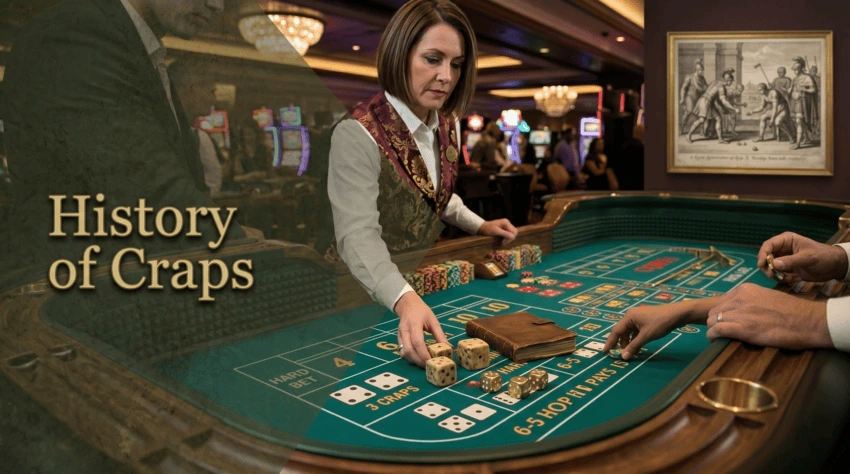
Craps started with Hazard, a medieval English dice game. Some say Hazard came from Roman soldiers who carved pig knucklebones into dice and rolled them on their shields. Getting from 14th-century English taverns to Vegas casinos took centuries. The game crossed oceans, changed names, and morphed into something simpler each time someone new picked it up.
Rich people used to play a complicated version. Now it's the loudest, fastest game on any casino floor. Here's how that transformation happened, from ancient dice to crypto-powered tables.
What is craps?
Craps is a dice game. You throw two dice, and everyone bets on what numbers come up. Americans simplified an old European game called Hazard, which people had been playing since the 1300s. One player, called the "shooter," throws the dice while everyone else at the table places wagers on what numbers will come up.
Here's how it works. On the first roll (the "come-out roll"), a 7 or 11 wins for Pass Line bettors, while a 2, 3, or 12 loses. Any other number becomes the "point," and the shooter keeps rolling until hitting that point again (a win) or rolling a 7 (a loss).
- Pass Line: The most popular bet, backing the shooter to win
- Don't Pass: Betting against the shooter
- Come/Don't Come: Similar wagers placed after a point is set
- Proposition bets: One-roll wagers on specific number combinations
Ancient dice games and the roots of craps
Dice games are ancient. People have been rolling and betting for thousands of years. Today's craps links back to dice games people played in ancient Egypt, Greece, and Rome.
Roman soldiers and pig knucklebones
Legend says Roman soldiers invented an early version. The story goes that soldiers carved pig knucklebones into dice and rolled them on their shields when they weren't fighting. Maybe that part's true, maybe not. But dice games have always traveled with soldiers and anyone else who wanted to gamble while killing time.
Early dice in Egypt and Greece
Archaeologists have found dice in ancient Egypt, Greece, and Mesopotamia. Some are over 5,000 years old. Those ancient dice weren't perfect cubes like casino dice today, but the concept was the same: roll something random and bet on what happens.
Hazard and the medieval origins of craps
Craps comes from Hazard, a dice game that took off in medieval England. If you understand Hazard, the structure of modern craps makes a lot more sense.
How the game of Hazard worked
Hazard was more complicated than modern craps, but the basic setup feels similar:
- The caster: The player rolling the dice (like today's shooter)
- The main: A number between 5 and 9, chosen before the first throw
- The chance: A point number established after the opening roll
You won or lost based on how these two numbers matched up. Some combos won or lost right away. Others meant you kept rolling. Rules changed depending on where you played. Over time, people wanted simpler versions.
Hazard among the English nobility and the Crusaders
One theory: Crusaders brought the game back from the Middle East. Other people think it started in England. Either way, by the 1300s, the game was popular enough that Geoffrey Chaucer referenced it in The Canterbury Tales. Rich people played in private clubs. Common folks played in taverns. Hazard worked for everyone.
Why is it called craps
The name "craps" sounds strange until you trace where it came from. The French borrowed from English gambling slang, and then the word changed over time.
The French word crabes
In Hazard, rolling a two or three was called "crabs," the worst possible result. When French players picked up the game, they pronounced it "crabes." Eventually, people used the term for the bad roll and for the whole game.
How crabs became craps
French colonists brought Hazard to Louisiana in the 1700s. In New Orleans, "crabes" gradually shifted to "craps" in local speech. By the early 1800s, most people called the American version craps. The name stuck.
How craps came to America
Craps turned into the modern game in New Orleans. From there, it spread on riverboats and railroads.
Bernard de Marigny and New Orleans
A rich Creole guy named Bernard Xavier Philippe de Marigny de Mandeville gets credit for bringing craps to America. He learned Hazard in England and brought it to New Orleans around 1805. Marigny got so tied to the game that New Orleans named a street after him. It's still there today.
The Mississippi River and riverboat gambling
The game spread fast on Mississippi riverboats. Pro gamblers found tons of merchants and travelers willing to play. The problem was that the early rules made it easy to cheat with loaded dice. Craps got a reputation for being crooked. That took decades to fix.
Street craps and American gambling culture
Casino craps has official rules. Meanwhile, a street version thrived in alleys, military barracks, and back rooms.
How street craps differs from casino craps
Street craps is bare bones: one shooter, some dice, and players betting against each other. No table, no dealers, no house edge.
Street craps in African American communities
During the 1900s, street craps became a big part of Black urban culture. You'd see it in music, movies, and books. It symbolized risk and community at the same time. Casino craps meant Vegas glamour. Street craps was more accessible, more real.
Who invented modern craps
One guy fixed the cheating problem that killed early American craps. That's why we have today's game.
John H. Winn and the Don't Pass bet
Around 1907, a dice maker named John H. Winn changed craps forever by introducing the "Don't Pass" bet. Now players could bet against the shooter. That killed the advantage loaded dice gave cheaters. If someone could bet either way, rigging the dice no longer guaranteed profit.
Winn's change made the game fair enough that real casinos would actually run it. People call him the father of modern craps.
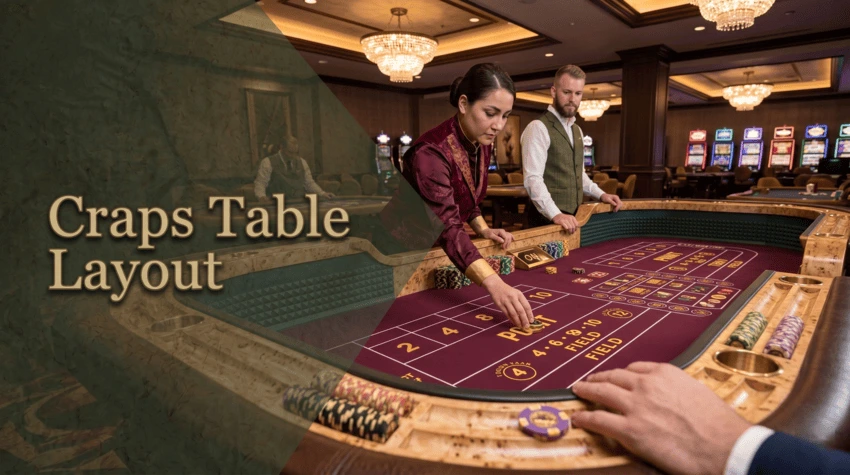
The modern casino craps table layout
Winn also standardized the table. He created separate areas for different bets. The setup let lots of people play at the same time. Dealers could track all the bets. That layout barely changed. You'll see the same Pass Line, Don't Pass bar, and prop bet sections on tables today.
Craps in Las Vegas and the casino boom
Nevada legalized gambling in 1931. Craps had found its home.
Legalization and the rise of Vegas casinos
Early Las Vegas casinos featured craps tables prominently, a tradition that continues in today's online casinos with both classic and crypto versions. The energy pulled people in. Once a crowd formed, more players showed up. By the 1950s, craps had become one of the most important table games in American casinos.
Why craps became a high-roller favorite
Big gamblers loved craps for a few reasons:
- Low house edge: The Pass Line bet carries only a 1.41% house advantage
- Social energy: The whole table often wins or loses together
- Perceived control: Shooters feel like they influence outcomes, even though dice are random
- Fast action: Rounds resolve quickly, keeping the pace high
Card-based craps and legal variations
Some places don't allow dice gambling. Casinos had to get creative.
Why some states ban dice gambling
California, for example, bans games that rely only on dice. The reasoning traces back to old statutes classifying dice games as "banking games" that unfairly favor the house. Does that make sense today? Probably not. But the laws haven't changed.
How card craps works in California
California casinos use cards to simulate dice rolls. Two cards are drawn from a deck containing cards numbered one through six, and their values determine the "roll." The odds and rules are the same as regular craps. You're just using cards instead of dice.
Craps in movies and pop culture
Craps looks great on camera. The crowded table, the dramatic throw, the collective reaction: it's naturally cinematic.
Iconic craps scenes in film
Movies from The Cooler to Diamonds Are Forever have featured memorable craps sequences. Dice bouncing across felt, chips stacking up. It all looks good on film.
Famous craps rolls and casino legends
Gambling legends are full of crazy hot streaks. The most famous happened in 2009 at the Borgata. Patricia DeMauro rolled 154 times without sevening out. That streak lasted over four hours.
Online craps and the digital era
Online craps kept the same rules but added new options.
Virtual craps tables and RNG games
Online casinos use random number generators (RNG) to simulate dice rolls. Live dealer versions stream real tables with actual dice, combining digital convenience with physical authenticity.
Crypto craps and provably fair gaming
Crypto casinos have introduced provably fair craps, where players can verify that each roll was genuinely random. The system uses cryptographic hashes. Check them after each round, and you don't have to blindly trust the casino. If you care about transparency, provably fair gaming beats traditional online casinos.
Why the craps dice game remains a casino favorite
Craps has lasted centuries. The excitement is real, and the odds are decent. The Pass Line bet has one of the lowest house edges in the casino. Plus, the whole table wins or loses together, which creates real tension and celebration.
Physical table or crypto casino, the appeal is the same: fast action, simple rules, and hoping your number hits.
FAQs about the history of craps
Why is the number 11 called yo in craps?
Dealers say "yo-eleven" to prevent confusion with "seven" in a noisy casino. The two words sound similar when shouted across a crowded table.
Is craps a game of strategy or pure luck?
The dice are random, but which bets you make actually matters. Some wagers carry a house edge under 1.5% (comparable to blackjack when played optimally), while others exceed 10%. Choosing wisely matters.
Why is craps illegal in some US states?
Some states say dice games are pure luck and ban them. But card-based versions are fine. California is the most notable example.
What is the oldest known dice game in history?
Dice games go back at least 5,000 years. Archaeologists have found evidence in ancient Mesopotamia, Egypt, and the Indus Valley. Craps came along way later, but it's part of that ancient tradition.